

Nucleophosmin [ABT210] mouse mAb
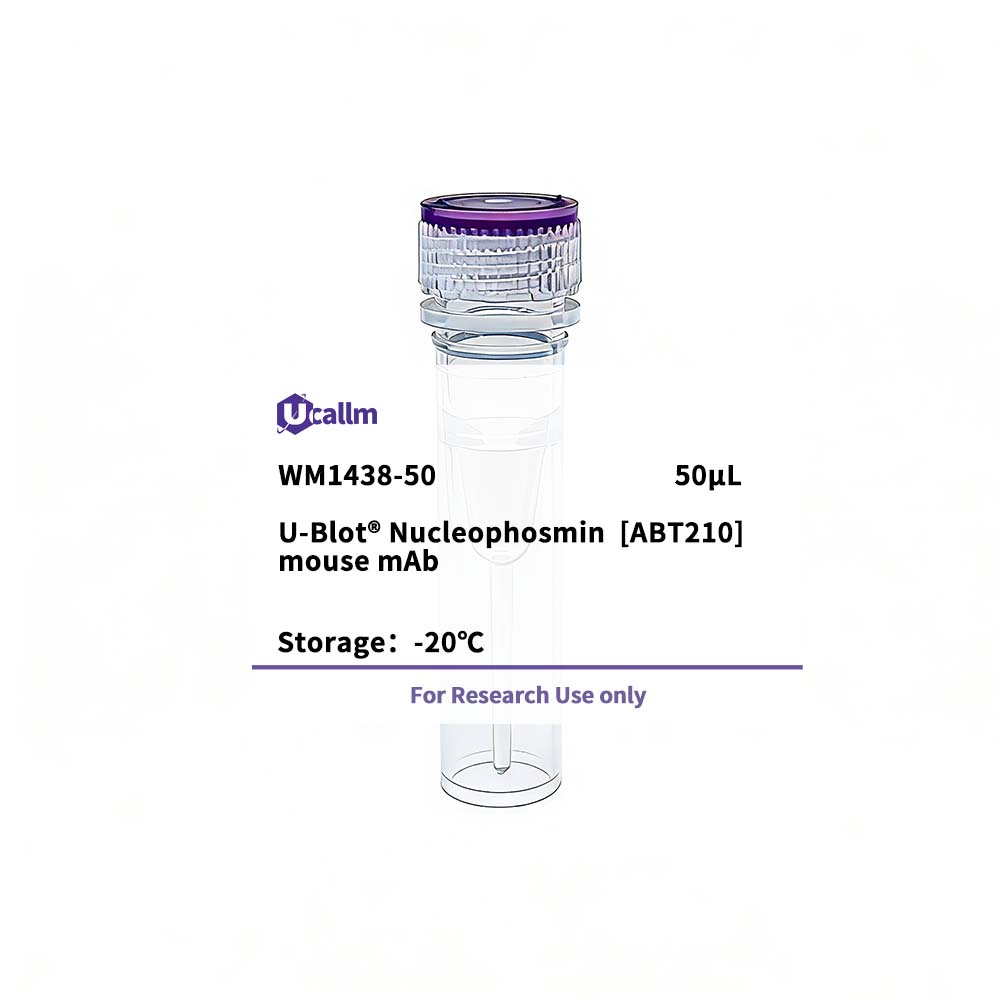
Ucallm_WM1438-50
Price range: $268.00 through $328.00
Product details
Background:
Nucleophosmin is the most abundant nuclear phosphoprotein in cells, which usually accumulates in the cytoplasm. Generally speaking, the content of tumor growing cells is higher than that of normal quiescent cells. It can be used as a nuclear marker, as well as for the observation of the efficacy of anticancer drugs and the study of cell apoptosis.
Specifications
| Size | 50μL/100μL |
| Target | Nucleophosmin |
| Reactivity | Human |
| Applications | IHC, WB, IF, ELISA |
| MW(Calculated) | 32kD |
| MW(Observed) | 33kD |
| Host Species | Mouse |
| Isotype | IgG2b,Kappa |
| Conjugate/Modification | Unmodified |
| Recommended Dilution Ratio | IHC 1:200-1000; WB 1:500-2000; IF 1:100-500; ELISA 1:1000-5000 / Note: For IHC, we suggest antigen retrieval with TE buffer pH 9.0 (Cat#WT1004) |
| Formulation | PBS, 50% glycerol, 0.05% Proclin 300, 0.05%BSA |
| Purification | Recombinant Antibody expressed in animal component-free (ACF) media, purified via Protein G affinity chromatography. |
| Storage | -15°C to -25°C/1 year(Do not lower than -25°C) |
| Concentration | |
| Clonality | Monoclonal |
| Clone Number | RMM210 |
| Immunogen | Synthesized peptide derived from human Nucleophosmin AA range: 100-200 |
| Specificity | The antibody can specifically recognize human Nucleophosmin protein. |
| Gene Name | NPM1 NPM |
| Protein Name | Nucleophosmin |
| Other Name | NPM1; / NPM; / Nucleophosmin; / NPM; / Nucleolar phosphoprotein B23; / Nucleolar protein NO38; / Numatrin |
| Species | Human |
| Gene ID | 4869 |
| Uniprot | P06748 |
| Species.1 | |
| Gene ID.1 | |
| Uniprot.1 | |
| Species.2 | |
| Gene ID.2 | |
| Uniprot.2 | |
| Cellular Localization | Nuclear, Cytoplasmic |
| Tissue Expression | Nuclear, Cytoplasmic |
| Signaling_pathway | |
| Research Areas | |
| Function | Disease:A chromosomal aberration involving NPM1 is a cause of myelodysplastic syndrome (MDS). Translocation t(3; 5)(q25.1; q34) with MLF1.,Disease:A chromosomal aberration involving NPM1 is found in a form of acute promyelocytic leukemia. Translocation t(5; 17)(q32; q11) with RARA.,Disease:A chromosomal aberration involving NPM1 is found in a form of non-Hodgkin lymphoma. Translocation t(2; 5)(p23; q35) with ALK. The resulting chimeric NPM1-ALK protein homodimerize and the kinase becomes constitutively activated.,Disease:Defects in NPM1 are associated with acute myelogenous leukemia (AML). Mutations in exon 12 affecting the C-terminus of the protein are associated with an aberrant cytoplasmic location.,Function:Involved in diverse cellular processes such as ribosome biogenesis, centrosome duplication, protein chaperoning, histone assembly, cell proliferation, and regulation of tumor suppressors TP53/p53 and ARF. Binds ribosome presumably to drive ribosome nuclear export. Associated with nucleolar ribonucleoprotein structures and bind single-stranded nucleic acids. Acts as a chaperonin for the core histones H3, H2B and H4.,PTM:Acetylated at C-terminal lysine residues, thereby increasing affinity to histones.,PTM:ADP-ribosylated.,PTM:Phosphorylated at Ser-4 by PLK1. Phosphorylated by CDK2 at Ser-125 and Thr-199. Phosphorylation at Thr-199 may trigger initiation of centrosome duplication. Phosphorylated by CDC2 at Thr-199, Thr-219, Thr-234 and Thr-237 during cell mitosis. When these four sites are phosphorated, RNA-binding activity seem to be abolished. May be phosphoryled at Ser-70 by NEK2.,PTM:Sumoylated by ARF.,similarity:Belongs to the nucleoplasmin family.,subcellular location:Generally nucleolar, but is translocated to the nucleoplasm in case of serum starvation or treatment with anticancer drugs. Has been found in the cytoplasm in patients with primary acute myelogenous leukemia (AML), but not with secondary AML. Can shuttle between cytoplasm and nucleus.,subunit:Decamer formed by two pentameric rings associated in a head-to-head fashion. Disulfide-linked dimers under certain conditions. The SWAP complex consists of NPM1, NCL, PARP1 and SWAP70 (By similarity). Interacts with NSUN2. Interacts with hepatitis delta virus S-HDAg., |
Please login to post questions
Related products





