SKU: WR4179 Categories: ,

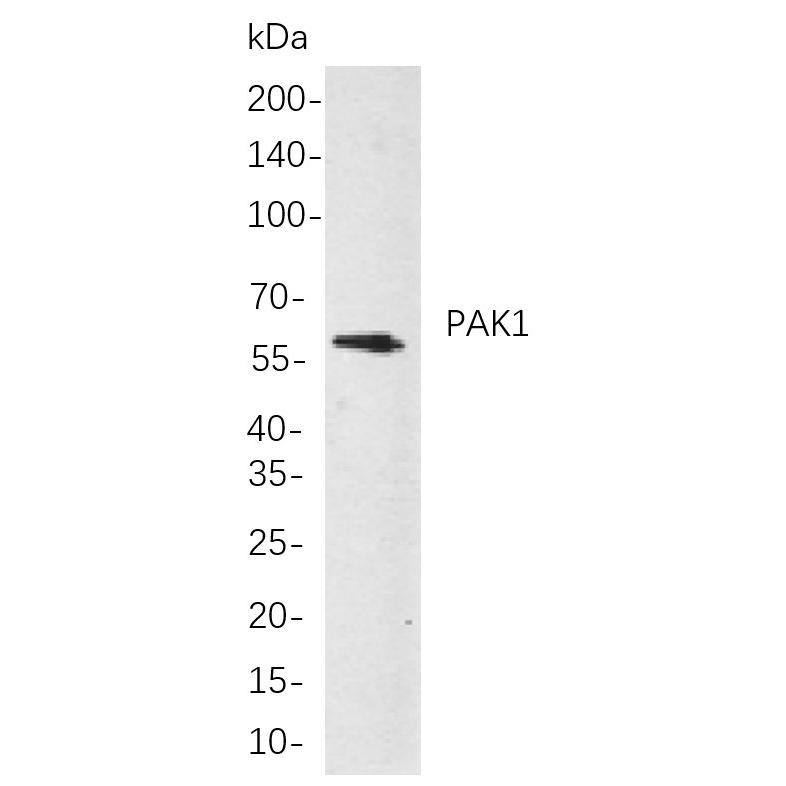
U-Blot® PAK1 Rabbit mAb

Price range: $268.00 through $328.00

SKU: WR4179-50
Enter the quantity you would like, or drag the panel to find the quantity and price that best for you
Bulk QuoteAuthorize OEM & ODM

Product details

Background:This gene encodes a family member of serine/threonine p21-activating kinases, known as PAK proteins. These proteins are critical effectors that link RhoGTPases to cytoskeleton reorganization and nuclear signaling, and they serve as targets for the small GTP binding proteins Cdc42 and Rac. This specific family member regulates cell motility and morphology. Alternatively spliced transcript variants encoding different isoforms have been found for this gene. [provided by RefSeq, Apr 2010],


Specifications

Size50μL/100μL
TargetPAK1
ReactivityHuman, Mouse, Rat
ApplicationsWB, IHC, IF, IP, ELISA
MW(Calculated)61kD
MW(Observed)61kD
Host SpeciesRabbit
IsotypeIgG,Kappa
Conjugate/ModificationUnmodified
Recommended Dilution RatioIHC 1:200-1:1000; WB 1:1000-1:5000; IF 1:200-1:1000; ELISA 1:5000-1:20000; IP 1:50-1:200; / Note: For IHC, we suggest antigen retrieval with TE buffer pH 9.0 (Cat#WT1004)
FormulationPBS, 50% glycerol, 0.05% Proclin 300, 0.05%BSA
PurificationRecombinant Antibody expressed in animal component-free (ACF) media, purified via Protein A affinity chromatography.
Storage-15°C to -25°C/1 year(Do not lower than -25°C)
Concentration
ClonalityMonoclonal
Clone NumberRM0342R
ImmunogenThe specific immunogen used to produce this antibody is proprietary information.
SpecificityEndogenous
Gene NamePAK1
Protein NameSerine/threonine-protein kinase PAK 1
Other NamePAK1; / Serine/threonine-protein kinase PAK 1; / Alpha-PAK; / p21-activated kinase 1; / PAK-1; / p65-PAK
SpeciesHuman
Gene ID5058
UniprotQ13153,
Species.1Mouse
Gene ID.1
Uniprot.1O88643,
Species.2Rat
Gene ID.229431
Uniprot.2P35465
Cellular LocalizationCytoplasm
Tissue ExpressionOverexpressed in gastric cancer cells and tissues (at protein level) (PubMed:25766321).
Signaling_pathwayCellular Processes >> Cellular community - eukaryotes >> Focal adhesion;Cellular Processes >> Cell motility >> Regulation of actin cytoskeleton;Organismal Systems >> Immune system >> Natural killer cell mediated cytotoxicity;Organismal Systems >> Immune system >> T cell receptor signaling pathway;Organismal Systems >> Immune system >> Fc gamma R-mediated phagocytosis;Organismal Systems >> Immune system >> Chemokine signaling pathway;Human Diseases >> Cancer: specific types >> Renal cell carcinoma;Environmental Information Processing >> Signal transduction >> MAPK signaling pathway;Environmental Information Processing >> Signal transduction >> ErbB signaling pathway;Environmental Information Processing >> Signal transduction >> Ras signaling pathway;Environmental Information Processing >> Signal transduction >> Hippo signaling pathway - multiple species;Environmental Information Processing >> Signal transduction >> cAMP signaling pathway
Research Areas>>MAPK signaling pathway; / >>ErbB signaling pathway; / >>Ras signaling pathway; / >>cAMP signaling pathway; / >>Chemokine signaling pathway; / >>Axon guidance; / >>Hippo signaling pathway - multiple species; / >>Focal adhesion; / >>C-type lectin receptor signaling pathway; / >>Natural killer cell mediated cytotoxicity; / >>T cell receptor signaling pathway; / >>Fc gamma R-mediated phagocytosis; / >>Regulation of actin cytoskeleton; / >>Epithelial cell signaling in Helicobacter pylori infection; / >>Pathogenic Escherichia coli infection; / >>Salmonella infection; / >>Human immunodeficiency virus 1 infection; / >>Proteoglycans in cancer; / >>Renal cell carcinoma
FunctionCatalytic activity:ATP + a protein = ADP + a phosphoprotein.,cofactor:Magnesium.,enzyme regulation:Activated by binding small G proteins. Binding of GTP-bound CDC42 or RAC1 to the autoregulatory region releases monomers from the autoinhibited dimer, enables phosphorylation of Thr-423 and allows the kinase domain to adopt an active structure. Also activated by binding to GTP-bound CDC42, independent of the phosphorylation state of Thr-423. Phosphorylation of Thr-84 by OXSR1 inhibits this activation.,Function:The activated kinase acts on a variety of targets. Likely to be the GTPase effector that links the Rho-related GTPases to the JNK MAP kinase pathway. Activated by CDC42 and RAC1. Involved in dissolution of stress fibers and reorganization of focal complexes. Involved in regulation of microtubule biogenesis through phosphorylation of TBCB. Activity is inhibited in cells undergoing apoptosis, potentially due to binding of CDC2L1 and CDC2L2.,PTM:Autophosphorylated when activated by CDC42/p21 and RAC1.,similarity:Belongs to the protein kinase superfamily. STE Ser/Thr protein kinase family. STE20 subfamily.,similarity:Contains 1 CRIB domain.,similarity:Contains 1 protein kinase domain.,subcellular location:Recruited to focal adhesions upon activation.,subunit:Homodimer in its autoinhibited state. Active as monomer. Interacts tightly with GTP-bound but not GDP-bound CDC42/P21 and RAC1. Binds to the caspase-cleaved p110 isoform of CDC2L1 and CDC2L2, p110C, but not the full-length proteins. Component of cytoplasmic complexes, which also contain PXN, ARHGEF6 and GIT1. Interacts with ARHGEF7. Also interacts with CRIPAK. Interacts with NISCH.,
Please login to post questions

Back to Top
Product has been added to your cart

