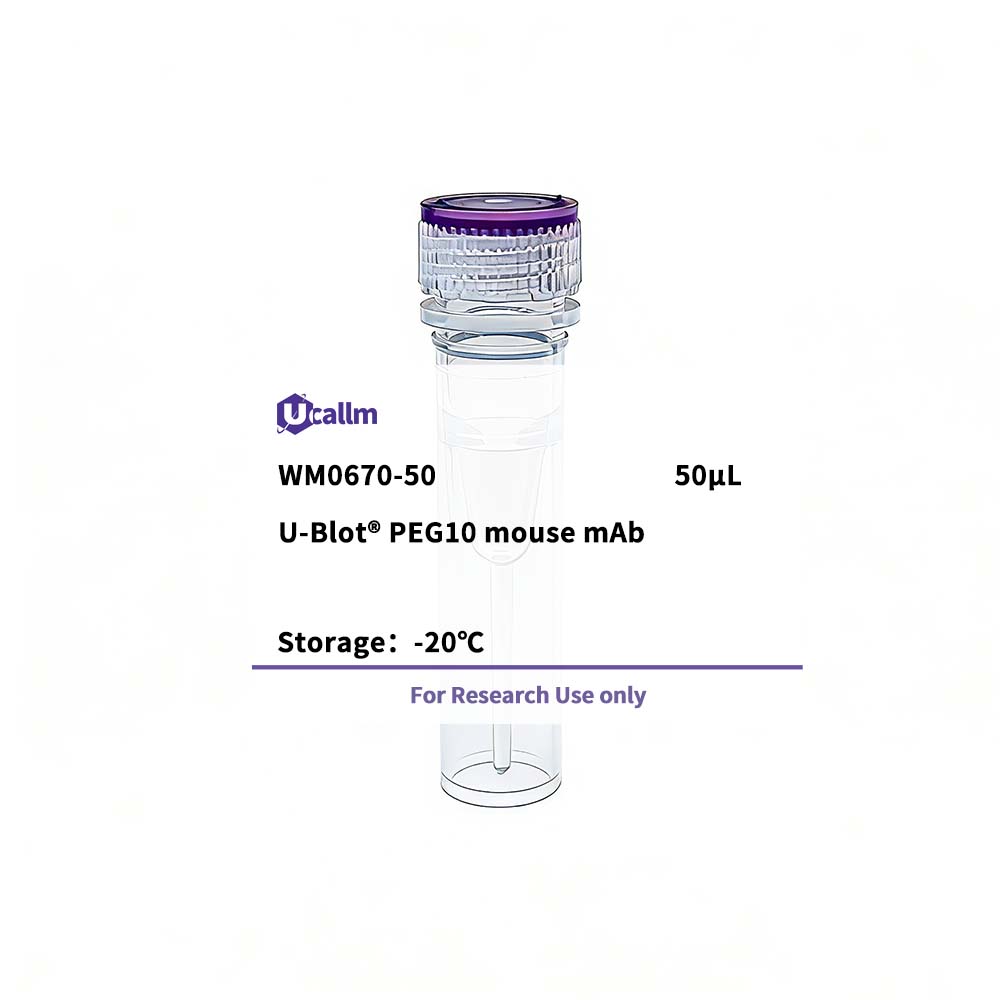
SKU: WM0670 Categories: ,

PEG10 mouse mAb

Price range: $268.00 through $328.00

SKU: WM0670-50
Enter the quantity you would like, or drag the panel to find the quantity and price that best for you
Bulk QuoteAuthorize OEM & ODM

Product details

Background:
This is a paternally expressed imprinted gene that is thought to have been derived from the Ty3/Gypsy family of retrotransposons. It contains two overlapping open reading frames, RF1 and RF2, and expresses two proteins: a shorter, gag-like protein (with a CCHC-type zinc finger domain) from RF1; and a longer, gag/pol-like fusion protein (with an additional aspartic protease motif) from RF1/RF2 by -1 translational frameshifting (-1 FS). While -1 FS has been observed in RNA viruses and transposons in both prokaryotes and eukaryotes, this gene represents the first example of -1 FS in a eukaryotic cellular gene. This gene is highly conserved across mammalian species and retains the heptanucleotide (GGGAAAC) and pseudoknot elements required for -1 FS. It is expressed in adult and embryonic tissues (most notably in placenta) and reported to have a role in cell proliferation, differentiation and apoptosis.

Specifications

Size50μL/100μL
TargetPEG10
ReactivityHuman
ApplicationsWB, IP
MW(Calculated)
MW(Observed)55kD
Host SpeciesMouse
Isotype
Conjugate/ModificationUnmodified
Recommended Dilution RatioWB 1:1000
FormulationLiquid in PBS containing 50% glycerol, 0.5% BSA and 0.02% sodium azide.
PurificationThe antibody was affinity-purified from mouse ascites by affinity-chromatography using epitope-specific immunogen.
Storage-15°C to -25°C/1 year(Do not lower than -25°C)
Concentration
ClonalityMonoclonal
Clone Number15F5
ImmunogenPurified recombinant human PEG10 protein fragments expressed in E.coli.
SpecificityThis antibody detects endogenous levels of PEG10 and does not cross-react with related proteins.
Gene NamePEG10
Protein Name
Other NamePEG10; / EDR; / KIAA1051; / MAR2; / MART2; / MEF3L1; / RGAG3; / Retrotransposon-derived protein PEG10; / Embryonal carcinoma differentiation-regulated protein; / Mammalian retrotransposon-derived protein 2; / Myelin expression factor 3-like protein 1; / MEF3-lik
SpeciesHuman
Gene ID23089
UniprotQ86TG7
Species.1
Gene ID.1
Uniprot.1
Species.2
Gene ID.2
Uniprot.2
Cellular LocalizationExtracellular vesicle membrane . Cytoplasm . Nucleus . Forms virion-like extracellular vesicles that are released from cells (PubMed:34413232). Detected predominantly in the cytoplasm of breast and prostate carcinomas, in hepatocellular carcinoma (HCC) and B-cell chronic lymphocytic leukemia (B-CLL) cells and in the Hep-G2 cell line (PubMed:12810624). .
Tissue ExpressionExpressed in the cytotrophoblast layer but not in the overlying syncytiotrophoblast of the placenta. Expressed in prostate and breast carcinomas but not in normal breast and prostate epithelial cells. Expressed in the Hep-G2 cell line (at protein level). Expressed in brain, liver, spleen, kidney, thymus, lung, ovary, testis, reactive lymph node, skeletal muscle, adipose tissue and placenta. Expressed in pancreatic and hepatocellular carcinomas (HCC).
Signaling_pathway
Research Areas
FunctionAlternative products:The ribosomal frameshifting efficiency yield up to 66% of protein RF1/RF2 compared to RF1,developmental stage:Expressed in placenta during the first trimester of gestation (at protein level). In placenta, down-regulated at early hypoxic phase, and highly activated at 11-12 week of gestation.,Function:Prevents apoptosis in hepatocellular carcinoma (HCC) cells through interaction with SIAH1, a mediator of apoptosis. May also have a role in cell growth promotion and hepatoma formation. Inhibits the TGF-beta signaling by interacting with the TGF-beta receptor ALK1. When overexpressed, induces the formation of cellular extension, such as filipodia in association with ALK1. Involved at the immediate early stage of adipocyte differentiation (By similarity). May bind to the 5'-GCCTGTCTTT-3' DNA sequence of the MB1 domain in the myelin basic protein (MBP) promoter.,induction:Up-regulated by MYC and dihydrotestosteron (DHT).,miscellaneous:The PEG10 locus is imprinted, giving rise to paternally expressed proteins.,PTM:Isoform RF1/RF2 undergoes proteolytic cleavage.,sequence Caution:Wrong choice of frame.,similarity:Contains 1 CCHC-type zinc finger.,subcellular location:Detected predominantly in the cytoplasm of breast and prostate carcinomas, in hepatocellular carcinoma (HCC) and B-cell chronic lymphocytic leukemia (B-CLL) cells and in the HepG2 cell line. Colocalized with ALK1.,subunit:Interacts with ALK1, SIAH1 and SIAH2.,tissue specificity:Expressed in the cytotrophoblast layer but not in the overlying syncytiotrophoblast of the placenta. Expressed in prostate and breast carcinomas but not in normal breast and prostate epithelial cells. Expressed in the HepG2 cell line (at protein level). Expressed in brain, liver, spleen, kidney, thymus, lung, ovary, testis, reactive lymph node, skeletal muscle, adipose tissue and placenta. Expressed in pancreatic and hepatocellular carcinomas (HCC).,
Please login to post questions
Back to Top
Product has been added to your cart
