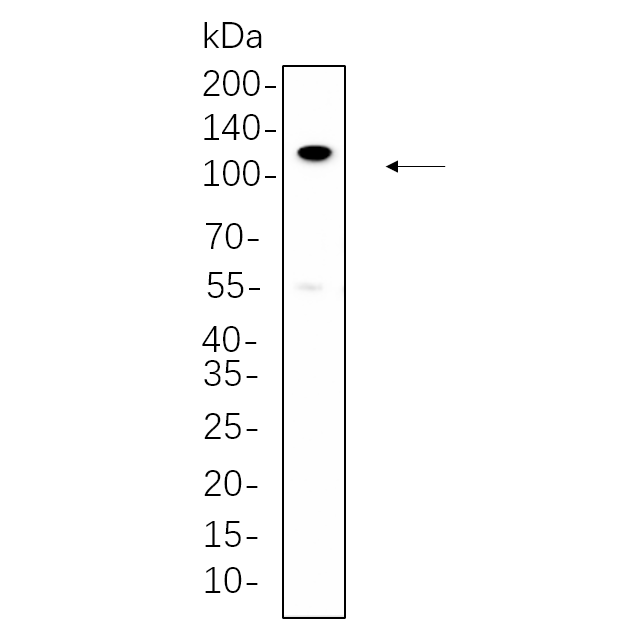
SKU: WR4327 Categories: ,

U-Blot® PI3-Kinase p110 β Rabbit mAb

Price range: $268.00 through $328.00

SKU: WR4327-50
Enter the quantity you would like, or drag the panel to find the quantity and price that best for you
Bulk QuoteAuthorize OEM & ODM

Product details

Background:This gene encodes an isoform of the catalytic subunit of phosphoinositide 3-kinase (PI3K). These kinases are important in signaling pathways involving receptors on the outer membrane of eukaryotic cells and are named for their catalytic subunit. The encoded protein is the catalytic subunit for PI3Kbeta (PI3KB). PI3KB has been shown to be part of the activation pathway in neutrophils which have bound immune complexes at sites of injury or infection. Alternative splicing results in multiple transcript variants. [provided by RefSeq, Dec 2011],


Specifications

Size50μL/100μL
TargetPIK3CB
ReactivityHuman, Mouse, Rat
ApplicationsWB, IHC, IF, ELISA
MW(Calculated)123kD
MW(Observed)110kD
Host SpeciesRabbit
IsotypeIgG,Kappa
Conjugate/ModificationUnmodified
Recommended Dilution RatioIHC 1:200-1:1000; WB 1:2000-1:10000; IF 1:200-1:1000; ELISA 1:5000-1:20000; / Note: For IHC, we suggest antigen retrieval with TE buffer pH 9.0 (Cat#WT1004)
FormulationPBS, 50% glycerol, 0.05% Proclin 300, 0.05%BSA
PurificationRecombinant Antibody expressed in animal component-free (ACF) media, purified via Protein A affinity chromatography.
Storage-15°C to -25°C/1 year(Do not lower than -25°C)
Concentration
ClonalityMonoclonal
Clone NumberRM0533R
ImmunogenThe specific immunogen used to produce this antibody is proprietary information.
SpecificityEndogenous
Gene NamePIK3CB PIK3C1
Protein NamePhosphatidylinositol 4,5-bisphosphate 3-kinase catalytic subunit beta isoform (PI3-kinase subunit beta) (PI3K-beta) (PI3Kbeta) (PtdIns-3-kinase subunit beta) (Phosphatidylinositol 4,5-bisphosphate 3-kinase 110 kDa catalytic subunit beta) (PtdIns-3-kinase subunit p110-beta) (p110beta)
Other Name
SpeciesHuman
Gene ID5291
UniprotP42338,
Species.1Mouse
Gene ID.1
Uniprot.1Q8BTI9,
Species.2Rat
Gene ID.2
Uniprot.2Q9Z1L0
Cellular LocalizationCytoplasm . Nucleus . Interaction with PIK3R2 is required for nuclear localization and export.
Tissue ExpressionExpressed ubiquitously.
Signaling_pathwayCellular Processes >> Transport and catabolism >> Autophagy - animal;Cellular Processes >> Cell growth and death >> Apoptosis;Cellular Processes >> Cell growth and death >> Cellular senescence;Cellular Processes >> Cellular community - eukaryotes >> Focal adhesion;Cellular Processes >> Cellular community - eukaryotes >> Signaling pathways regulating pluripotency of stem cells;Cellular Processes >> Cell motility >> Regulation of actin cytoskeleton;Organismal Systems >> Immune system >> Platelet activation;Organismal Systems >> Immune system >> Neutrophil extracellular trap formation;Organismal Systems >> Immune system >> Toll-like receptor signaling pathway;Organismal Systems >> Immune system >> Natural killer cell mediated cytotoxicity;Organismal Systems >> Immune system >> T cell receptor signaling pathway;Organismal Systems >> Immune system >> B cell receptor signaling pathway;Organismal Systems >> Immune system >> Fc epsilon RI signaling pathway;Organismal Systems >> Immune system >> Fc gamma R-mediated phagocytosis;Organismal Systems >> Immune system >> Leukocyte transendothelial migration;Organismal Systems >> Immune system >> Chemokine signaling pathway;Organismal Systems >> Endocrine system >> Insulin signaling pathway;Organismal Systems >> Endocrine system >> Estrogen signaling pathway;Organismal Systems >> Endocrine system >> Prolactin signaling pathway;Organismal Systems >> Endocrine system >> Relaxin signaling pathway;Organismal Systems >> Endocrine system >> Growth hormone synthesis, secretion and action;Organismal Systems >> Endocrine system >> Thyroid hormone signaling pathway;Organismal Systems >> Nervous system >> Cholinergic synapse;Organismal Systems >> Nervous system >> Neurotrophin signaling pathway;Organismal Systems >> Sensory system >> Inflammatory mediator regulation of TRP channels;Organismal Systems >> Development and regeneration >> Osteoclast differentiation;Organismal Systems >> Aging >> Longevity regulating pathway;Organismal Systems >> Aging >> Longevity regulating pathway - multiple species;Human Diseases >> Cancer: overview >> Pathways in cancer;Human Diseases >> Cancer: overview >> MicroRNAs in cancer;Human Diseases >> Cancer: overview >> Central carbon metabolism in cancer;Human Diseases >> Cancer: overview >> PD-L1 expression and PD-1 checkpoint pathway in cancer;Human Diseases >> Cancer: specific types >> Colorectal cancer;Human Diseases >> Cancer: specific types >> Pancreatic cancer;Human Diseases >> Cancer: specific types >> Hepatocellular carcinoma;Human Diseases >> Cancer: specific types >> Gastric cancer;Human Diseases >> Cancer: specific types >> Glioma;Human Diseases >> Cancer: specific types >> Acute myeloid leukemia;Human Diseases >> Cancer: specific types >> Chronic myeloid leukemia;Human Diseases >> Cancer: specific types >> Melanoma;Human Diseases >> Cancer: specific types >> Renal cell carcinoma;Human Diseases >> Cancer: specific types >> Prostate cancer;Human Diseases >> Cancer: specific types >> Endometrial cancer;Human Diseases >> Cancer: specific types >> Breast cancer;Human Diseases >> Cancer: specific types >> Small cell lung cancer;Human Diseases >> Cancer: specific types >> Non-small cell lung cancer;Human Diseases >> Neurodegenerative disease >> Alzheimer disease;Human Diseases >> Neurodegenerative disease >> Spinocerebellar ataxia;Human Diseases >> Neurodegenerative disease >> Prion disease;Environmental Information Processing >> Signal transduction >> ErbB signaling pathway;Environmental Information Processing >> Signal transduction >> Ras signaling pathway;Environmental Information Processing >> Signal transduction >> Rap1 signaling pathway;Environmental Information Processing >> Signal transduction >> VEGF signaling pathway;Environmental Information Processing >> Signal transduction >> JAK-STAT signaling pathway;Environmental Information Processing >> Signal transduction >> TNF signaling pathway;Environmental Information Processing >> Signal transduction >> HIF-1 signaling pathway;Environmental Information Processing >> Signal transduction >> FoxO signaling pathway;Environmental Information Processing >> Signal transduction >> Phospholipase D signaling pathway;Environmental Information Processing >> Signal transduction >> Sphingolipid signaling pathway;Environmental Information Processing >> Signal transduction >> cAMP signaling pathway;Environmental Information Processing >> Signal transduction >> PI3K-Akt signaling pathway;Environmental Information Processing >> Signal transduction >> AMPK signaling pathway;Environmental Information Processing >> Signal transduction >> mTOR signaling pathway
Research Areas>>Inositol phosphate metabolism; / >>Metabolic pathways; / >>EGFR tyrosine kinase inhibitor resistance; / >>Endocrine resistance; / >>Platinum drug resistance; / >>ErbB signaling pathway; / >>Ras signaling pathway; / >>Rap1 signaling pathway; / >>cAMP signaling pathway; / >>Chemokine signaling pathway; / >>HIF-1 signaling pathway; / >>FoxO signaling pathway; / >>Phosphatidylinositol signaling system; / >>Sphingolipid signaling pathway; / >>Phospholipase D signaling pathway; / >>Autophagy - animal; / >>mTOR signaling pathway; / >>PI3K-Akt signaling pathway; / >>AMPK signaling pathway; / >>Apoptosis; / >>Longevity regulating pathway; / >>Longevity regulating pathway - multiple species; / >>Cellular senescence; / >>Axon guidance; / >>VEGF signaling pathway; / >>Osteoclast differentiation; / >>Focal adhesion; / >>Signaling pathways regulating pluripotency of stem cells; / >>Platelet activation; / >>Neutrophil extracellular trap formation; / >>Toll-like receptor signaling pathway; / >>C-type lectin receptor signaling pathway; / >>JAK-STAT signaling pathway; / >>Natural killer cell mediated cytotoxicity; / >>T cell receptor signaling pathway; / >>B cell receptor signaling pathway; / >>Fc epsilon RI signaling pathway; / >>Fc gamma R-mediated phagocytosis; / >>TNF signaling pathway; / >>Leukocyte transendothelial migration; / >>Neurotrophin signaling pathway; / >>Cholinergic synapse; / >>Inflammatory mediator regulation of TRP channels; / >>Regulation of actin cytoskeleton; / >>Insulin signaling pathway; / >>Progesterone-mediated oocyte maturation; / >>Estrogen signaling pathway; / >>Prolactin signaling pathway; / >>Thyroid hormone signaling pathway; / >>Regulation of lipolysis in adipocytes; / >>Relaxin signaling pathway; / >>GnRH secretion; / >>Type II diabetes mellitus; / >>Insulin resistance; / >>Non-alcoholic fatty liver disease; / >>AGE-RAGE signaling pathway in diabetic complications; / >>Growth hormone synthesis, secretion and action; / >>Aldosterone-regulated sodium reabsorption; / >>Carbohydrate digestion and absorption; / >>Alzheimer disease; / >>Spinocerebellar ataxia; / >>Prion disease; / >>Bacterial invasion of epithelial cells; / >>Shigellosis; / >>Salmonella infection; / >>Yersinia infection; / >>Chagas disease; / >>Amoebiasis; / >>Hepatitis C; / >>Hepatitis B; / >>Measles; / >>Human cytomegalovirus infection; / >>Influenza A; / >>Human papillomavirus infection; / >>Human T-cell leukemia virus 1 infection; / >>Kaposi sarcoma-associated herpesvirus infection; / >>Herpes simplex virus 1 infection; / >>Epstein-Barr virus infection; / >>Human immunodeficiency virus 1 infection; / >>Coronavirus disease - COVID-19; / >>Pathways in cancer; / >>Viral carcinogenesis; / >>Proteoglycans in cancer; / >>MicroRNAs in cancer; / >>Chemical carcinogenesis - receptor activation; / >>Chemical carcinogenesis - reactive oxygen species; / >>Colorectal cancer; / >>Renal cell carcinoma; / >>Pancreatic cancer; / >>Endometrial cancer; / >>Glioma; / >>Prostate cancer; / >>Melanoma; / >>Chronic myeloid leukemia; / >>Acute myeloid leukemia; / >>Small cell lung cancer; / >>Non-small cell lung cancer; / >>Breast cancer; / >>Hepatocellular carcinoma; / >>Gastric cancer; / >>Central carbon metabolism in cancer; / >>Choline metabolism in cancer; / >>PD-L1 expression and PD-1 checkpoint pathway in cancer; / >>Diabetic cardiomyopathy; / >>Lipid and atherosclerosis; / >>Fluid shear stress and atherosclerosis
FunctionCatalytic activity:ATP + 1-phosphatidyl-1D-myo-inositol 4,5-bisphosphate = ADP + 1-phosphatidyl-1D-myo-inositol 3,4,5-trisphosphate.,Function:Phosphorylates PtdIns, PtdIns4P and PtdIns(4,5)P2 with a preference for PtdIns(4,5)P2.,pathway:Phospholipid metabolism; phosphatidylinositol phosphate biosynthesis.,similarity:Belongs to the PI3/PI4-kinase family.,similarity:Contains 1 PI3K/PI4K domain.,subunit:Heterodimer of a p110 (catalytic) and a p85 (regulatory) subunit.,tissue specificity:Expressed ubiquitously.,
Please login to post questions

Back to Top
Product has been added to your cart
