

U-Blot® PKC α Rabbit mAb

WR4349
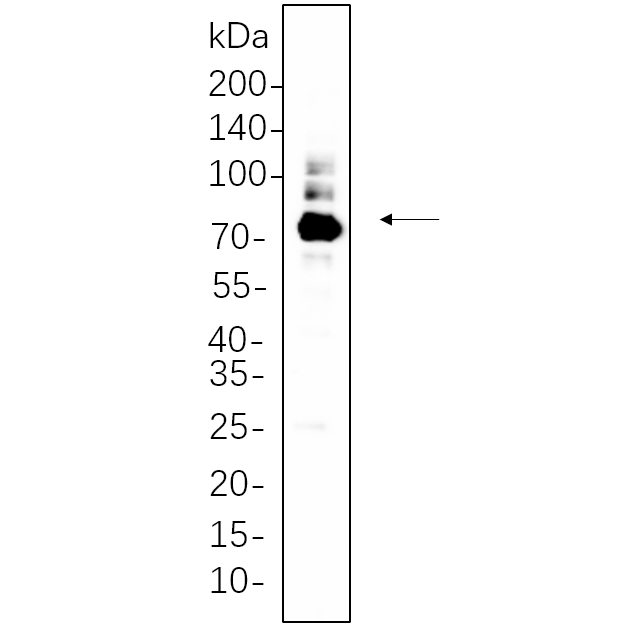
WR4349 huh-7 cell lysates were separated by 4-20% SDS-PAGE, and the membrane was blotted with primary antibody 1:1000. The HRP-conjugated Goat anti-Rabbit IgG(H + L) antibody was used to detect the antibody.
Price range: $268.00 through $328.00
Product details
Background:Protein kinase C (PKC) is a family of serine- and threonine-specific protein kinases that can be activated by calcium and the second messenger diacylglycerol. PKC family members phosphorylate a wide variety of protein targets and are known to be involved in diverse cellular signaling pathways. PKC family members also serve as major receptors for phorbol esters, a class of tumor promoters. Each member of the PKC family has a specific expression profile and is believed to play a distinct role in cells. The protein encoded by this gene is one of the PKC family members. This kinase has been reported to play roles in many different cellular processes, such as cell adhesion, cell transformation, cell cycle checkpoint, and cell volume control. Knockout studies in mice suggest that this kinase may be a fundamental regulator of cardiac contractility and Ca(2+) handling in myocytes. [provided by RefSeq, Jul 2
Specifications
| Size | 50μL/100μL |
| Target | PKC α |
| Reactivity | Human, Mouse, Rat |
| Applications | WB, IHC, IF, IP, ELISA |
| MW(Calculated) | 77kD |
| MW(Observed) | 77kD |
| Host Species | Rabbit |
| Isotype | IgG,Kappa |
| Conjugate/Modification | Unmodified |
| Recommended Dilution Ratio | IHC 1:500-1:1000; WB 1:2000-1:10000; IF 1:200-1:1000; ELISA 1:5000-1:20000; IP 1:50-1:200; / Note: For IHC, we suggest antigen retrieval with TE buffer pH 9.0 (Cat#WT1004) |
| Formulation | PBS, 50% glycerol, 0.05% Proclin 300, 0.05%BSA |
| Purification | Recombinant Antibody expressed in animal component-free (ACF) media, purified via Protein A affinity chromatography. |
| Storage | -15°C to -25°C/1 year(Do not lower than -25°C) |
| Concentration | |
| Clonality | Monoclonal |
| Clone Number | RM0560R |
| Immunogen | The specific immunogen used to produce this antibody is proprietary information. |
| Specificity | Endogenous |
| Gene Name | PRKCA |
| Protein Name | Protein kinase C alpha type |
| Other Name | PRKCA; / PKCA; / PRKACA; / Protein kinase C alpha type; / PKC-A; / PKC-alpha |
| Species | Human |
| Gene ID | 5578 |
| Uniprot | P17252, |
| Species.1 | Mouse |
| Gene ID.1 | 18750 |
| Uniprot.1 | P20444, |
| Species.2 | Rat |
| Gene ID.2 | |
| Uniprot.2 | P05696 |
| Cellular Localization | Membrane, Cytoplasm |
| Tissue Expression | Blood,Brain,Epithelium,Lung,Platelet, |
| Signaling_pathway | Cellular Processes >> Cellular community - eukaryotes >> Focal adhesion;Cellular Processes >> Cellular community - eukaryotes >> Gap junction;Organismal Systems >> Immune system >> Neutrophil extracellular trap formation;Organismal Systems >> Immune system >> Natural killer cell mediated cytotoxicity;Organismal Systems >> Immune system >> Fc epsilon RI signaling pathway;Organismal Systems >> Immune system >> Fc gamma R-mediated phagocytosis;Organismal Systems >> Immune system >> Leukocyte transendothelial migration;Organismal Systems >> Endocrine system >> Insulin secretion;Organismal Systems >> Endocrine system >> GnRH signaling pathway;Organismal Systems >> Endocrine system >> Oxytocin signaling pathway;Organismal Systems >> Endocrine system >> Relaxin signaling pathway;Organismal Systems >> Endocrine system >> Growth hormone synthesis, secretion and action;Organismal Systems >> Endocrine system >> Thyroid hormone signaling pathway;Organismal Systems >> Endocrine system >> Aldosterone synthesis and secretion;Organismal Systems >> Circulatory system >> Adrenergic signaling in cardiomyocytes;Organismal Systems >> Circulatory system >> Vascular smooth muscle contraction;Organismal Systems >> Nervous system >> Glutamatergic synapse;Organismal Systems >> Nervous system >> Cholinergic synapse;Organismal Systems >> Nervous system >> Dopaminergic synapse;Organismal Systems >> Sensory system >> Inflammatory mediator regulation of TRP channels;Human Diseases >> Cancer: overview >> Pathways in cancer;Human Diseases >> Cancer: overview >> MicroRNAs in cancer;Human Diseases >> Cancer: specific types >> Hepatocellular carcinoma;Human Diseases >> Cancer: specific types >> Glioma;Human Diseases >> Cancer: specific types >> Non-small cell lung cancer;Human Diseases >> Neurodegenerative disease >> Spinocerebellar ataxia;Human Diseases >> Neurodegenerative disease >> Pathways of neurodegeneration - multiple diseases;Environmental Information Processing >> Signal transduction >> MAPK signaling pathway;Environmental Information Processing >> Signal transduction >> ErbB signaling pathway;Environmental Information Processing >> Signal transduction >> Ras signaling pathway;Environmental Information Processing >> Signal transduction >> Rap1 signaling pathway;Environmental Information Processing >> Signal transduction >> Wnt signaling pathway;Environmental Information Processing >> Signal transduction >> VEGF signaling pathway;Environmental Information Processing >> Signal transduction >> HIF-1 signaling pathway;Environmental Information Processing >> Signal transduction >> Calcium signaling pathway;Environmental Information Processing >> Signal transduction >> Phospholipase D signaling pathway;Environmental Information Processing >> Signal transduction >> Sphingolipid signaling pathway;Environmental Information Processing >> Signal transduction >> PI3K-Akt signaling pathway;Environmental Information Processing >> Signal transduction >> mTOR signaling pathway |
| Research Areas | >>EGFR tyrosine kinase inhibitor resistance; / >>MAPK signaling pathway; / >>ErbB signaling pathway; / >>Ras signaling pathway; / >>Rap1 signaling pathway; / >>Calcium signaling pathway; / >>HIF-1 signaling pathway; / >>Phosphatidylinositol signaling system; / >>Sphingolipid signaling pathway; / >>Phospholipase D signaling pathway; / >>mTOR signaling pathway; / >>PI3K-Akt signaling pathway; / >>Adrenergic signaling in cardiomyocytes; / >>Vascular smooth muscle contraction; / >>Wnt signaling pathway; / >>Axon guidance; / >>VEGF signaling pathway; / >>Focal adhesion; / >>Gap junction; / >>Neutrophil extracellular trap formation; / >>Natural killer cell mediated cytotoxicity; / >>Fc epsilon RI signaling pathway; / >>Fc gamma R-mediated phagocytosis; / >>Leukocyte transendothelial migration; / >>Circadian entrainment; / >>Long-term potentiation; / >>Retrograde endocannabinoid signaling; / >>Glutamatergic synapse; / >>Cholinergic synapse; / >>Serotonergic synapse; / >>GABAergic synapse; / >>Dopaminergic synapse; / >>Long-term depression; / >>Inflammatory mediator regulation of TRP channels; / >>Insulin secretion; / >>GnRH signaling pathway; / >>Melanogenesis; / >>Thyroid hormone synthesis; / >>Thyroid hormone signaling pathway; / >>Oxytocin signaling pathway; / >>Aldosterone synthesis and secretion; / >>Relaxin signaling pathway; / >>Parathyroid hormone synthesis, secretion and action; / >>GnRH secretion; / >>AGE-RAGE signaling pathway in diabetic complications; / >>Growth hormone synthesis, secretion and action; / >>Aldosterone-regulated sodium reabsorption; / >>Endocrine and other factor-regulated calcium reabsorption; / >>Salivary secretion; / >>Gastric acid secretion; / >>Pancreatic secretion; / >>Spinocerebellar ataxia; / >>Pathways of neurodegeneration - multiple diseases; / >>Amphetamine addiction; / >>Morphine addiction; / >>Vibrio cholerae infection; / >>African trypanosomiasis; / >>Amoebiasis; / >>Hepatitis B; / >>Human cytomegalovirus infection; / >>Influenza A; / >>Human immunodeficiency virus 1 infection; / >>Coronavirus disease - COVID-19; / >>Pathways in cancer; / >>Proteoglycans in cancer; / >>MicroRNAs in cancer; / >>Chemical carcinogenesis - receptor activation; / >>Glioma; / >>Non-small cell lung cancer; / >>Hepatocellular carcinoma; / >>Choline metabolism in cancer; / >>Diabetic cardiomyopathy; / >>Lipid and atherosclerosis |
| Function | Catalytic activity:ATP + a protein = ADP + a phosphoprotein.,cofactor:Binds 3 calcium ions per subunit. The ions are bound to the C2 domain.,Function:PKC is activated by diacylglycerol which in turn phosphorylates a range of cellular proteins. PKC also serves as the receptor for phorbol esters, a class of tumor promoters.,Function:This is a calcium-activated, phospholipid-dependent, serine- and threonine-specific enzyme. May play a role in cell motility by phosphorylating CSPG4.,similarity:Belongs to the protein kinase superfamily.,similarity:Belongs to the protein kinase superfamily. AGC Ser/Thr protein kinase family. PKC subfamily.,similarity:Contains 1 AGC-kinase C-terminal domain.,similarity:Contains 1 C2 domain.,similarity:Contains 1 protein kinase domain.,similarity:Contains 2 phorbol-ester/DAG-type zinc fingers.,subunit:Interacts with ADAP1/CENTA1, CSPG4 and PRKCABP. Binds to SDPR in the presence of phosphatidylserine., |
Please login to post questions
Related products




