

PKM2 mouse mAb
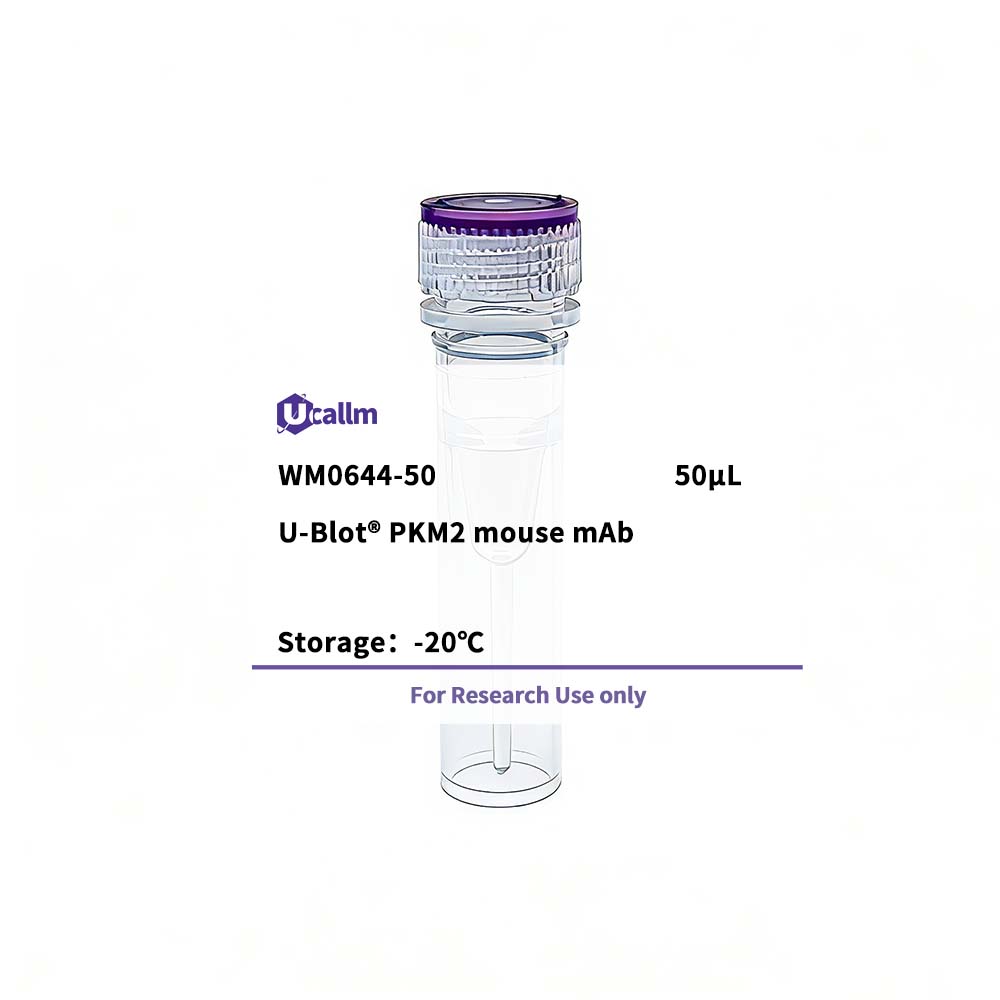
Ucallm_WM0644-50
Price range: $268.00 through $328.00
Product details
Background:
This gene encodes a protein involved in glycolysis. The encoded protein is a pyruvate kinase that catalyzes the transfer of a phosphoryl group from phosphoenolpyruvate to ADP, generating ATP and pyruvate. This protein has been shown to interact with thyroid hormone and may mediate cellular metabolic effects induced by thyroid hormones. This protein has been found to bind Opa protein, a bacterial outer membrane protein involved in gonococcal adherence to and invasion of human cells, suggesting a role of this protein in bacterial pathogenesis. Several alternatively spliced transcript variants encoding a few distinct isoforms have been reported. [provided by RefSeq, May 2011],
Specifications
| Size | 50μL/100μL |
| Target | PKM2 |
| Reactivity | Human, Mouse, Rat, Monkey |
| Applications | WB, IF |
| MW(Calculated) | |
| MW(Observed) | 60kD |
| Host Species | Mouse |
| Isotype | |
| Conjugate/Modification | Unmodified |
| Recommended Dilution Ratio | WB 1:1000; ICC 1:400; IF 1:50-200 |
| Formulation | Liquid in PBS containing 50% glycerol, 0.5% BSA and 0.02% sodium azide. |
| Purification | The antibody was affinity-purified from mouse ascites by affinity-chromatography using epitope-specific immunogen. |
| Storage | -15°C to -25°C/1 year(Do not lower than -25°C) |
| Concentration | |
| Clonality | Monoclonal |
| Clone Number | 11G7 |
| Immunogen | Purified recombinant human PKM2 protein fragments expressed in E.coli. |
| Specificity | This antibody detects endogenous levels of PKM2 and does not cross-react with related proteins. |
| Gene Name | PKM |
| Protein Name | Pyruvate kinase PKM |
| Other Name | CTHBP; / Cytosolic thyroid hormone binding protein; / Cytosolic thyroid hormone-binding protein; / KPYM_HUMAN; / MGC3932; / OIP 3; / OIP-3; / OIP3; / OPA interacting protein 3; / Opa-interacting protein 3; / p58; / PK muscle type; / PK, muscle type; / PK2; / PK3; / PKM; / PKM2; / pykm; / Pyruvate kinase 2/3; / Pyruvate kinase 3; / Pyruvate kinase isozymes M1/M2; / Pyruvate kinase muscle; / Pyruvate kinase muscle isozyme; / pyruvate kinase PKM; / Pyruvate kinase, muscle 2; / TCB; / THBP1; / Thyroid hormone binding protein 1; / Thyroid hormone binding protein cytosolic; / Thyroid hormone-binding protein 1; / Tumor M2 PK; / Tumor M2-PK. |
| Species | Human |
| Gene ID | 5315 |
| Uniprot | P14618, |
| Species.1 | Mouse |
| Gene ID.1 | 18746 |
| Uniprot.1 | P52480 |
| Species.2 | |
| Gene ID.2 | |
| Uniprot.2 | |
| Cellular Localization | [Isoform M2]: Cytoplasm . Nucleus . Translocates to the nucleus in response to various signals, such as EGF receptor activation or apoptotic stimuli (PubMed:17308100, PubMed:22056988, PubMed:24120661). Nuclear translocation is promoted by acetylation by EP300 (PubMed:24120661). Deacetylation by SIRT6 promotes its nuclear export in a process dependent of XPO4, thereby suppressing its ability to activate transcription and promote tumorigenesis (PubMed:26787900). .; [Isoform M1]: Cytoplasm . |
| Tissue Expression | [Isoform M2]: Specifically expressed in proliferating cells, such as embryonic stem cells, embryonic carcinoma cells, as well as cancer cells.; [Isoform M1]: Expressed in adult tissues (PubMed:18337823). Not expressed in tumor cells (PubMed:18337823). |
| Signaling_pathway | Organismal Systems >> Endocrine system >> Glucagon signaling pathway;Human Diseases >> Cancer: overview >> Central carbon metabolism in cancer |
| Research Areas | >>Glycolysis / Gluconeogenesis; / >>Pyruvate metabolism; / >>Metabolic pathways; / >>Carbon metabolism; / >>Biosynthesis of amino acids; / >>Glucagon signaling pathway; / >>Type II diabetes mellitus; / >>Human papillomavirus infection; / >>Viral carcinogenesis; / >>Central carbon metabolism in cancer |
| Function | Catalytic activity:ATP + pyruvate = ADP + phosphoenolpyruvate.,cofactor:Divalent metal cations.,cofactor:Magnesium.,cofactor:Potassium.,enzyme regulation:Isoform M2 is allosterically activated by D-fructose 1,6-biphosphate (FBP). Inhibited by oxalate and 3,3',5-triiodo-L-thyronine (T3).,Function:Glycolytic enzyme that catalyzes the transfer of a phosphoryl group from phosphoenolpyruvate (PEP) to ADP, generating ATP.,miscellaneous:There are 4 isozymes of pyruvate kinase in mammals: L, R, M1 and M2. L type is major isozyme in the liver, R is found in red cells, M1 is the main form in muscle, heart and brain, and M2 is found in early fetal tissues as well as in most cancer cells.,online information:Pyruvate kinase entry,pathway:Carbohydrate degradation; glycolysis; pyruvate from D-glyceraldehyde 3-phosphate: step 5/5.,PTM:Phosphorylated upon DNA damage, probably by ATM or ATR.,similarity:Belongs to the pyruvate kinase family.,subunit:Monomer and homotetramer. Exists as a monomer in the absence of FBP, and reversibly associates to form a homotetramer in the presence of FBP. The monomeric form binds T3. Tetramer formation induces pyruvate kinase activity. Interacts with HERC1., |
Please login to post questions
Related products



