SKU: WR4107 Categories: ,

U-Blot® Polycomb Protein SUZ12 Rabbit mAb

Price range: $268.00 through $328.00

SKU: WR4107-50
Enter the quantity you would like, or drag the panel to find the quantity and price that best for you
Bulk QuoteAuthorize OEM & ODM

Product details

Background:This zinc finger gene has been identified at the breakpoints of a recurrent chromosomal translocation reported in endometrial stromal sarcoma. Recombination of these breakpoints results in the fusion of this gene and JAZF1. The protein encoded by this gene contains a zinc finger domain in the C terminus of the coding region. [provided by RefSeq, Jul 2009],

Specifications

Size50μL/100μL
TargetSUZ12
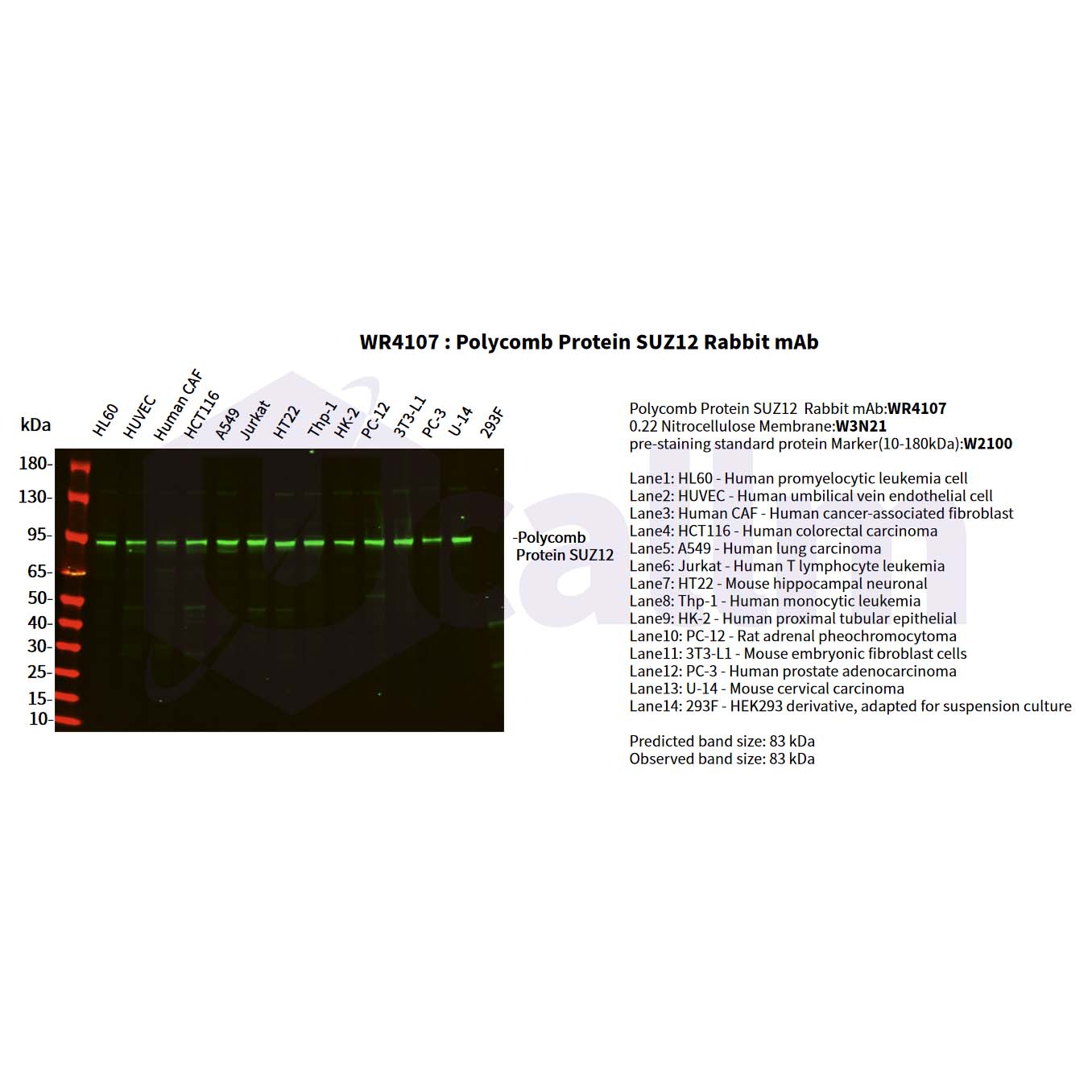
ReactivityHuman, Mouse, Rat
ApplicationsWB, IHC, IF, IP, ELISA
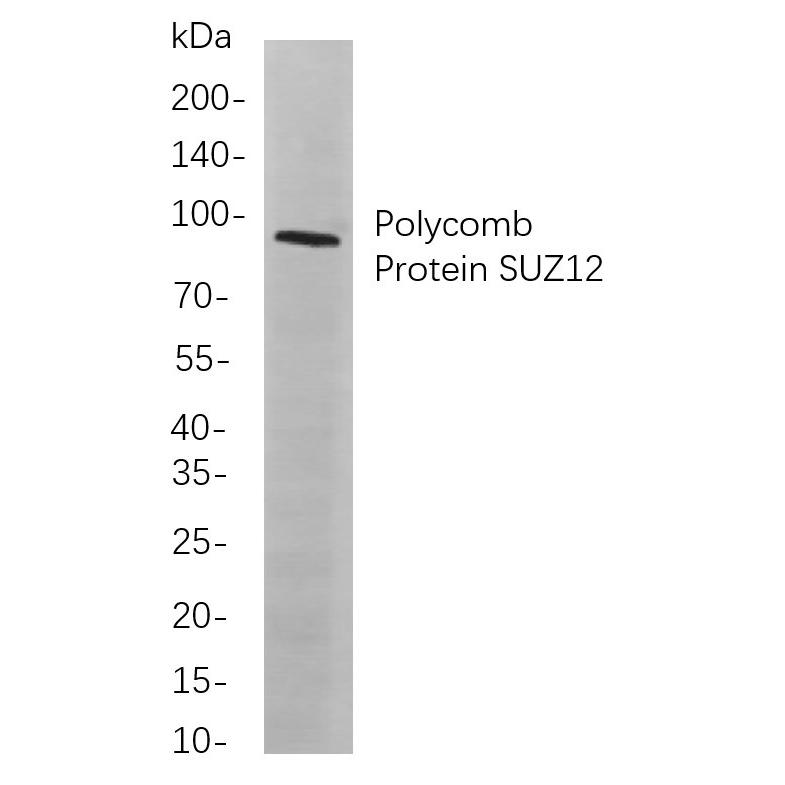
MW(Calculated)83kD
MW(Observed)83kD
Host SpeciesRabbit
IsotypeIgG,Kappa
Conjugate/ModificationUnmodified
Recommended Dilution RatioIHC 1:200-1000; WB 1:1000-5000; IF 1:200-1000; ELISA 1:5000-20000; IP 1:50-200 / Note: For IHC, we suggest antigen retrieval with TE buffer pH 9.0 (Cat#WT1004)
FormulationPBS, 50% glycerol, 0.05% Proclin 300, 0.05%BSA
PurificationRecombinant Antibody expressed in animal component-free (ACF) media, purified via Protein A affinity chromatography.
Storage-15°C to -25°C/1 year(Do not lower than -25°C)
Concentration
ClonalityMonoclonal
Clone NumberRM0203R
ImmunogenThe specific immunogen used to produce this antibody is proprietary information.
SpecificityEndogenous
Gene NameSUZ12
Protein NamePolycomb protein SUZ12
Other NameSUZ12; / CHET9; / JJAZ1; / KIAA0160; / Polycomb protein SUZ12; / Chromatin precipitated E2F target 9 protein; / ChET 9 protein; / Joined to JAZF1 protein; / Suppressor of zeste 12 protein homolog
SpeciesHuman
Gene ID23512
UniprotQ15022,
Species.1Mouse
Gene ID.1
Uniprot.1Q80U70
Species.2
Gene ID.2
Uniprot.2
Cellular LocalizationNucleus
Tissue ExpressionOverexpressed in breast and colon cancer.
Signaling_pathway
Research Areas
FunctionCaution:Two variants of the PRC2 complex have been described, termed PRC3 and PRC4. Each of the three complexes may include a different complement of EED isoforms, although the precise sequences of the isoforms in each complex have not been determined. The PRC2 and PRC4 complexes may also methylate 'Lys-26' of histone H1 in addition to 'Lys-27' of histone H3 (PubMed:15099518 and PubMed:15684044), although other studies have demonstrated no methylation of 'Lys-26' of histone H1 by PRC2 (PubMed:16431907).,developmental stage:Expressed at low levels in quiescent cells. Expression rises at the G1/S phase transition.,Disease:A chromosomal aberration involving SUZ12 may be a cause of endometrial stromal tumors. Translocation t(7; 17)(p15; q21) with JAZF1. The translocation generates the JAZF1-SUZ12 oncogene consisting of the N-terminus part of JAZF1 and the C-terminus part of SUZ12. It is frequently found in all cases of endometrial stromal tumors, except in endometrial stromal sarcomas, where it is rarer.,Function:Polycomb group (PcG) protein. Component of the PRC2/EED-EZH2 complex, which methylates 'Lys-9' and 'Lys-27' of histone H3, leading to transcriptional repression of the affected target gene. The PRC2/EED-EZH2 complex may also serve as a recruiting platform for DNA methyltransferases, thereby linking two epigenetic repression systems. Genes repressed by the PRC2/EED-EZH2 complex include HOXC8, HOXA9, MYT1 and CDKN2A.,induction:Expression is induced by E2F1, E2F2 and E2F3.,similarity:Belongs to the VEFS (VRN2-EMF2-FIS2-SU(Z)12) family.,similarity:Contains 1 C2H2-type zinc finger.,subunit:Component of the PRC2/EED-EZH2 complex, which includes EED, EZH2, SUZ12, RBBP4 and RBBP7 and possibly AEBP2. The minimum components required for methyltransferase activity of the PRC2/EED-EZH2 complex are EED, EZH2 and SUZ12. Component of the PRC2/EED-EZH1 complex, which includes EED, EZH1, SUZ12, RBBP4 and AEBP2. The PRC2 complex may also interact with DNMT1, DNMT3A, DNMT3B and PHF1 via the EZH2 subunit and with SIRT1 via the SUZ12 subunit. Interacts with WDR77. Interacts with histone H1.,tissue specificity:Overexpressed in breast and colon cancer.,
Please login to post questions

Back to Top
Product has been added to your cart