

PRMT1 Monoclonal Antibody
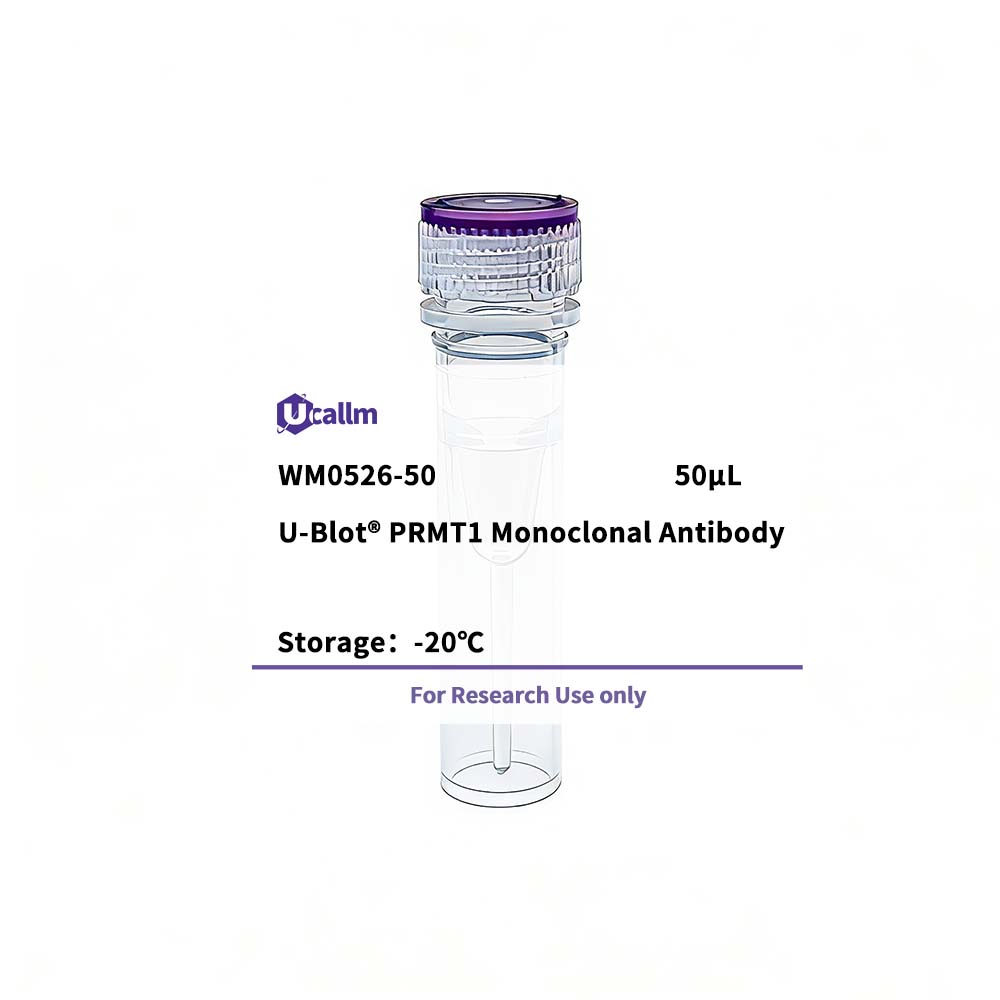
Ucallm_WM0526-50
Price range: $268.00 through $328.00
Product details
Background:
This gene encodes a member of the protein arginine N-methyltransferase (PRMT) family. Post-translational modification of target proteins by PRMTs plays an important regulatory role in many biological processes, whereby PRMTs methylate arginine residues by transferring methyl groups from S-adenosyl-L-methionine to terminal guanidino nitrogen atoms. The encoded protein is a type I PRMT and is responsible for the majority of cellular arginine methylation activity. Increased expression of this gene may play a role in many types of cancer. Alternatively spliced transcript variants encoding multiple isoforms have been observed for this gene, and a pseudogene of this gene is located on the long arm of chromosome 5. [provided by RefSeq, Dec 2011],
Specifications
| Size | 50μL/100μL |
| Target | PRMT1 |
| Reactivity | Human, Mouse, Rat, Dog |
| Applications | WB |
| MW(Calculated) | 42kD |
| MW(Observed) | |
| Host Species | Mouse |
| Isotype | |
| Conjugate/Modification | Unmodified |
| Recommended Dilution Ratio | WB 1:1000-1:2000; Not yet tested in other applications. |
| Formulation | Liquid in PBS containing 50% glycerol, 0.5% BSA and 0.02% sodium azide. |
| Purification | Affinity purification |
| Storage | -15°C to -25°C/1 year(Do not lower than -25°C) |
| Concentration | |
| Clonality | Monoclonal |
| Clone Number | 19G5 |
| Immunogen | Purified recombinant human PRMT1 protein fragments expressed in E.coli. |
| Specificity | PRMT1 Monoclonal Antibody detects endogenous levels of PRMT1 protein. |
| Gene Name | PRMT1 |
| Protein Name | Protein arginine N-methyltransferase 1 |
| Other Name | PRMT1; / HMT2; / HRMT1L2; / IR1B4; / Protein arginine N-methyltransferase 1; / Histone-arginine N-methyltransferase PRMT1; / Interferon receptor 1-bound protein 4 |
| Species | Human |
| Gene ID | 3276 |
| Uniprot | Q99873, |
| Species.1 | Mouse |
| Gene ID.1 | 15469 |
| Uniprot.1 | Q9JIF0, |
| Species.2 | Rat |
| Gene ID.2 | 60421 |
| Uniprot.2 | Q63009 |
| Cellular Localization | Nucleus . Nucleus, nucleoplasm . Cytoplasm . Cytoplasm, cytosol . Mostly found in the cytoplasm. Colocalizes with CHTOP within the nucleus. Low levels detected also in the chromatin fraction (By similarity). . |
| Tissue Expression | Widely expressed (PubMed:11097842). Expressed strongly in colorectal cancer cells (at protein level) (PubMed:28040436). Expressed strongly in colorectal cancer tissues compared to wild-type colon samples (at protein level) (PubMed:28040436). Expressed strongly in colorectal cancer tissues compared to wild-type colon samples (PubMed:28040436). |
| Signaling_pathway | Organismal Systems >> Endocrine system >> Glucagon signaling pathway;Environmental Information Processing >> Signal transduction >> FoxO signaling pathway |
| Research Areas | >>FoxO signaling pathway; / >>Glucagon signaling pathway |
| Function | enzyme regulation:By BTG1, BTG2 and ILF3.,Function:Methylates (mono and asymmetric dimethylation) the guanidino nitrogens of arginyl residues present in a glycine and arginine-rich domain (may methylate HNRNPA1 and histones). Methylates SUPT5H and EWS.,similarity:Belongs to the protein arginine N-methyltransferase family.,subunit:Homodimer and heterodimer with PRMT8. The dimer can then associate to form a homohexamer. Interacts with ILF3, BTG1, BTG2, SUPT5H and interferon-alpha/beta receptor 1. Interacts with NFATC2IP., |
Please login to post questions
Related products



