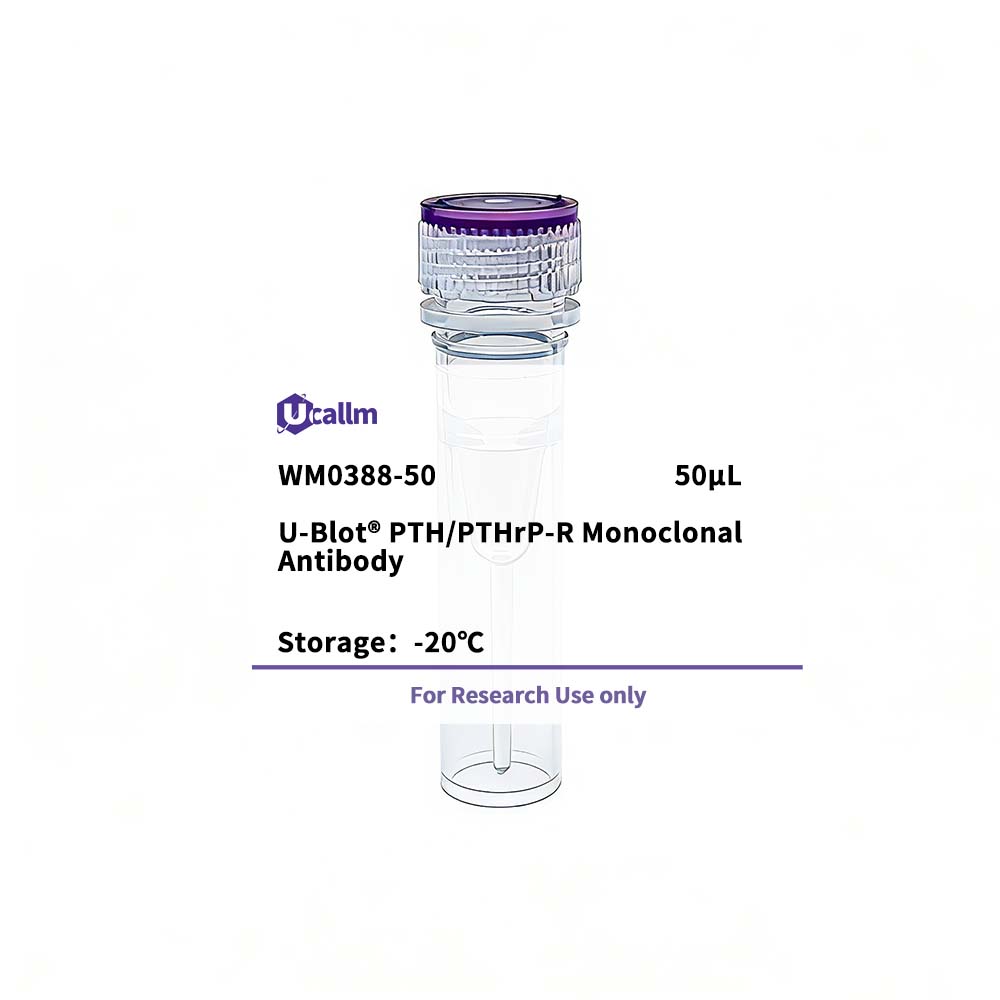
SKU: WM0388 Categories: ,

PTH/PTHrP-R Monoclonal Antibody

Price range: $268.00 through $328.00

SKU: WM0388-50
Enter the quantity you would like, or drag the panel to find the quantity and price that best for you
Bulk QuoteAuthorize OEM & ODM

Product details

Background:
The protein encoded by this gene is a member of the G-protein coupled receptor family 2. This protein is a receptor for parathyroid hormone (PTH) and for parathyroid hormone-like hormone (PTHLH). The activity of this receptor is mediated by G proteins which activate adenylyl cyclase and also a phosphatidylinositol-calcium second messenger system. Defects in this receptor are known to be the cause of Jansen's metaphyseal chondrodysplasia (JMC), chondrodysplasia Blomstrand type (BOCD), as well as enchodromatosis. Two transcript variants encoding the same protein have been found for this gene. [provided by RefSeq, May 2010],

Specifications

Size50μL/100μL
TargetPTH/PTHrP-R
ReactivityHuman
ApplicationsWB, IHC, IF, ELISA
MW(Calculated)66kD
MW(Observed)
Host SpeciesMouse
Isotype
Conjugate/ModificationUnmodified
Recommended Dilution RatioWB 1:500-1:2000; IHC 1:200-1:1000; IF 1:200-1:1000; ELISA 1:10000; Not yet tested in other applications. / Note: For IHC, we suggest antigen retrieval with TE buffer pH 9.0 (Cat#WT1004)
FormulationLiquid in PBS containing 50% glycerol, 0.5% BSA and 0.02% sodium azide.
PurificationAffinity purification
Storage-15°C to -25°C/1 year(Do not lower than -25°C)
Concentration
ClonalityMonoclonal
Clone Number15B4
ImmunogenPurified recombinant fragment of human PTH/PTHrP-R expressed in E. Coli.
SpecificityPTH/PTHrP-R Monoclonal Antibody detects endogenous levels of PTH/PTHrP-R protein.
Gene NamePTH1R PTHR PTHR1
Protein NameParathyroid hormone/parathyroid hormone-related peptide receptor
Other NamePTH1R; / PTHR; / PTHR1; / Parathyroid hormone/parathyroid hormone-related peptide receptor; / PTH/PTHrP type I receptor; / PTH/PTHr receptor; / Parathyroid hormone 1 receptor; / PTH1 receptor
SpeciesHuman
Gene ID5745
UniprotQ03431,
Species.1Mouse
Gene ID.119228
Uniprot.1P41593
Species.2
Gene ID.2
Uniprot.2
Cellular LocalizationCell membrane; Multi-pass membrane protein .
Tissue ExpressionExpressed in most tissues. Most abundant in kidney, bone and liver.
Signaling_pathway
Research Areas>>Neuroactive ligand-receptor interaction; / >>Parathyroid hormone synthesis, secretion and action; / >>Endocrine and other factor-regulated calcium reabsorption
FunctionDisease:Defects in PTH1R are a cause of primary failure of tooth eruption (PFE) [MIM:125350]. PFE is a rare condition that has high penetrance and variable expressivity and in which tooth retention occurs without evidence of any obvious mechanical interference. Instead, malfunction of the eruptive mechanism itself appears to cause nonankylosed permanent teeth to fail to erupt, although the eruption pathway has been cleared by bone resorption.,Disease:Defects in PTH1R are the cause of chondrodysplasia Blomstrand type (BOCD) [MIM:215045]. BOCD is a severe skeletal dysplasia.,Disease:Defects in PTH1R are the cause of Eiken syndrome [MIM:600002]; also called Eiken skeletal dysplasia or bone modeling defect of hands and feet. Eiken syndrome is a rare familial autosomal recessive skeletal dysplasia. It is characterized by multiple epiphyseal dysplasia, with extremely retarded ossification, principally of the epiphyses, pelvis, hands and feet, as well as by abnormal modeling of the bones in hands and feet, abnormal persistence of cartilage in the pelvis and mild growth retardation.,Disease:Defects in PTH1R are the cause of Jansen metaphyseal chondrodysplasia (JMC) [MIM:156400]. JMC is a rare autosomal dominant disorder characterized by a short-limbed dwarfism associated with hypercalcemia and normal or low serum concentrations of the two parathyroid hormones.,Disease:Defects in PTH1R may be a cause of enchondromatosis [MIM:166000]. Enchondromas are common benign cartilage tumors of bone. They can occur as solitary lesions or as multiple lesions in enchondromatosis (Ollier and Maffucci diseases). Clinical problems caused by enchondromas include skeletal deformity and the potential for malignant change to osteosarcoma.,Function:This is a receptor for parathyroid hormone and for parathyroid hormone-related peptide. The activity of this receptor is mediated by G proteins which activate adenylyl cyclase and also a phosphatidylinositol-calcium second messenger system.,similarity:Belongs to the G-protein coupled receptor 2 family.,tissue specificity:Expressed in most tissues. Most abundant in kidney, bone and liver.,
Please login to post questions
Back to Top
Product has been added to your cart