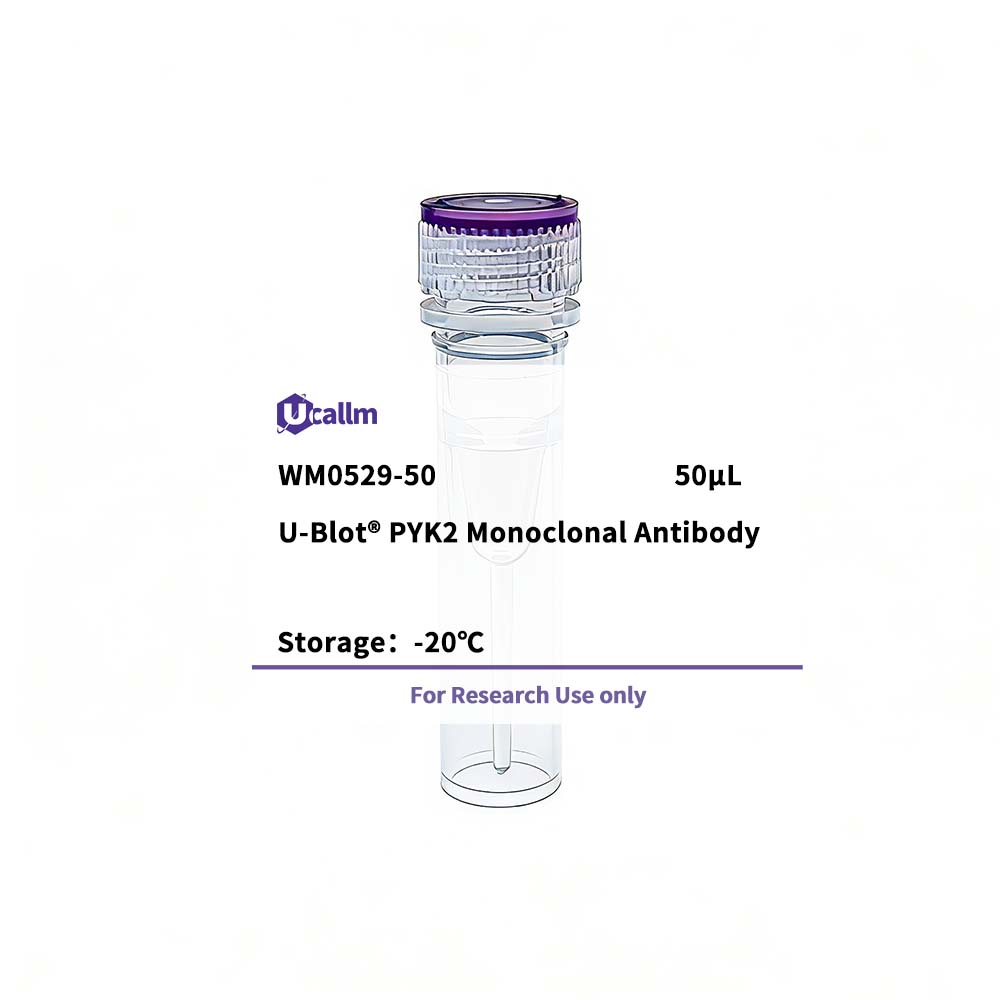
SKU: WM0529 Categories: ,

PYK2 Monoclonal Antibody

Price range: $268.00 through $328.00

SKU: WM0529-50
Enter the quantity you would like, or drag the panel to find the quantity and price that best for you
Bulk QuoteAuthorize OEM & ODM

Product details

Background:
This gene encodes a cytoplasmic protein tyrosine kinase which is involved in calcium-induced regulation of ion channels and activation of the map kinase signaling pathway. The encoded protein may represent an important signaling intermediate between neuropeptide-activated receptors or neurotransmitters that increase calcium flux and the downstream signals that regulate neuronal activity. The encoded protein undergoes rapid tyrosine phosphorylation and activation in response to increases in the intracellular calcium concentration, nicotinic acetylcholine receptor activation, membrane depolarization, or protein kinase C activation. This protein has been shown to bind CRK-associated substrate, nephrocystin, GTPase regulator associated with FAK, and the SH2 domain of GRB2. The encoded protein is a member of the FAK subfamily of protein tyrosine kinases but lacks significant sequence similarity t

Specifications

Size50μL/100μL
TargetPYK2
ReactivityHuman, Mouse, Dog, Pig
ApplicationsWB
MW(Calculated)116kD
MW(Observed)
Host SpeciesMouse
Isotype
Conjugate/ModificationUnmodified
Recommended Dilution RatioWB 1:1000-1:2000; Not yet tested in other applications.
FormulationLiquid in PBS containing 50% glycerol, 0.5% BSA and 0.02% sodium azide.
PurificationAffinity purification
Storage-15°C to -25°C/1 year(Do not lower than -25°C)
Concentration
ClonalityMonoclonal
Clone Number2C8
ImmunogenPurified recombinant human PYK2 protein fragments expressed in E.coli.
SpecificityPYK2 Monoclonal Antibody detects endogenous levels of PYK2 protein.
Gene NamePTK2B
Protein NameProtein-tyrosine kinase 2-beta
Other NamePTK2B; / FAK2; / PYK2; / RAFTK; / Protein-tyrosine kinase 2-beta; / Calcium-dependent tyrosine kinase; / CADTK; / Calcium-regulated non-receptor proline-rich tyrosine kinase; / Cell adhesion kinase beta; / CAK-beta; / CAKB; / Focal adhesion kinase 2; / FADK 2; / Pro
SpeciesHuman
Gene ID2185
UniprotQ14289,
Species.1Mouse
Gene ID.119229
Uniprot.1Q9QVP9,
Species.2Rat
Gene ID.250646
Uniprot.2P70600
Cellular LocalizationCytoplasm. Cytoplasm, perinuclear region. Cell membrane; Peripheral membrane protein; Cytoplasmic side. Cell junction, focal adhesion. Cell projection, lamellipodium. Cytoplasm, cell cortex. Nucleus. Interaction with NPHP1 induces the membrane-association of the kinase. Colocalizes with integrins at the cell periphery.
Tissue ExpressionMost abundant in the brain, with highest levels in amygdala and hippocampus. Low levels in kidney (at protein level). Also expressed in spleen and lymphocytes.
Signaling_pathwayOrganismal Systems >> Immune system >> Natural killer cell mediated cytotoxicity;Organismal Systems >> Immune system >> Leukocyte transendothelial migration;Organismal Systems >> Immune system >> Chemokine signaling pathway;Organismal Systems >> Endocrine system >> GnRH signaling pathway;Environmental Information Processing >> Signal transduction >> Calcium signaling pathway;Environmental Information Processing >> Signal transduction >> Phospholipase D signaling pathway
Research Areas>>Calcium signaling pathway; / >>Chemokine signaling pathway; / >>Phospholipase D signaling pathway; / >>Natural killer cell mediated cytotoxicity; / >>Leukocyte transendothelial migration; / >>GnRH signaling pathway; / >>Yersinia infection; / >>Hepatitis B; / >>Human cytomegalovirus infection; / >>Human immunodeficiency virus 1 infection
FunctionCatalytic activity:ATP + a [protein]-L-tyrosine = ADP + a [protein]-L-tyrosine phosphate.,Function:Involved in calcium induced regulation of ion channel and activation of the map kinase signaling pathway. May represent an important signaling intermediate between neuropeptide activated receptors or neurotransmitters that increase calcium flux and the downstream signals that regulate neuronal activity. Interacts with the SH2 domain of Grb2. May phosphorylate the voltage-gated potassium channel protein Kv1.2. Its activation is highly correlated with the stimulation of c-Jun N-terminal kinase activity. Involved in osmotic stress-dependent SNCA 'Tyr-125' phosphorylation.,PTM:Phosphorylated on tyrosine residues in response to various stimuli that elevate the intracellular calcium concentration, as well as by PKC activation. Recruitment by nephrocystin to cell matrix adhesions initiates Tyr-402 phosphorylation. In monocytes, adherence to substrata is required for tyrosine phosphorylation and kinase activation. Angiotensin II, thapsigargin and L-alpha-lysophosphatidic acid (LPA) also induce autophosphorylation and increase kinase activity.,similarity:Belongs to the protein kinase superfamily. Tyr protein kinase family.,similarity:Belongs to the protein kinase superfamily. Tyr protein kinase family. FAK subfamily.,similarity:Contains 1 FERM domain.,similarity:Contains 1 protein kinase domain.,subcellular location:Interaction with nephrocystin induces the membrane-association of the kinase.,subunit:Interacts with Crk-associated substrate (Cas), PTPNS1 and SH2D3C (By similarity). Interacts with nephrocystin, ASAP2, OPHN1L, SKAP2 and TGFB1I1.,tissue specificity:Most abundant in the brain, with highest levels in amygdala and hippocampus. Low levels in kidney. Also expressed in spleen and lymphocytes.,
Please login to post questions
Back to Top
Product has been added to your cart

