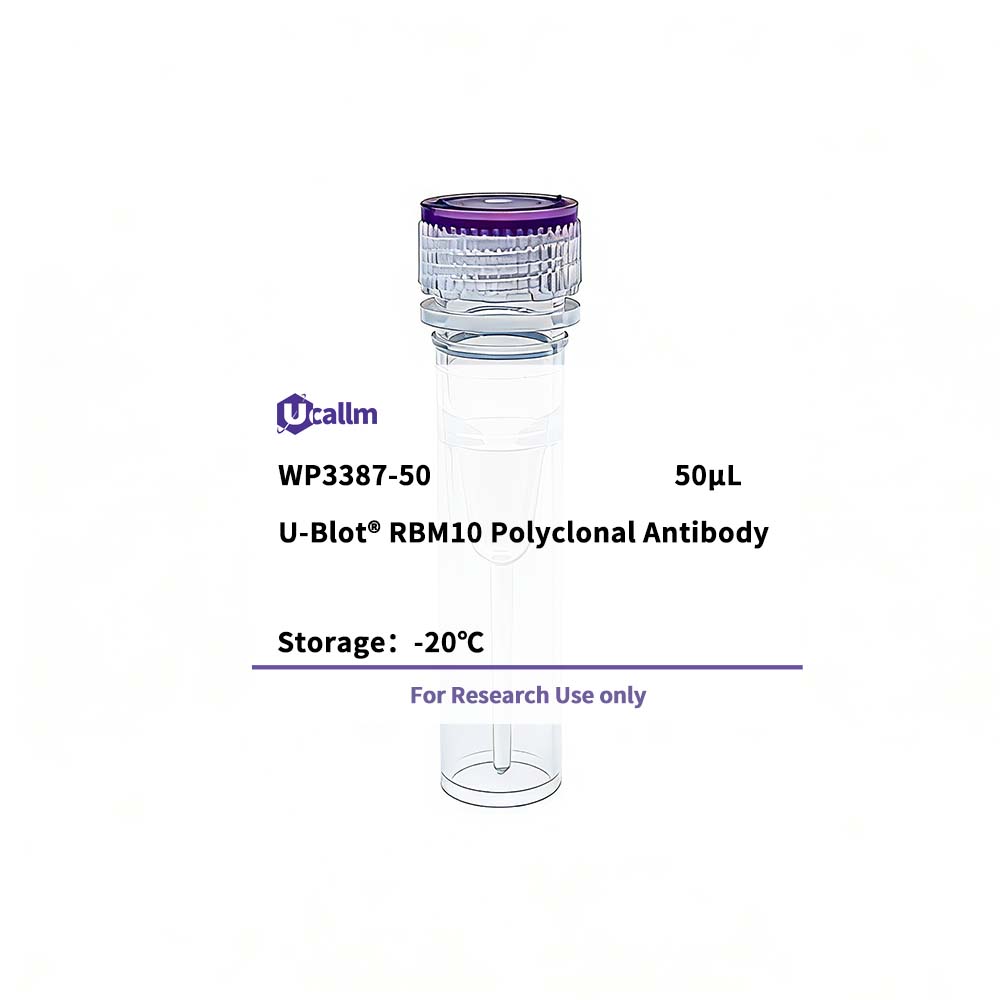
SKU: WP3387 Categories: ,

RBM10 Polyclonal Antibody

Price range: $268.00 through $328.00

SKU: WP3387-100
Enter the quantity you would like, or drag the panel to find the quantity and price that best for you
Bulk QuoteAuthorize OEM & ODM

Product details

Background:

This gene encodes a nuclear protein that belongs to a family proteins that contain an RNA-binding motif. The encoded protein associates with hnRNP proteins and may be involved in regulating alternative splicing. Defects in this gene are the cause of the X-linked recessive disorder, TARP syndrome. Alternate splicing results in multiple transcript variants.[provided by RefSeq, Mar 2011],

Specifications

Size50μL/100μL
TargetRBM10
ReactivityHuman, Mouse, Rat
ApplicationsWB, ELISA
MW(Calculated)
MW(Observed)102kD
Host SpeciesRabbit
IsotypeIgG
Conjugate/ModificationUnmodified
Recommended Dilution RatioWB 1:500-2000; ELISA 1:5000-20000
FormulationLiquid in PBS containing 50% glycerol,0.5% BSA and 0.02% sodium azide.
PurificationThe antibody was affinity-purified from rabbit antiserum by affinity-chromatography using epitope-specific immunogen.
Storage-15°C to -25°C/1 year(Do not lower than -25°C)
Concentration1 mg/ml
ClonalityPolyclonal
Clone Number
ImmunogenSynthesized peptide derived from part region of human protein
SpecificityRBM10 Polyclonal Antibody detects endogenous levels of protein.
Gene NameRBM10 DXS8237E GPATC9 GPATCH9 KIAA0122
Protein NameRNA-binding protein 10 (G patch domain-containing protein 9) (RNA-binding motif protein 10) (RNA-binding protein S1-1) (S1-1)
Other Name
SpeciesHuman
Gene ID8241
UniprotP98175,
Species.1Mouse
Gene ID.1
Uniprot.1Q99KG3,
Species.2Rat
Gene ID.2
Uniprot.2P70501
Cellular LocalizationNucleus . In the extranucleolar nucleoplasm constitutes hundreds of nuclear domains, which dynamically change their structures in a reversible manner. Upon globally reducing RNA polymerase II transcription, the nuclear bodies enlarge and decrease in number. They occur closely adjacent to nuclear speckles or IGCs (interchromatin granule clusters) but coincide with TIDRs (transcription-inactivation-dependent RNA domains).
Tissue ExpressionBone marrow,Brain,Colon,Epithelium,Fetal brain,Human endometrium,Liver,Lung
Signaling_pathway
Research Areas
FunctionFunction:May be involved in post-transcriptional processing, most probably in mRNA splicing. Binds to RNA homopolymers, with a preference for poly(G) and poly(U) and little for poly(A).,PTM:Phosphorylated upon DNA damage, probably by ATM or ATR.,sequence Caution:Translation N-terminally extended.,similarity:Contains 1 C2H2-type zinc finger.,similarity:Contains 1 G-patch domain.,similarity:Contains 1 RanBP2-type zinc finger.,similarity:Contains 2 RRM (RNA recognition motif) domains.,subcellular location:In the extranucleolar nucleoplasm constitutes hundreds of nuclear domains, which dynamically change their structures in a reversible manner. Upon globally reducing RNA polymerase II transcription, the nuclear bodies enlarge and decrease in number. They occur closely adjacent to nuclear speckles or IGCs (interchromatin granule clusters) but coincide with TIDRs (transcription-inactivation-dependent RNA domains).,subunit:Associates with the spliceosome. Component of a large chromatin remodeling complex, at least composed of MYSM1, PCAF, RBM10 and KIF11/TRIP5.,
Please login to post questions
Back to Top
Product has been added to your cart

