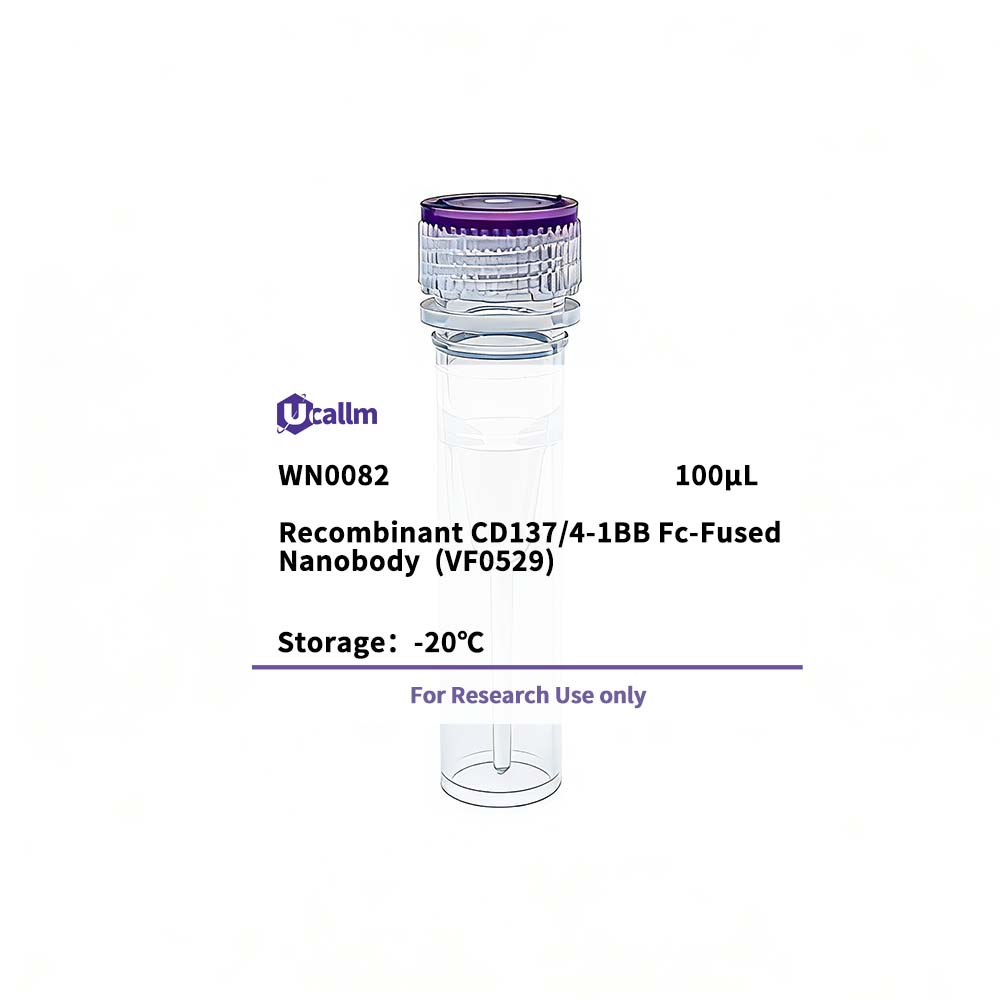
SKU: WN0082 Categories: ,

Recombinant CD137/4-1BB Fc-Fused Nanobody (VF0529)

$365.00

SKU: WN0082
Enter the quantity you would like, or drag the panel to find the quantity and price that best for you
Bulk QuoteAuthorize OEM & ODM

Product details

Background:The protein encoded byThis gene is a member of the TNF-receptor superfamily.This receptor contributes to the clonal expansion, survival, and development of T cells. It can also induce proliferation in peripheral monocytes, enhance T cell apoptosis induced by TCR/CD3 triggered activation, and regulate CD28 co-stimulation to promote Th1 cell responses. The expression ofThis receptor is induced by lymphocyte activation. TRAF adaptor proteins have been shown to bind toThis receptor and transduce the signals leading to activation of NF-kappaB. [provided by RefSeq, Jul 2008]

Specifications

Size100μL
TargetCD137
ReactivityHuman
ApplicationsELISA
MW(Calculated)
MW(Observed)
Host Species
IsotypeIgG2a,Kappa
Conjugate/ModificationUnmodified
Recommended Dilution RatioELISA 1:5000-100000
FormulationPhosphate-buffered solution
PurificationRecombinant Expression and Affinity purified
Storage-15°C to -25°C/1 year(Avoid freeze / thaw cycles)
ConcentrationPlease check the information on the tube
Clonality
Clone NumberVF0366
ImmunogenPurified recombinant Human CD137
SpecificityThis recombinant monoclonal antibody can detects endogenous levels of CD137/4-1BB protein.
Gene NameTNFRSF9 CD137 ILA
Protein NameTumor necrosis factor receptor superfamily member 9 (4-1BB ligand receptor) (CDw137) (T-cell antigen 4-1BB homolog) (T-cell antigen ILA) (CD antigen CD137)
Other NameTNFRSF9; / CD137; / ILA; / Tumor necrosis factor receptor superfamily member 9; / 4-1BB ligand receptor; / CDw137; / T-cell antigen 4-1BB homolog; / T-cell antigen ILA; / CD antigen CD137
SpeciesHuman
Gene ID3604
UniprotQ07011
Species.1
Gene ID.1
Uniprot.1
Species.2
Gene ID.2
Uniprot.2
Cellular LocalizationMembrane; Single-pass type I membrane protein.
Tissue ExpressionHighly expressed in the heart, skeletal muscle, placenta and lung. Weakly expressed in the thymus, spleen, kidney and liver. Expressed on activated T- and B-cells, dendritic cells, keratinocytes and monocytes.
Signaling_pathwayEnvironmental Information Processing >> Signaling molecules and interaction >> Cytokine-cytokine receptor interaction
Research Areas
FunctionReceptor for TNFSF14/4-1BBL. Possibly active during T cell activation.,similarity:Contains 4 TNFR-Cys repeats.,subunit:Interacts with TRAF1, TRAF2 and TRAF3. Interacts with LRR-repeat protein 1/LRR-1.,tissue specificity:Expressed on the surface of activated T-cells.,
Please login to post questions
Back to Top
Product has been added to your cart


