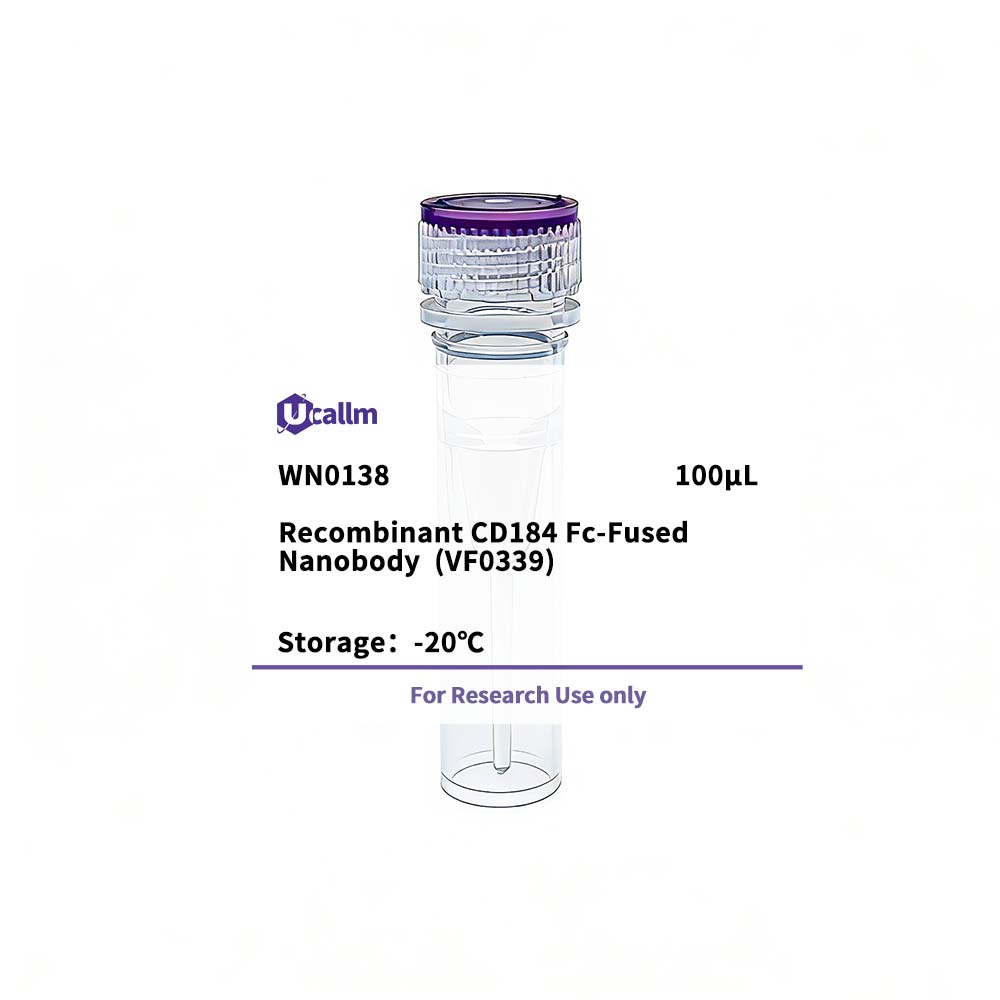
SKU: WN0138 Categories: ,

Recombinant CD184 Fc-Fused Nanobody (VF0339)

$365.00

SKU: WN0138
Enter the quantity you would like, or drag the panel to find the quantity and price that best for you
Bulk QuoteAuthorize OEM & ODM

Product details

Background:CD184, also known as fusin or CXCR4, is a 45 kD seven transmembrane G-protein-linked CXC chemokine receptor. CD184 is widely expressed on blood and tissue cells, including B and T cells, monocytes, macrophages, dendritic cells, granulocytes, megakaryocytes/platelets, lymphoid, myeloid precursor cells, endothelial cells, epithelial cells, astrocytes, and neurons, among other tissue cells. CD184 is the receptor for CXC chemokine SDF-1, mediates blood cell migration, and is involved in B lymphopoiesis and myelopoiesis, cardiogenesis, blood vessel formation, and cerebellar development. CXCR4 is also a coreceptor of X4 HIV-1 and an alternative receptor for some isolates of HIV-2.

Specifications

Size100μL
TargetCD184
ReactivityHuman
ApplicationsELISA
MW(Calculated)
MW(Observed)
Host Species
IsotypeIgG2a,Kappa
Conjugate/ModificationUnmodified
Recommended Dilution RatioELISA 1:5000-100000
FormulationPhosphate-buffered solution
PurificationRecombinant Expression and Affinity purified
Storage-15°C to -25°C/1 year(Avoid freeze / thaw cycles)
ConcentrationPlease check the information on the tube
Clonality
Clone NumberVF0324
ImmunogenPurified recombinant Human CD184
SpecificityThis recombinant monoclonal antibody can detects endogenous levels of CD184 protein.
Gene NameCXCR4
Protein NameC-X-C chemokine receptor type 4 (CXC-R4) (CXCR-4) (FB22) (Fusin) (HM89) (LCR1) (Leukocyte-derived seven transmembrane domain receptor) (LESTR) (Lipopolysaccharide-associated protein 3) (LAP-3) (LPS-associated protein 3) (NPYRL) (Stromal cell-derived factor 1 receptor) (SDF-1 receptor) (CD antigen CD184)
Other NameCXCR4; / FB22; / HM89; / LAP3; / LCR1; / NPYR; / WHIM; / CD184; / LAP-3; / LESTR; / NPY3R; / NPYRL; / WHIMS; / HSY3RR; / NPYY3R; / WHIMS1; / D2S201E; / C-X-C chemokine receptor type 4 antibody; / CD184 antibody; / CD184 antigen antibody; / Chemokine; / C X C motif; / receptor 4 antibody; / Chemokine CXC Motif Receptor 4 antibody; / CXC-R4 antibody; / CXCR-4 antibody; / CXCR4 antibody; / CXCR4_HUMAN antibody; / D2S201E antibody; / FB22 antibody; / Fusin antibody; / HM89 antibody; / HSY3RR antibody; / LAP 3 antibody; / LAP3 antibody; / LCR1 antibody; / LESTR antibody; / Leukocyte derived seven transmembrane domain receptor antibody; / Leukocyte-derived seven transmembrane domain receptor antibody; / Lipopolysaccharide associated protein 3 antibody; / Neuropeptide Y receptor Y3 antibody; / NPY3R antibody; / NPYR antibody; / NPYRL antibody; / NPYY3 antibody; / NPYY3R antibody; / Probable G protein coupled receptor lcr1 homolog antibody; / SDF 1 receptor antibody; / SDF-1 receptor antibody; / SEVEN-TRANSMEMBRANE-SEGMENT RECEPTOR antibody; / Stromal cell derived factor 1 receptor antibody; / Stromal cell-derived factor 1 receptor antibody; / WHIM antibody; / WHIMS antibody
SpeciesHuman
Gene ID7852
UniprotP61073
Species.1
Gene ID.1
Uniprot.1
Species.2
Gene ID.2
Uniprot.2
Cellular LocalizationCell membrane; Multi-pass membrane protein . Cell junction. Early endosome. Late endosome. Lysosome. In unstimulated cells, diffuse pattern on plasma membrane. On agonist stimulation, colocalizes with ITCH at the plasma membrane where it becomes ubiquitinated. In the presence of antigen, distributes to the immunological synapse forming at the T-cell-APC contact area, where it localizes at the peripheral and distal supramolecular activation cluster (SMAC).
Tissue ExpressionExpressed specifically in lymphatic vessels but not in blood vessels in the skin, small intestine, esophagus, ovary, breast and prostate glands. Not detected in lymphatic vessels in the lung, kidney, uterus, liver and stomach (at protein level). Expressed in the poorly differentiated crypt cells of the small intestine as well as in the mature villous cells. Expressed at very low levels in the colon.
Signaling_pathwayCellular Processes >> Cell motility >> Regulation of actin cytoskeleton;Organismal Systems >> Immune system >> Leukocyte transendothelial migration;Organismal Systems >> Immune system >> Intestinal immune network for IgA production;Organismal Systems >> Immune system >> Chemokine signaling pathway;Human Diseases >> Cancer: overview >> Pathways in cancer;Environmental Information Processing >> Signal transduction >> Calcium signaling pathway;Environmental Information Processing >> Signaling molecules and interaction >> Cytokine-cytokine receptor interaction;Environmental Information Processing >> Signaling molecules and interaction >> Viral protein interaction with cytokine and cytokine receptor
Research Areas
FunctionReceptor for the C-X-C chemokine CXCL12/SDF-1 that transduces a signal by increasing intracellular calcium ions levels and enhancing MAPK1/MAPK3 activation. Acts as a receptor for extracellular ubiquitin; leading to enhance intracellular calcium ions and reduce cellular cAMP levels. Involved in haematopoiesis and in cardiac ventricular septum formation. Plays also an essential role in vascularization of the gastrointestinal tract, probably by regulating vascular branching and/or remodeling processes in endothelial cells. Could be involved in cerebellar development. In the CNS, could mediate hippocampal-neuron survival. Acts as a coreceptor (CD4 being the primary receptor) for HIV-1 X4 isolates and as a primary receptor for some HIV-2 isolates. Promotes Env-mediated fusion of the virus.
Please login to post questions
Back to Top
Product has been added to your cart
