


Recombinant CD54 Fc-Fused Nanobody (VF0343)
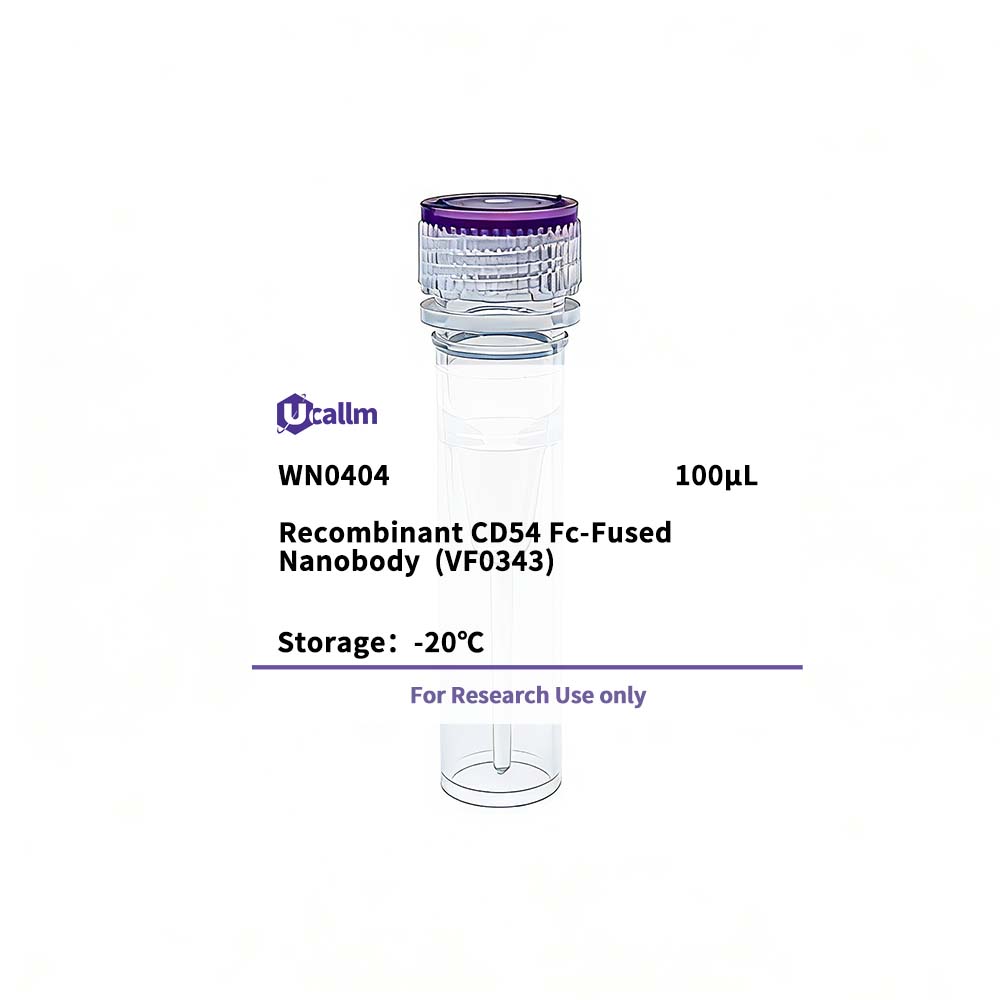
Ucallm_WN0404
$365.00
Product details
Background:This gene encodes a cell surface glycoprotein which is typically expressed on endothelial cells and cells of the immune system. It binds to integrins of type CD11a / CD18, or CD11b / CD18 and is also exploited by Rhinovirus as a receptor. [provided by RefSeq, Jul 2008]
Specifications
| Size | 100μL |
| Target | CD54 |
| Reactivity | Human |
| Applications | ELISA, FC |
| MW(Calculated) | |
| MW(Observed) | |
| Host Species | |
| Isotype | IgG2a,Kappa |
| Conjugate/Modification | Unmodified |
| Recommended Dilution Ratio | ELISA 1:5000-100000 |
| Formulation | Phosphate-buffered solution |
| Purification | Recombinant Expression and Affinity purified |
| Storage | -15°C to -25°C/1 year(Avoid freeze / thaw cycles) |
| Concentration | Please check the information on the tube |
| Clonality | |
| Clone Number | VF0292 |
| Immunogen | Purified recombinant Human CD54 |
| Specificity | This recombinant monoclonal antibody can detects endogenous levels of CD54 protein. |
| Gene Name | ICAM1 |
| Protein Name | Intercellular adhesion molecule 1 (ICAM-1) (Major group rhinovirus receptor) (CD antigen CD54) |
| Other Name | Antigen identified by monoclonal antibody BB2 antibody; / BB 2 antibody; / BB2 antibody; / CD 54 antibody; / CD_antigen=CD54 antibody; / CD54 antibody; / Cell surface glycoprotein P3.58 antibody; / Human rhinovirus receptor antibody; / ICAM 1 antibody; / ICAM-1 antibody; / ICAM1 antibody; / ICAM1_HUMAN antibody; / intercellular adhesion molecule 1; / CD54; / antibody; / intercellular adhesion molecule 1; / CD54; / human rhinovirus receptor antibody; / Intercellular adhesion molecule 1 antibody; / Major group rhinovirus receptor antibody; / MALA 2 antibody; / MALA2 antibody; / MyD 10 antibody; / MyD10 antibody; / P3.58 antibody; / Surface antigen of activated B cells antibody; / Surface antigen of activated B cells; / BB2 antibody; / CD54 nanobody |
| Species | Human |
| Gene ID | 3383 |
| Uniprot | P05362 |
| Species.1 | |
| Gene ID.1 | |
| Uniprot.1 | |
| Species.2 | |
| Gene ID.2 | |
| Uniprot.2 | |
| Cellular Localization | Membrane; Single-pass type I membrane protein. |
| Tissue Expression | Expressed specifically in lymphatic vessels but not in blood vessels in the skin, small intestine, esophagus, ovary, breast and prostate glands. Not detected in lymphatic vessels in the lung, kidney, uterus, liver and stomach (at protein level). Expressed in the poorly differentiated crypt cells of the small intestine as well as in the mature villous cells. Expressed at very low levels in the colon. |
| Signaling_pathway | Organismal Systems >> Immune system >> Natural killer cell mediated cytotoxicity;Organismal Systems >> Immune system >> Leukocyte transendothelial migration;Human Diseases >> Immune disease >> Rheumatoid arthritis;Environmental Information Processing >> Signal transduction >> NF-kappa B signaling pathway;Environmental Information Processing >> Signal transduction >> TNF signaling pathway;Environmental Information Processing >> Signaling molecules and interaction >> Cell adhesion molecules |
| Research Areas | |
| Function | ICAM proteins are ligands for the leukocyte adhesion protein LFA-1 (integrin alpha-L/beta-2). During leukocyte trans-endothelial migration, ICAM1 engagement promotes the assembly of endothelial apical cups through SGEF and RHOG activation. In case of rhinovirus infection acts as a cellular receptor for the virus.,online information:ICAM-1,online information:Icosahedral capsid structure,online information:Intercellular adhesion molecule entry,polymorphism:Homozygotes with ICAM1-Kalifi Met-56 seem to have an increased risk for cerebral malaria.,PTM:Monoubiquitinated, which is promoted by MARCH9 and leads to endocytosis.,similarity:Belongs to the immunoglobulin superfamily. ICAM family.,similarity:Contains 5 Ig-like C2-type (immunoglobulin-like) domains.,subunit:Homodimer (Probable). Interacts with human herpesvirus 8 MIR2 protein (Probable). Interacts with MUC1 and promotes cell aggregation in epithelial cells. Interacts with SGEF. Binds to coxsackievirus A21 capsid proteins and acts as a receptor for this virus., |
Please login to post questions
Related products



