

RNF26 rabbit pAb
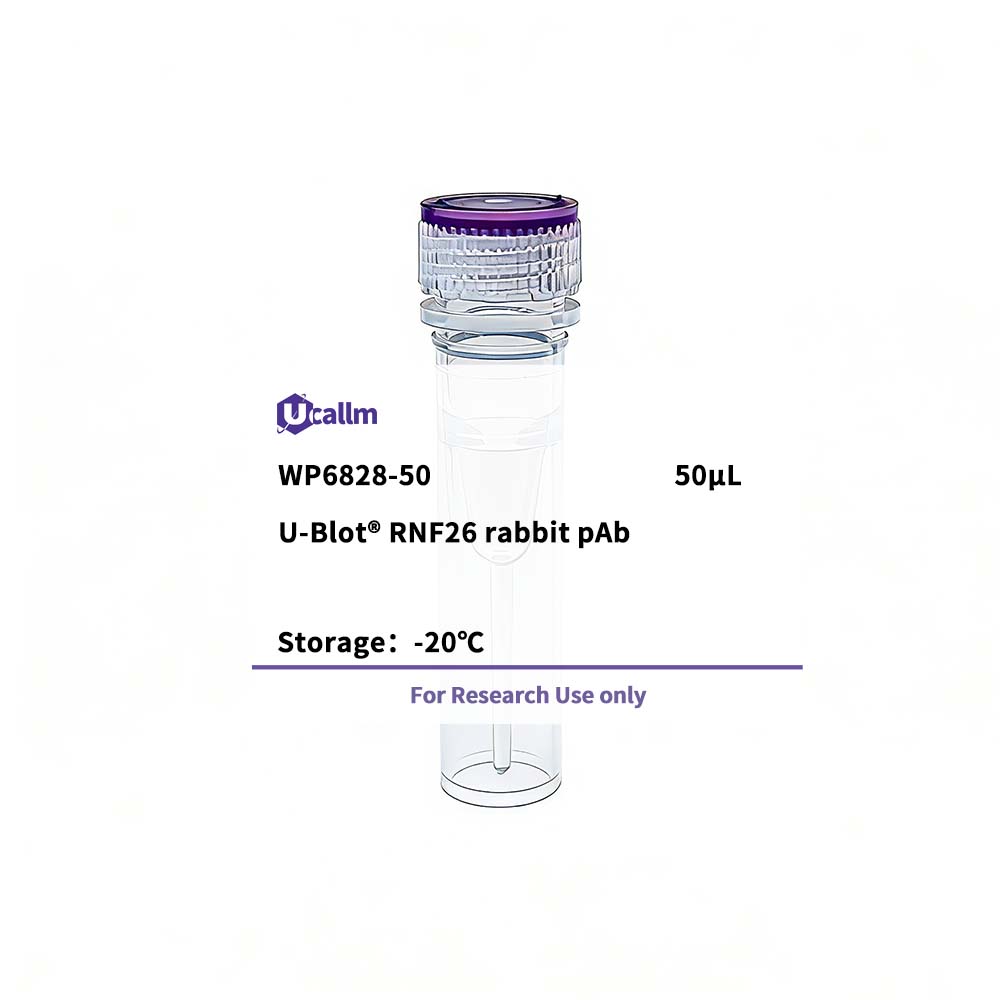
Ucallm_WP6828-50
Price range: $268.00 through $328.00
Product details
Background:
Specifications
| Size | 50μL/100μL |
| Target | RNF26 |
| Reactivity | Human, Mouse |
| Applications | WB |
| MW(Calculated) | 48kD |
| MW(Observed) | |
| Host Species | Rabbit |
| Isotype | IgG |
| Conjugate/Modification | Unmodified |
| Recommended Dilution Ratio | WB 1:500-2000 |
| Formulation | Liquid in PBS containing 50% glycerol, 0.5% BSA and 0.02% sodium azide. |
| Purification | The antibody was affinity-purified from rabbit antiserum by affinity-chromatography using epitope-specific immunogen. |
| Storage | -15°C to -25°C/1 year(Do not lower than -25°C) |
| Concentration | 1 mg/ml |
| Clonality | Polyclonal |
| Clone Number | |
| Immunogen | Synthesized peptide derived from human RNF26 |
| Specificity | This antibody detects endogenous levels of RNF26 at Human, Mouse |
| Gene Name | RNF26 |
| Protein Name | RING finger protein 26 |
| Other Name | |
| Species | Human |
| Gene ID | 79102 |
| Uniprot | Q9BY78, |
| Species.1 | Mouse |
| Gene ID.1 | 213211 |
| Uniprot.1 | Q8BUH7 |
| Species.2 | |
| Gene ID.2 | |
| Uniprot.2 | |
| Cellular Localization | Endoplasmic reticulum membrane; Multi-pass membrane protein . |
| Tissue Expression | Ubiquitous. Up-regulated in several cancer cell lines. |
| Signaling_pathway | |
| Research Areas | |
| Function | E3 ubiquitin-protein ligase that plays a key role in endosome organization by retaining vesicles in the perinuclear cloud . Acts as a platform for perinuclear positioning of the endosomal system by mediating ubiquitination of SQSTM1 through interaction with the ubiquitin conjugating enzyme UBE2J1 . Ubiquitinated SQSTM1 attracts specific vesicle-associated adapters, forming a molecular bridge that restrains cognate vesicles in the perinuclear region and organizes the endosomal pathway for efficient cargo transport . Also acts as a regulator of type I interferon production in response to viral infection by mediating the formation of 'Lys-11'-linked polyubiquitin chains on TMEM173/STING, leading to stabilize TMEM173/STING . Also required to limit type I interferon response by promoting autophagic degradation of IRF3 . |
Please login to post questions
Related products





