SKU: WM0410 Categories: ,

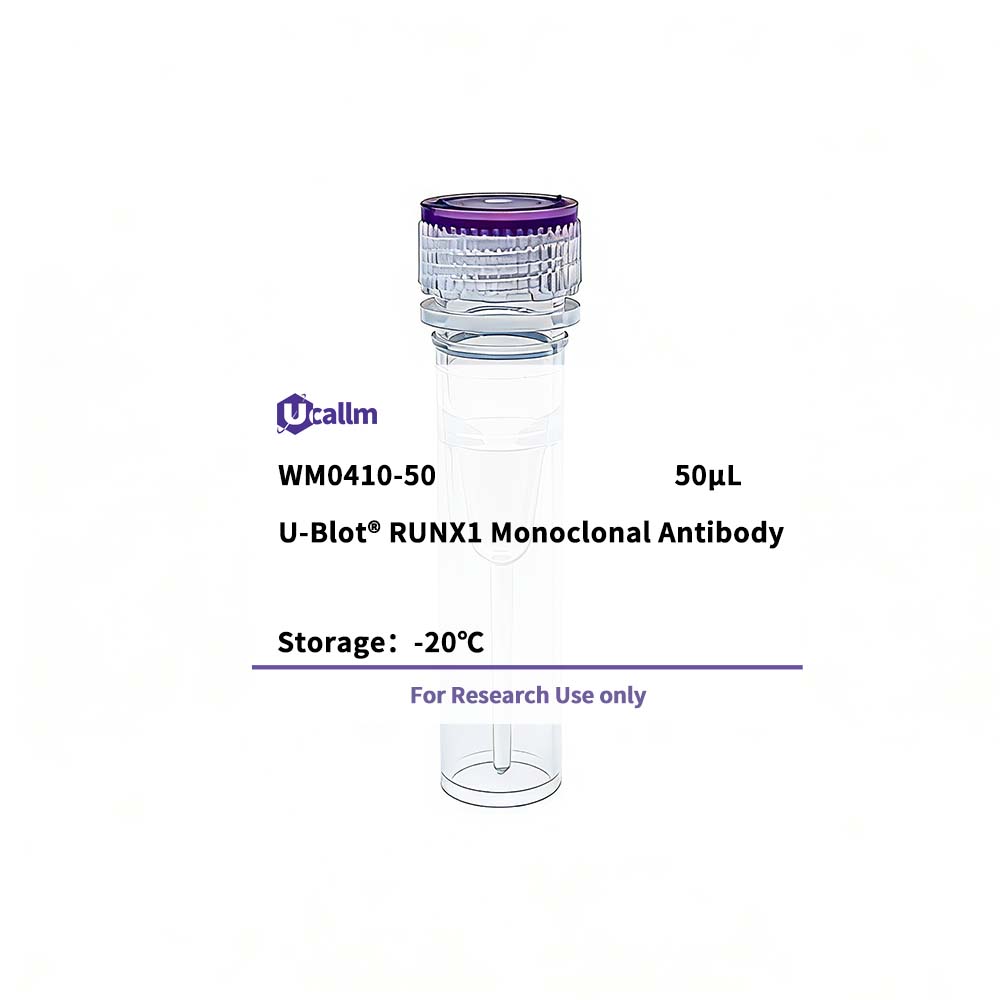
RUNX1 Monoclonal Antibody

Price range: $268.00 through $328.00

SKU: WM0410-50
Enter the quantity you would like, or drag the panel to find the quantity and price that best for you
Bulk QuoteAuthorize OEM & ODM

Product details

Background:
Core binding factor (CBF) is a heterodimeric transcription factor that binds to the core element of many enhancers and promoters. The protein encoded by this gene represents the alpha subunit of CBF and is thought to be involved in the development of normal hematopoiesis. Chromosomal translocations involving this gene are well-documented and have been associated with several types of leukemia. Three transcript variants encoding different isoforms have been found for this gene. [provided by RefSeq, Jul 2008],

Specifications

Size50μL/100μL
TargetRUNX1
ReactivityHuman
ApplicationsWB, IF, ELISA
MW(Calculated)49kD
MW(Observed)
Host SpeciesMouse
Isotype
Conjugate/ModificationUnmodified
Recommended Dilution RatioWB 1:500-1:2000; IF 1:200-1:1000; ELISA 1:10000; Not yet tested in other applications.
FormulationLiquid in PBS containing 50% glycerol, 0.5% BSA and 0.02% sodium azide.
PurificationAffinity purification
Storage-15°C to -25°C/1 year(Do not lower than -25°C)
Concentration
ClonalityMonoclonal
Clone Number19E7
ImmunogenSynthesized peptide of human RUNX1.
SpecificityRUNX1 Monoclonal Antibody detects endogenous levels of RUNX1 protein.
Gene NameRUNX1
Protein NameRunt-related transcription factor 1
Other NameRUNX1; / AML1; / CBFA2; / Runt-related transcription factor 1; / Acute myeloid leukemia 1 protein; / Core-binding factor subunit alpha-2; / CBF-alpha-2; / Oncogene AML-1; / Polyomavirus enhancer-binding protein 2 alpha B subunit; / PEA2-alpha B; / PEBP2-alpha
SpeciesHuman
Gene ID861
UniprotQ01196
Species.1
Gene ID.1
Uniprot.1
Species.2
Gene ID.2
Uniprot.2
Cellular LocalizationNucleus.
Tissue ExpressionExpressed in all tissues examined except brain and heart. Highest levels in thymus, bone marrow and peripheral blood.
Signaling_pathwayCellular Processes >> Cellular community - eukaryotes >> Tight junction;Organismal Systems >> Immune system >> Th17 cell differentiation;Human Diseases >> Cancer: overview >> Pathways in cancer;Human Diseases >> Cancer: overview >> Transcriptional misregulation in cancer;Human Diseases >> Cancer: specific types >> Acute myeloid leukemia;Human Diseases >> Cancer: specific types >> Chronic myeloid leukemia
Research Areas>>Tight junction; / >>Th17 cell differentiation; / >>Pathways in cancer; / >>Transcriptional misregulation in cancer; / >>Chronic myeloid leukemia; / >>Acute myeloid leukemia
FunctionAlternative products:Additional isoforms seem to exist,Caution:The fusion of AML1 with EAP in T-MDS induces a change of reading frame in the latter resulting in 17 AA unrelated to those of EAP.,Disease:A chromosomal aberration involving RUNX1/AML1 is a cause of chronic myelogenous leukemia (CML). Translocation t(3; 21)(q26; q22) with EAP, MSD1 or EVI1.,Disease:A chromosomal aberration involving RUNX1/AML1 is a cause of chronic myelomonocytic leukemia. Inversion inv(21)(q21; q22) with USP16.,Disease:A chromosomal aberration involving RUNX1/AML1 is a cause of M2 type acute myeloid leukemia (AML-M2). Translocation t(8; 21)(q22; q22) with RUNX1T1/MTG8/ETO.,Disease:A chromosomal aberration involving RUNX1/AML1 is a cause of therapy-related myelodysplastic syndrome (T-MDS). Translocation t(3; 21)(q26; q22) with EAP, MSD1 or EVI1.,Disease:A chromosomal aberration involving RUNX1/AML1 is found in childhood acute lymphoblastic leukemia (ALL). Translocation t(12; 21)(p13; q22) with TEL. The translocation fuses the 3'-end of TEL to the alternate 5'-exon of AML-1H.,Disease:A chromosomal aberration involving RUNX1/AML1 is found in therapy-related myeloid malignancies. Translocation t(16; 21)(q24; q22) that forms a RUNX1-CBFA2T3 fusion protein.,Disease:Defects in RUNX1 are the cause of familial platelet disorder with associated myeloid malignancy (FPDMM) [MIM:601399]. FPDMM is an autosomal dominant disease characterized by qualitative and quantitative platelet defects, and propensity to develop acute myelogenous leukemia.,Domain:A proline/serine/threonine rich region at the C-terminus is necessary for transcriptional activation of target genes.,Function:CBF binds to the core site, 5'-PYGPYGGT-3', of a number of enhancers and promoters, including murine leukemia virus, polyomavirus enhancer, T-cell receptor enhancers, LCK, IL-3 and GM-CSF promoters. The alpha subunit binds DNA and appears to have a role in the development of normal hematopoiesis. Isoform AML-1L interferes with the transactivation activity of RUNX1. Acts synergistically with ELF4 to transactivate the IL-3 promoter and with ELF2 to transactivate the mouse BLK promoter. Inhibits MYST4-dependent transcriptional activation.,PTM:Methylated.,PTM:Phosphorylated in its C-terminus upon IL-6 treatment. Phosphorylation enhances interaction with MYST3.,similarity:Contains 1 Runt domain.,subunit:Heterodimer with CBFB. RUNX1 binds DNA as a monomer and through the Runt domain. DNA-binding is increased by heterodimerization. Isoform AML-1L can neither bind DNA nor heterodimerize. Interacts with TLE1 and THOC4. Interacts with ELF1, ELF2 and SPI1. Interacts via its Runt domain with the ELF4 N-terminal region. Interaction with ELF2 isoform 2 (NERF-1a) may act to repress RUNX1-mediated transactivation. Interacts with MYST3 and MYST4. Interacts with SUV39H1, leading to abrogate the transactivating and DNA-binding properties of RUNX1.,tissue specificity:Expressed in all tissues examined except brain and heart. Highest levels in thymus, bone marrow and peripheral blood.,
Please login to post questions
Back to Top
Product has been added to your cart


