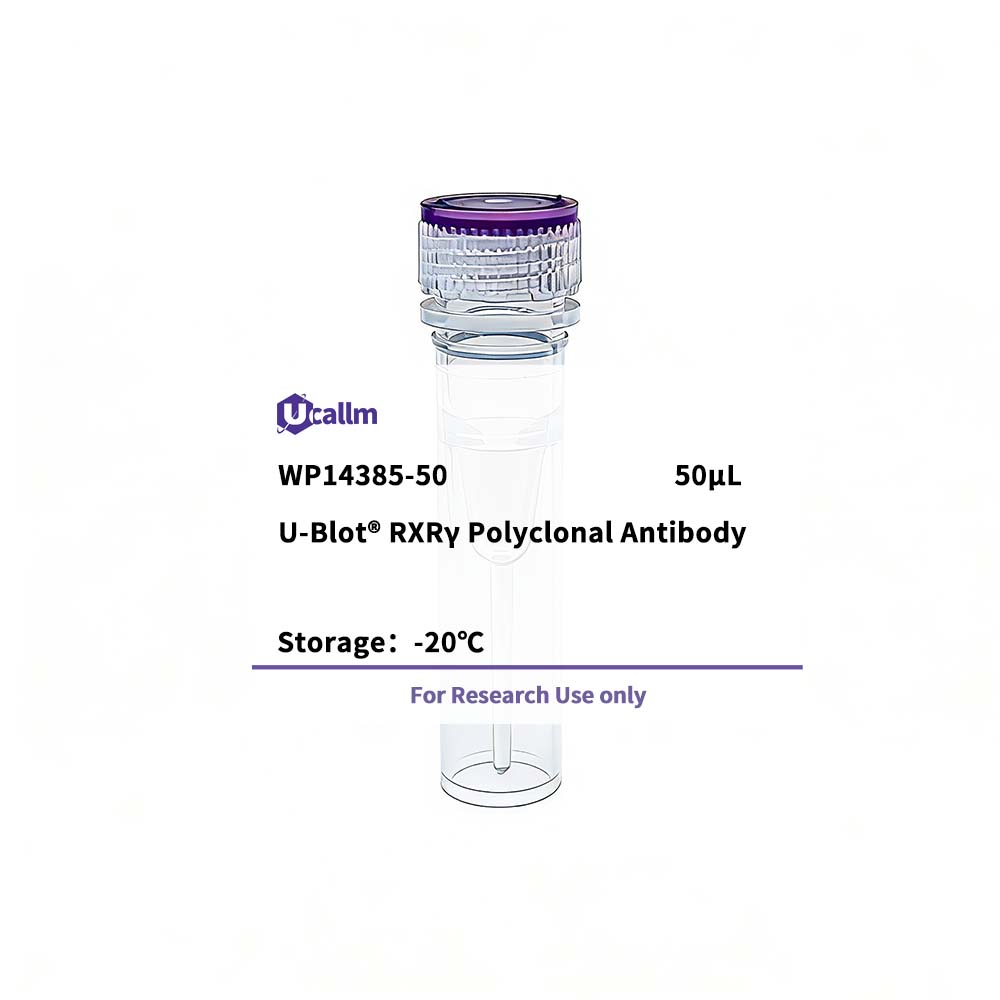
SKU: WP14385 Categories: ,

RXRγ Polyclonal Antibody

Price range: $268.00 through $328.00

SKU: WP14385-100
Enter the quantity you would like, or drag the panel to find the quantity and price that best for you
Bulk QuoteAuthorize OEM & ODM

Product details

Background:

retinoid X receptor gamma(RXRG) Homo sapiens This gene encodes a member of the retinoid X receptor (RXR) family of nuclear receptors which are involved in mediating the antiproliferative effects of retinoic acid (RA). This receptor forms dimers with the retinoic acid, thyroid hormone, and vitamin D receptors, increasing both DNA binding and transcriptional function on their respective response elements. This gene is expressed at significantly lower levels in non-small cell lung cancer cells. Alternatively spliced transcript variants have been described. [provided by RefSeq, Jun 2010],


Specifications

Size50μL/100μL
TargetRXRγ
ReactivityHuman, Mouse
ApplicationsWB, IHC, IF, ELISA
MW(Calculated)
MW(Observed)50kD
Host SpeciesRabbit
IsotypeIgG
Conjugate/ModificationUnmodified
Recommended Dilution RatioWB 1:500-1:2000; IHC 1:100-1:300; IF 1:200-1:1000; ELISA 1:10000; Not yet tested in other applications. / Note: For IHC, we suggest antigen retrieval with TE buffer pH 9.0 (Cat#WT1004)
FormulationLiquid in PBS containing 50% glycerol, 0.5% BSA and 0.02% sodium azide.
PurificationThe antibody was affinity-purified from rabbit antiserum by affinity-chromatography using epitope-specific immunogen.
Storage-15°C to -25°C/1 year(Do not lower than -25°C)
Concentration1 mg/ml
ClonalityPolyclonal
Clone Number
ImmunogenThe antiserum was produced against synthesized peptide derived from human Retinoid X Receptor gamma. AA range:171-220
SpecificityRXRγ Polyclonal Antibody detects endogenous levels of RXRγ protein.
Gene NameRXRG
Protein NameRetinoic acid receptor RXR-gamma
Other NameRXRG; / NR2B3; / Retinoic acid receptor RXR-gamma; / Nuclear receptor subfamily 2 group B member 3; / Retinoid X receptor gamma
SpeciesHuman
Gene ID6258
UniprotP48443,
Species.1Mouse
Gene ID.120183
Uniprot.1P28705
Species.2
Gene ID.2
Uniprot.2
Cellular LocalizationNucleus . Cytoplasm .
Tissue ExpressionExpressed in aortic endothelial cells (at protein level).
Signaling_pathwayOrganismal Systems >> Immune system >> Th17 cell differentiation;Organismal Systems >> Endocrine system >> Adipocytokine signaling pathway;Organismal Systems >> Endocrine system >> PPAR signaling pathway;Organismal Systems >> Endocrine system >> Thyroid hormone signaling pathway;Human Diseases >> Cancer: overview >> Pathways in cancer;Human Diseases >> Cancer: overview >> Transcriptional misregulation in cancer;Human Diseases >> Cancer: specific types >> Gastric cancer;Human Diseases >> Cancer: specific types >> Thyroid cancer;Human Diseases >> Cancer: specific types >> Small cell lung cancer;Human Diseases >> Cancer: specific types >> Non-small cell lung cancer
Research Areas>>PPAR signaling pathway; / >>Th17 cell differentiation; / >>Thyroid hormone signaling pathway; / >>Adipocytokine signaling pathway; / >>Parathyroid hormone synthesis, secretion and action; / >>Pathways in cancer; / >>Transcriptional misregulation in cancer; / >>Chemical carcinogenesis - receptor activation; / >>Thyroid cancer; / >>Small cell lung cancer; / >>Non-small cell lung cancer; / >>Gastric cancer; / >>Lipid and atherosclerosis
FunctionCaution:The sequence shown here is derived from an Ensembl automatic analysis pipeline and should be considered as preliminary data.,Domain:Composed of three domains: a modulating N-terminal domain, a DNA-binding domain and a C-terminal steroid-binding domain.,Function:Nuclear hormone receptor. Involved in the retinoic acid response pathway. Binds 9-cis retinoic acid (9C-RA).,similarity:Belongs to the nuclear hormone receptor family. NR2 subfamily.,similarity:Contains 1 nuclear receptor DNA-binding domain.,
Please login to post questions
Back to Top
Product has been added to your cart

