

S6A13 Polyclonal Antibody
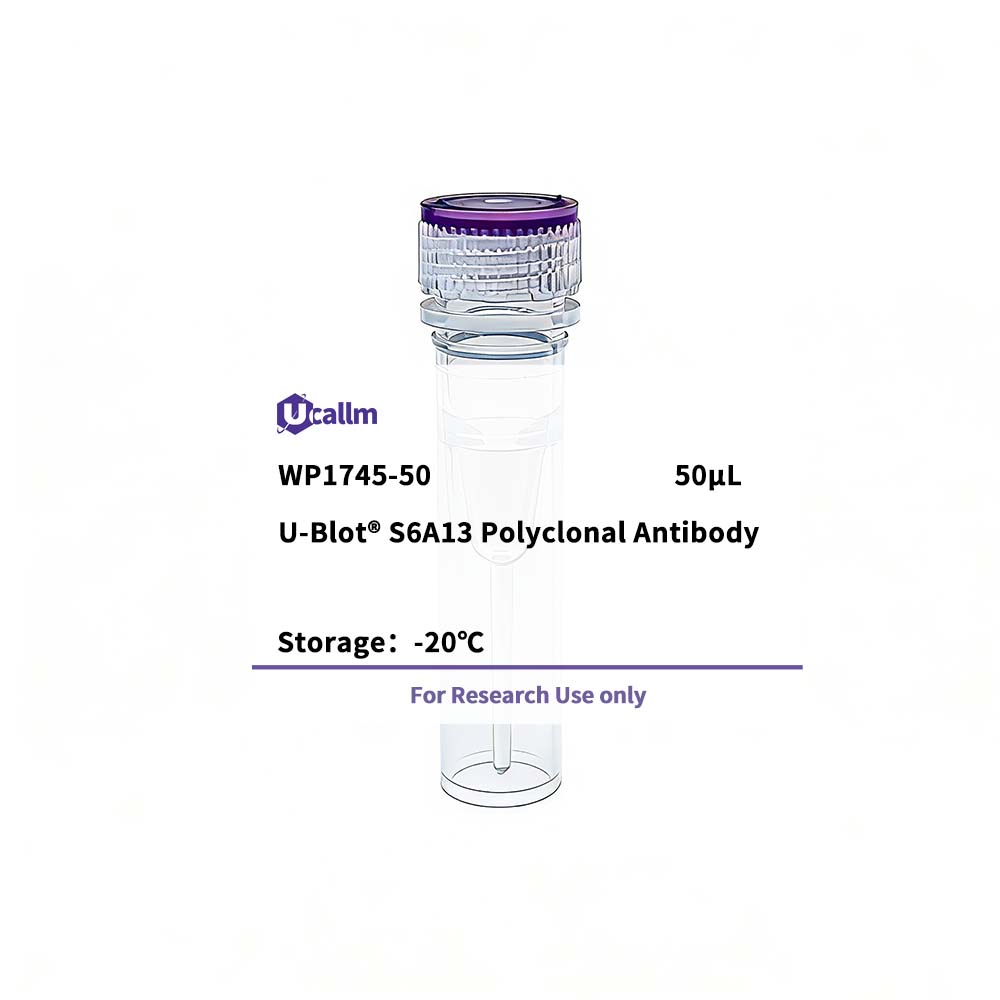
Ucallm_WP1745-50
Price range: $268.00 through $328.00
Product details
Background:
function:Terminates the action of GABA by its high affinity sodium-dependent reuptake into presynaptic terminals., similarity:Belongs to the sodium:neurotransmitter symporter (SNF) family., tissue specificity:Expressed in brain, kidney, lung, liver and testis.,
Specifications
| Size | 50μL/100μL |
| Target | S6A13 |
| Reactivity | Human, Mouse, Rat |
| Applications | WB, ELISA |
| MW(Calculated) | |
| MW(Observed) | 66kD |
| Host Species | Rabbit |
| Isotype | IgG |
| Conjugate/Modification | Unmodified |
| Recommended Dilution Ratio | WB 1:500-2000; ELISA 1:5000-20000 |
| Formulation | Liquid in PBS containing 50% glycerol,0.5% BSA and 0.02% sodium azide. |
| Purification | The antibody was affinity-purified from rabbit antiserum by affinity-chromatography using epitope-specific immunogen. |
| Storage | -15°C to -25°C/1 year(Do not lower than -25°C) |
| Concentration | 1 mg/ml |
| Clonality | Polyclonal |
| Clone Number | |
| Immunogen | Synthesized peptide derived from part region of human protein |
| Specificity | S6A13 Polyclonal Antibody detects endogenous levels of protein. |
| Gene Name | SLC6A13 GAT2 |
| Protein Name | Sodium- and chloride-dependent GABA transporter 2 (GAT-2) (Solute carrier family 6 member 13) |
| Other Name | |
| Species | Human |
| Gene ID | 6540 |
| Uniprot | Q9NSD5, |
| Species.1 | Mouse |
| Gene ID.1 | |
| Uniprot.1 | P31649, |
| Species.2 | Rat |
| Gene ID.2 | |
| Uniprot.2 | P31646 |
| Cellular Localization | Cell membrane; Multi-pass membrane protein . |
| Tissue Expression | Expressed in brain, kidney, lung, liver and testis. |
| Signaling_pathway | Organismal Systems >> Nervous system >> Synaptic vesicle cycle |
| Research Areas | >>Synaptic vesicle cycle; / >>GABAergic synapse |
| Function | Function:Terminates the action of GABA by its high affinity sodium-dependent reuptake into presynaptic terminals.,similarity:Belongs to the sodium:neurotransmitter symporter (SNF) family.,tissue specificity:Expressed in brain, kidney, lung, liver and testis., |
Please login to post questions
Related products





