SKU: WR4535 Categories: ,

U-Blot® SDHA Rabbit mAb

Price range: $268.00 through $328.00

SKU: WR4535-50
Enter the quantity you would like, or drag the panel to find the quantity and price that best for you
Bulk QuoteAuthorize OEM & ODM

Product details

Background:This gene encodes a major catalytic subunit of succinate-ubiquinone oxidoreductase, a complex of the mitochondrial respiratory chain. The complex is composed of four nuclear-encoded subunits and is localized in the mitochondrial inner membrane. Mutations in this gene have been associated with a form of mitochondrial respiratory chain deficiency known as Leigh Syndrome. A pseudogene has been identified on chromosome 3q29. Alternatively spliced transcript variants encoding different isoforms have been found for this gene. [provided by RefSeq, Jun 2014],


Specifications

Size50μL/100μL
TargetSDHA
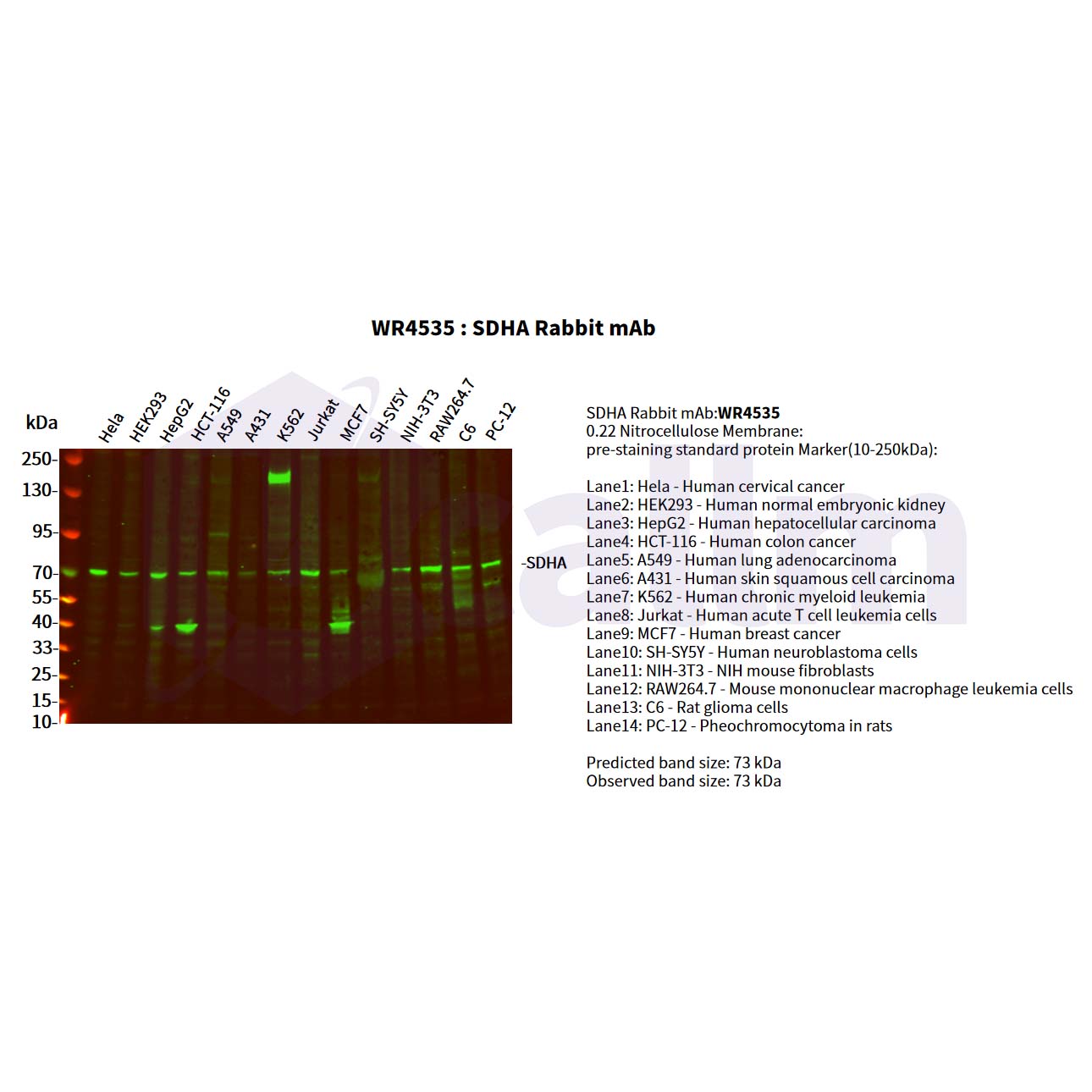
ReactivityHuman, Mouse, Rat
ApplicationsWB, IHC, IF, ELISA
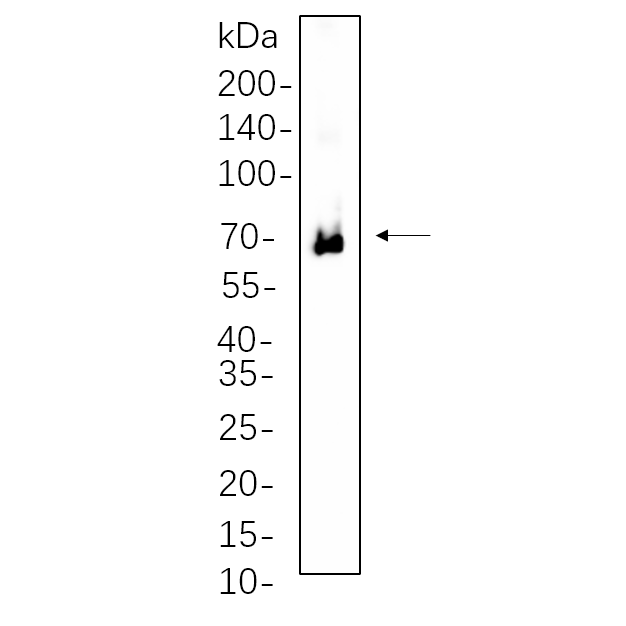
MW(Calculated)73kD
MW(Observed)73kD
Host SpeciesRabbit
IsotypeIgG,Kappa
Conjugate/ModificationUnmodified
Recommended Dilution RatioWB 1:2000-1:10000; IF 1:200-1:1000; ELISA 1:5000-1:20000;
FormulationPBS, 50% glycerol, 0.05% Proclin 300, 0.05%BSA
PurificationRecombinant Antibody expressed in animal component-free (ACF) media, purified via Protein A affinity chromatography.
Storage-15°C to -25°C/1 year(Do not lower than -25°C)
Concentration
ClonalityMonoclonal
Clone NumberRM0711R
ImmunogenThe specific immunogen used to produce this antibody is proprietary information.
SpecificityEndogenous
Gene NameSDHA
Protein NameSuccinate dehydrogenase [ubiquinone] flavoprotein subunit mitochondrial
Other NameSDHA; / SDH2; / SDHF; / Succinate dehydrogenase [ubiquinone] flavoprotein subunit; / mitochondrial; / Flavoprotein subunit of complex II; / Fp
SpeciesHuman
Gene ID7535;6850
UniprotP31040,
Species.1Mouse
Gene ID.166945
Uniprot.1Q8K2B3
Species.2
Gene ID.2
Uniprot.2
Cellular LocalizationCytoplasmic
Tissue ExpressionZAP70:Expressed in T- and natural killer cells. Also present in early thymocytes and pro/pre B-cells.SYK:Widely expressed in hematopoietic cells (at protein level) (PubMed:8163536). Expressed in neutrophils (at protein level) (PubMed:15123770). Within the B-cell compartment, expressed from pro- and pre-B cells to plasma cells (PubMed:8163536).
Signaling_pathwayOrganismal Systems >> Immune system >> Platelet activation;Organismal Systems >> Immune system >> Neutrophil extracellular trap formation;Organismal Systems >> Immune system >> Natural killer cell mediated cytotoxicity;Organismal Systems >> Immune system >> T cell receptor signaling pathway;Organismal Systems >> Immune system >> Th1 and Th2 cell differentiation;Organismal Systems >> Immune system >> Th17 cell differentiation;Organismal Systems >> Immune system >> B cell receptor signaling pathway;Organismal Systems >> Immune system >> Fc epsilon RI signaling pathway;Organismal Systems >> Immune system >> Fc gamma R-mediated phagocytosis;Organismal Systems >> Development and regeneration >> Osteoclast differentiation;Human Diseases >> Cancer: overview >> PD-L1 expression and PD-1 checkpoint pathway in cancer;Human Diseases >> Immune disease >> Primary immunodeficiency;Environmental Information Processing >> Signal transduction >> Ras signaling pathway;Environmental Information Processing >> Signal transduction >> NF-kappa B signaling pathway;Environmental Information Processing >> Signal transduction >> Phospholipase D signaling pathway;Environmental Information Processing >> Signal transduction >> PI3K-Akt signaling pathway
Research Areas>>Ras signaling pathway; / >>NF-kappa B signaling pathway; / >>Natural killer cell mediated cytotoxicity; / >>Th1 and Th2 cell differentiation; / >>Th17 cell differentiation; / >>T cell receptor signaling pathway; / >>Yersinia infection; / >>PD-L1 expression and PD-1 checkpoint pathway in cancer; / >>Primary immunodeficiency
FunctionCatalytic activity:Succinate + ubiquinone = fumarate + ubiquinol.,cofactor:FAD.,Disease:Defects in SDHA are a cause of complex II mitochondrial respiratory chain deficiency [MIM:252011]; also known as succinate CoQ reductase deficiency. Defects of oxidative phosphorylation give rise to heterogeneous clinical symptoms ranging from isolated organ dysfunction to multisystem disorder. A deficiency of complex II represents a rare cause of mitochondrial encephalomyopathy, leukodystrophy, late-onset optic atrophy and ataxia, myopathy with exercise intolerance, and isolated cardiomyopathy.,Disease:Defects in SDHA are a cause of Leigh syndrome (LS) [MIM:256000]. LS is a severe disorder characterized by bilaterally symmetrical necrotic lesions in subcortical brain regions.,Function:Flavoprotein (FP) subunit of succinate dehydrogenase (SDH) that is involved in complex II of the mitochondrial electron transport chain and is responsible for transferring electrons from succinate to ubiquinone (coenzyme Q).,miscellaneous:The complex, present in mitochondria, can be degraded to form EC 1.3.99.1, which no longer reacts with ubiquinone.,pathway:Carbohydrate metabolism; tricarboxylic acid cycle.,sequence Caution:Differs extensively from that shown.,similarity:Belongs to the FAD-dependent oxidoreductase 2 family. FRD/SDH subfamily.,subunit:Component of complex II composed of four subunits: the flavoprotein (FP) sdha, iron-sulfur protein (IP) sdhb, and a cytochrome b560 composed of sdhc and sdhd.,
Please login to post questions

Back to Top
Product has been added to your cart

