SKU: WP17084 Categories: ,

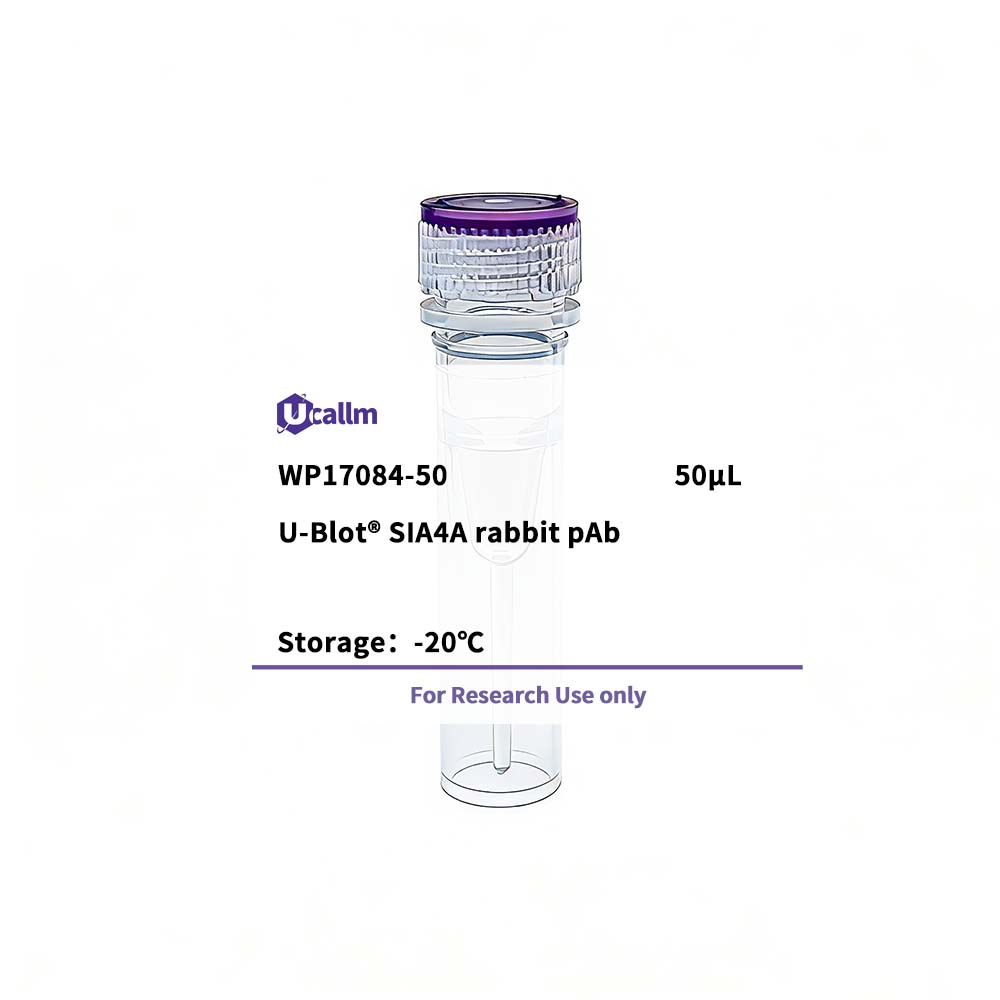
SIA4A rabbit pAb

Price range: $268.00 through $328.00

SKU: WP17084-100
Enter the quantity you would like, or drag the panel to find the quantity and price that best for you
Bulk QuoteAuthorize OEM & ODM

Product details

Background:

The protein encoded by this gene is a type II membrane protein that catalyzes the transfer of sialic acid from CMP-sialic acid to galactose-containing substrates. The encoded protein is normally found in the Golgi but can be proteolytically processed to a soluble form. Correct glycosylation of the encoded protein may be critical to its sialyltransferase activity. This protein, which is a member of glycosyltransferase family 29, can use the same acceptor substrates as does sialyltransferase 4B. Two transcript variants encoding the same protein have been found for this gene. Other transcript variants may exist, but have not been fully characterized yet. [provided by RefSeq, Jul 2008],
Specifications

TargetSIA4A
ReactivityHuman, Mouse
ApplicationsWB, ELISA, IHC
MW(Calculated)37kD
MW(Observed)
Host SpeciesRabbit
IsotypeIgG
Conjugate/ModificationUnmodified
Modification
Recommended Dilution RatioWB 1:500-2000; IHC 1:50-300; ELISA 1:2000-20000 / Note: For IHC, we suggest antigen retrieval with TE buffer pH 9.0 (Cat#YS0004)
FormulationLiquid in PBS containing 50% glycerol, 0.5% BSA and 0.02% sodium azide.
Source
PurificationThe antibody was affinity-purified from rabbit antiserum by affinity-chromatography using epitope-specific immunogen.
Purity
Storage-15°C to -25°C/1 year(Do not lower than -25°C)
Concentration1 mg/ml
ClonalityPolyclonal
Clone Number
ImmunogenSynthesized peptide derived from human SIA4A AA range: 189-239
Sequence
SpecificityThis antibody detects endogenous levels of SIA4A at Human/Mouse
Gene NameST3GAL1 SIAT4 SIAT4A
Protein NameSIA4A
Other Name
SpeciesHuman
Gene ID-16482
UniprotQ11201,
Species.1Mouse
Gene ID-220442
Uniprot.1P54751
Species.2
Gene ID-3
Uniprot.2
Organism-4
Gene ID-4
SwissProt-4
BackgroundThe protein encoded by this gene is a type II membrane protein that catalyzes the transfer of sialic acid from CMP-sialic acid to galactose-containing substrates. The encoded protein is normally found in the Golgi but can be proteolytically processed to a soluble form. Correct glycosylation of the encoded protein may be critical to its sialyltransferase activity. This protein, which is a member of glycosyltransferase family 29, can use the same acceptor substrates as does sialyltransferase 4B. Two transcript variants encoding the same protein have been found for this gene. Other transcript variants may exist, but have not been fully characterized yet. [provided by RefSeq, Jul 2008],
Cellular LocalizationGolgi apparatus, Golgi stack membrane; Single-pass type II membrane protein . Golgi apparatus, trans-Golgi network membrane; Single-pass type II membrane protein . Secreted. Membrane-bound form in medial and trans cisternae of Golgi (PubMed:9182658). Secreted into the body fluid. .
Tissue ExpressionExpressed in several tissues. Highest expression in lung, liver, skeletal muscle, kidney, pancreas, spleen and placenta.
Signaling_pathway
Research Areas>>Mucin type O-glycan biosynthesis; / >>Glycosaminoglycan biosynthesis - keratan sulfate; / >>Glycosphingolipid biosynthesis - globo and isoglobo series; / >>Glycosphingolipid biosynthesis - ganglio series; / >>Metabolic pathways
FunctionCatalytic activity:CMP-N-acetylneuraminate + beta-D-galactosyl-1,3-N-acetyl-alpha-D-galactosaminyl-R = CMP + alpha-N-acetylneuraminyl-2,3-beta-D-galactosyl-1,3-N-acetyl-alpha-D-galactosaminyl-R.,Function:It may be responsible for the synthesis of the sequence NeuAc-alpha-2,3-Gal-beta-1,3-GalNAc- found on sugar chains O-linked to Thr or Ser and also as a terminal sequence on certain gangliosides. SIAT4A and SIAT4B sialylate the same acceptor substrates but exhibit different Km values.,online information:GlycoGene database,online information:ST3Gal I,pathway:Protein modification; protein glycosylation.,PTM:The soluble form derives from the membrane form by proteolytic processing.,similarity:Belongs to the glycosyltransferase 29 family.,subcellular location:Membrane-bound form in trans cisternae of Golgi. Secreted into the body fluid.,tissue specificity:Expressed in several tissues. Highest expression in lung, liver, skeletal muscle, kidney, pancreas, spleen and placenta.,
RRID
Please login to post questions
Back to Top
Product has been added to your cart