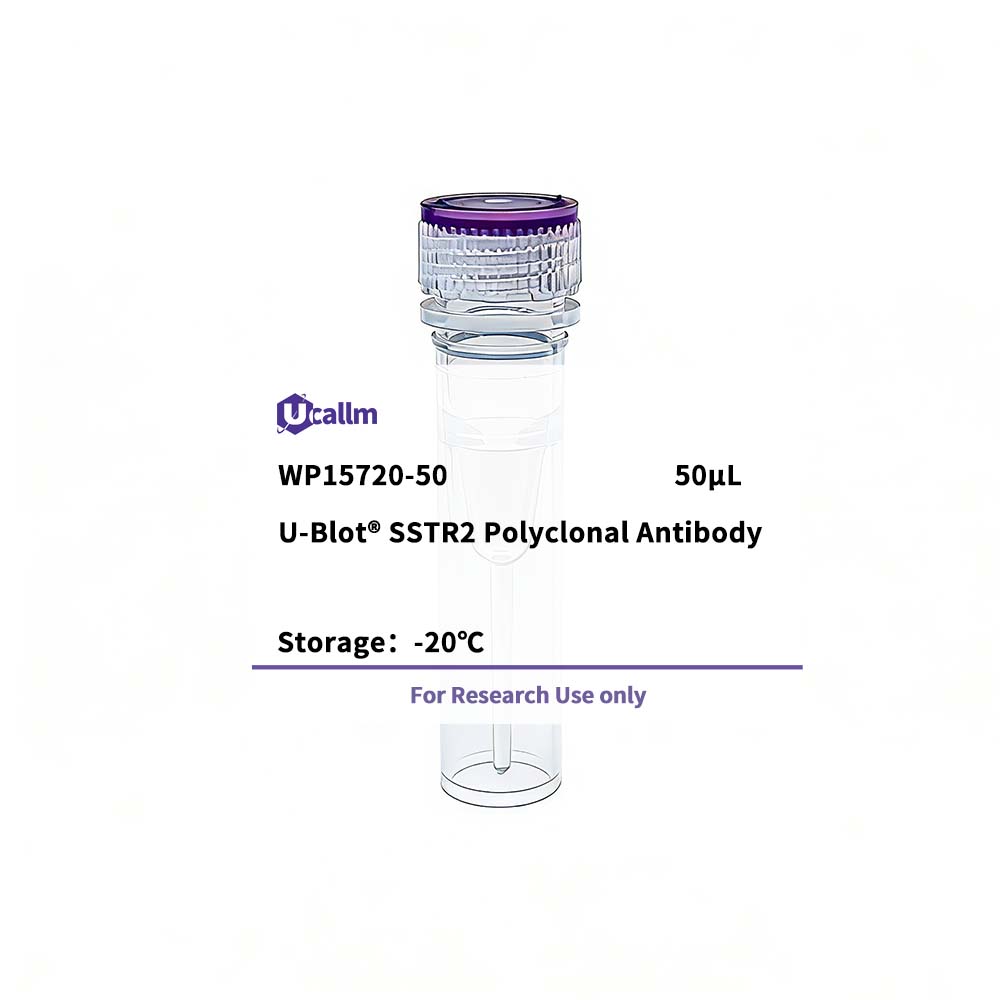
SKU: WP15720 Categories: ,

SSTR2 Polyclonal Antibody

Price range: $268.00 through $328.00

SKU: WP15720-100
Enter the quantity you would like, or drag the panel to find the quantity and price that best for you
Bulk QuoteAuthorize OEM & ODM

Product details

Background:

Somatostatin acts at many sites to inhibit the release of many hormones and other secretory proteins. The biologic effects of somatostatin are probably mediated by a family of G protein-coupled receptors that are expressed in a tissue-specific manner. SSTR2 is a member of the superfamily of receptors having seven transmembrane segments and is expressed in highest levels in cerebrum and kidney. [provided by RefSeq, Jul 2008],

Specifications

Size50μL/100μL
TargetSSTR2
ReactivityHuman, Mouse, Rat
ApplicationsWB, ELISA
MW(Calculated)
MW(Observed)40kD
Host SpeciesRabbit
IsotypeIgG
Conjugate/ModificationUnmodified
Recommended Dilution RatioWB 1:500-1:2000; ELISA 1:10000; Not yet tested in other applications.
FormulationLiquid in PBS containing 50% glycerol, 0.5% BSA and 0.02% sodium azide.
PurificationThe antibody was affinity-purified from rabbit antiserum by affinity-chromatography using epitope-specific immunogen.
Storage-15°C to -25°C/1 year(Do not lower than -25°C)
Concentration1 mg/ml
ClonalityPolyclonal
Clone Number
ImmunogenThe antiserum was produced against synthesized peptide derived from the Internal region of human SSTR2. AA range:220-270
SpecificitySSTR2 Polyclonal Antibody detects endogenous levels of somatostatin receptor 2
Gene NameSSTR2
Protein Namesomatostatin receptor 2
Other NameSomatostatin receptor type 2; / SS-2-R; / SS2-R; / SS2R; / SRIF-1
SpeciesHuman
Gene ID6752
UniprotP30874,
Species.1Mouse
Gene ID.120606
Uniprot.1P30875,
Species.2Rat
Gene ID.2
Uniprot.2P30680
Cellular LocalizationCell membrane; Multi-pass membrane protein. Cytoplasm. Located mainly at the cell surface under basal conditions. Agonist stimulation results in internalization to the cytoplasm.
Tissue ExpressionExpressed in both pancreatic alpha- and beta-cells (at protein level). Expressed at higher levels in the pancreas than other somatostatin receptors. Also expressed in the cerebrum and kidney and, in lesser amounts, in the jejunum, colon and liver. In the developing nervous system, expressed in the cortex where it is located in the preplate at early stages and is enriched in the outer part of the germinal zone at later stages. In the cerebellum, expressed in the deep part of the external granular layer at gestational week 19. This pattern persists until birth but disappears at adulthood.
Signaling_pathwayOrganismal Systems >> Endocrine system >> Growth hormone synthesis, secretion and action;Environmental Information Processing >> Signal transduction >> cAMP signaling pathway
Research Areas>>cAMP signaling pathway; / >>Neuroactive ligand-receptor interaction; / >>Growth hormone synthesis, secretion and action; / >>Gastric acid secretion
FunctionFunction:Receptor for somatostatins-14 and -28. This receptor is coupled via pertussis toxin sensitive G proteins to inhibition of adenylyl cyclase. In addition it stimulates phosphotyrosine phosphatase and PLC via pertussis toxin insensitive as well as sensitive G proteins. In RIN-5F cells, this receptor inhibits calcium entry by suppressing voltage dependent calcium-channels.,similarity:Belongs to the G-protein coupled receptor 1 family.,subunit:The C-terminus interacts with SHANK1 PDZ domain.,tissue specificity:Cerebrum and kidney. In lesser amounts in jejunum, colon and liver.,
Please login to post questions
Back to Top
Product has been added to your cart
