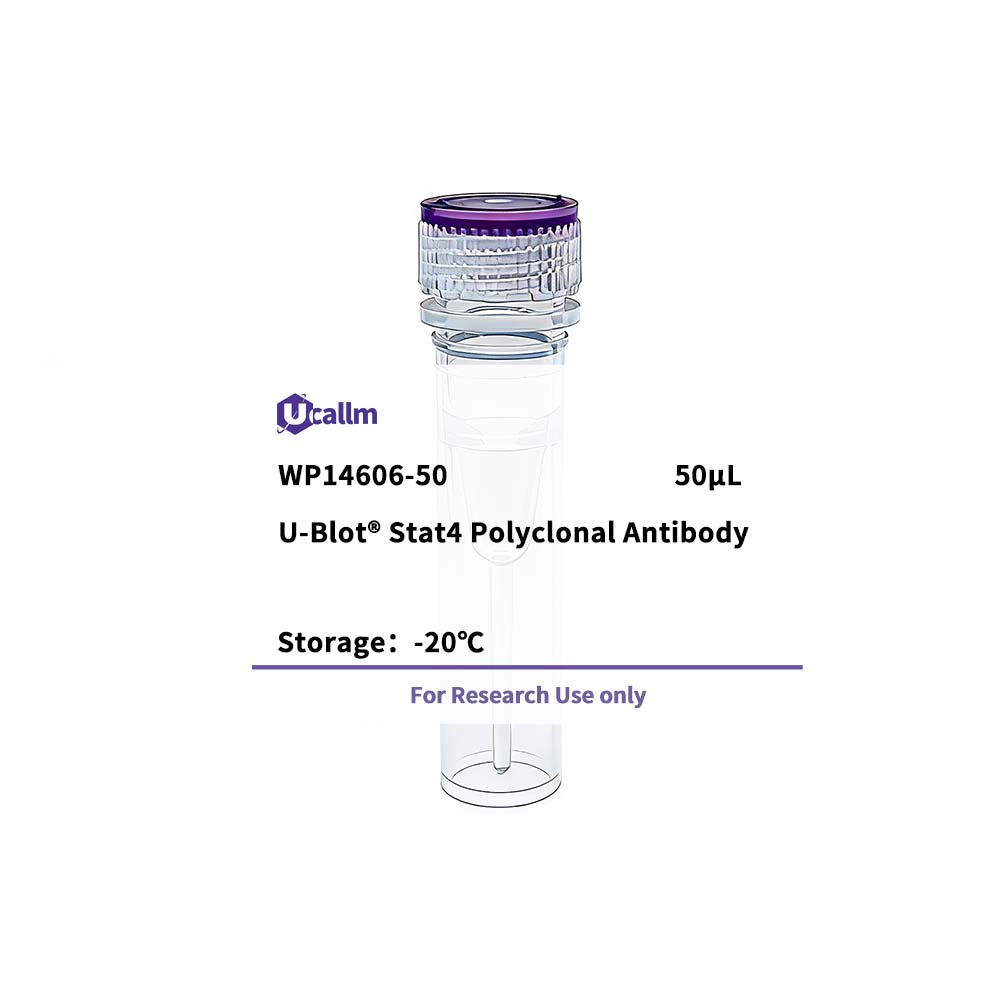
SKU: WP14606 Categories: ,

Stat4 Polyclonal Antibody

Price range: $268.00 through $328.00

SKU: WP14606-100
Enter the quantity you would like, or drag the panel to find the quantity and price that best for you
Bulk QuoteAuthorize OEM & ODM

Product details

Background:

The protein encoded by this gene is a member of the STAT family of transcription factors. In response to cytokines and growth factors, STAT family members are phosphorylated by the receptor associated kinases, and then form homo- or heterodimers that translocate to the cell nucleus where they act as transcription activators. This protein is essential for mediating responses to IL12 in lymphocytes, and regulating the differentiation of T helper cells. Mutations in this gene may be associated with systemic lupus erythematosus and rheumatoid arthritis. Alternate splicing results in multiple transcript variants that encode the same protein. [provided by RefSeq, Aug 2011],


Specifications

Size50μL/100μL
TargetStat4
ReactivityHuman, Mouse, Rat
ApplicationsWB, IHC, IF, IP, ELISA
MW(Calculated)
MW(Observed)85kD
Host SpeciesRabbit
IsotypeIgG
Conjugate/ModificationUnmodified
Recommended Dilution RatioWB 1:500-1:2000; IHC 1:100-1:300; IP 2-5 ug/mg lysate; ELISA 1:5000; IF 1:50-200 / Note: For IHC, we suggest antigen retrieval with TE buffer pH 9.0 (Cat#WT1004)
FormulationLiquid in PBS containing 50% glycerol, 0.5% BSA and 0.02% sodium azide.
PurificationThe antibody was affinity-purified from rabbit antiserum by affinity-chromatography using epitope-specific immunogen.
Storage-15°C to -25°C/1 year(Do not lower than -25°C)
Concentration1 mg/ml
ClonalityPolyclonal
Clone Number
ImmunogenThe antiserum was produced against synthesized peptide derived from human STAT4. AA range:660-709
SpecificitySTAT4 Polyclonal Antibody detects endogenous levels of STAT4 protein.
Gene NameSTAT4
Protein NameSignal transducer and activator of transcription 4
Other NameSTAT4; / Signal transducer and activator of transcription 4
SpeciesHuman
Gene ID6775
UniprotQ14765,
Species.1Mouse
Gene ID.120849
Uniprot.1P42228
Species.2
Gene ID.2
Uniprot.2
Cellular LocalizationCytoplasm. Nucleus. Translocated into the nucleus in response to phosphorylation.
Tissue ExpressionBrain,Kidney,Pancreas,Spleen,Testis,Uterus,
Signaling_pathwayCellular Processes >> Cell growth and death >> Necroptosis;Organismal Systems >> Immune system >> Th1 and Th2 cell differentiation;Human Diseases >> Cancer: overview >> Pathways in cancer;Human Diseases >> Immune disease >> Inflammatory bowel disease;Environmental Information Processing >> Signal transduction >> JAK-STAT signaling pathway
Research Areas>>Necroptosis; / >>JAK-STAT signaling pathway; / >>Th1 and Th2 cell differentiation; / >>Hepatitis B; / >>Pathways in cancer; / >>Inflammatory bowel disease
FunctionDisease:Genetic variations in STAT4 are associated with susceptibility to rheumatoid arthritis (RA) [MIM:180300]. Rheumatoid arthritis is a complex, multifactorial disorder. It is one of the most common autoimmune diseases and it is characterized by inflammation of synovial tissue and joint destruction.,Disease:Genetic variations in STAT4 are associated with susceptibility to systemic lupus erythematosus type 11 (SLEB11) [MIM:612253]. Systemic lupus erythematosus (SLE) is a chronic autoimmune disease with a complex genetic basis. SLE is an inflammatory, and often febrile multisystemic disorder of connective tissue characterized principally by involvement of the skin, joints, kidneys, and serosal membranes. It is thought to represent a failure of the regulatory mechanisms of the autoimmune system.,Function:Carries out a dual Function: signal transduction and activation of transcription. Involved in IL12 signaling.,PTM:Tyrosine phosphorylated. Serine phosphorylation is also required for maximal transcriptional activity.,similarity:Belongs to the transcription factor STAT family.,similarity:Contains 1 SH2 domain.,subcellular location:Translocated into the nucleus in response to phosphorylation.,subunit:Forms a homodimer or a heterodimer with a related family member (By similarity). The SH2 domain interacts, in vitro, with IL12RB2 via a short cytoplasmic domain.,
Please login to post questions
Back to Top
Product has been added to your cart

