

Synuclein-γ Monoclonal Antibody
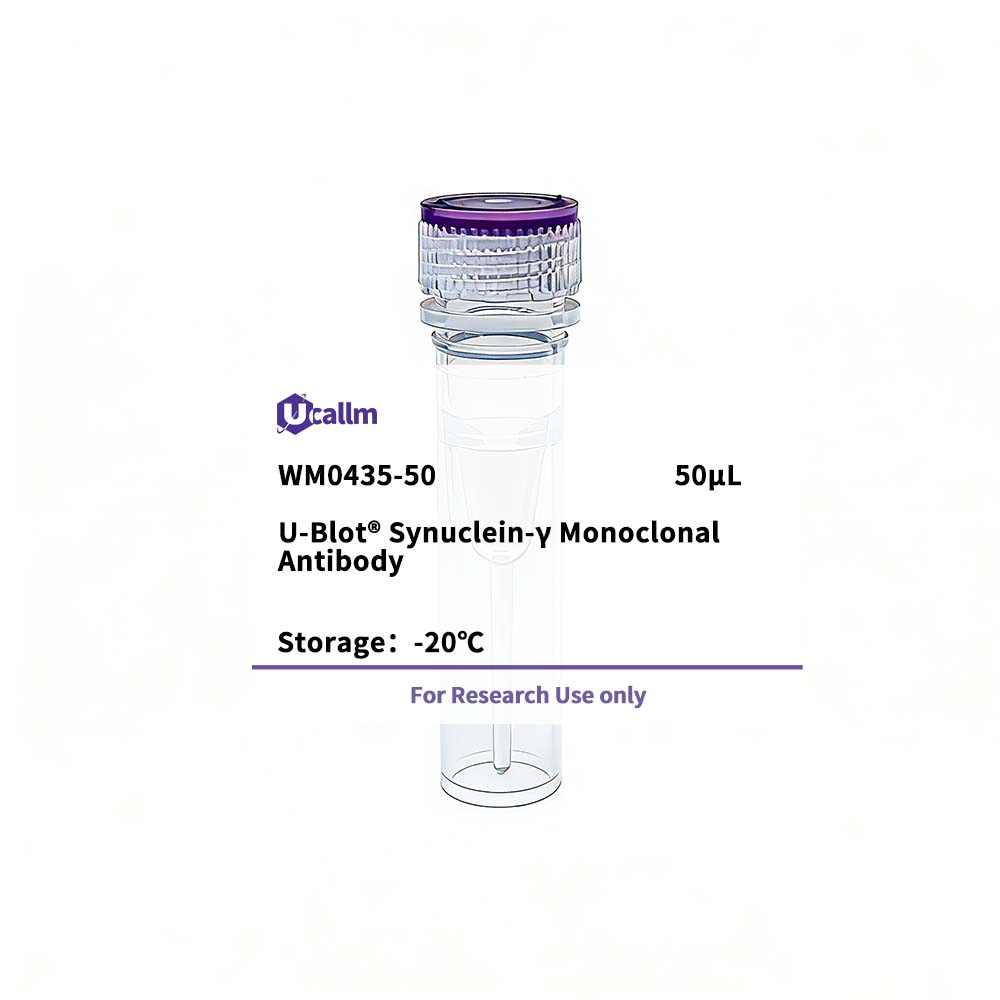
Ucallm_WM0435-50
Price range: $268.00 through $328.00
Product details
Background:
This gene encodes a member of the synuclein family of proteins which are believed to be involved in the pathogenesis of neurodegenerative diseases. Mutations in this gene have also been associated with breast tumor development. [provided by RefSeq, Jan 2010],
Specifications
| Size | 50μL/100μL |
| Target | Synuclein-γ |
| Reactivity | Human |
| Applications | WB, IHC, IF, ELISA |
| MW(Calculated) | 13kD |
| MW(Observed) | |
| Host Species | Mouse |
| Isotype | |
| Conjugate/Modification | Unmodified |
| Recommended Dilution Ratio | WB 1:500-1:2000; IHC 1:200-1:1000; ELISA 1:10000; IF 1:50-200 / Note: For IHC, we suggest antigen retrieval with TE buffer pH 9.0 (Cat#WT1004) |
| Formulation | Liquid in PBS containing 50% glycerol, 0.5% BSA and 0.02% sodium azide. |
| Purification | Affinity purification |
| Storage | -15°C to -25°C/1 year(Do not lower than -25°C) |
| Concentration | |
| Clonality | Monoclonal |
| Clone Number | 11G4 |
| Immunogen | Purified recombinant fragment of Synuclein-γ expressed in E. Coli. |
| Specificity | Synuclein-γ Monoclonal Antibody detects endogenous levels of Synuclein-γ protein. |
| Gene Name | SNCG |
| Protein Name | Gamma-synuclein |
| Other Name | SNCG; / BCSG1; / PERSYN; / PRSN; / Gamma-synuclein; / Breast cancer-specific gene 1 protein; / Persyn; / Synoretin; / SR |
| Species | Human |
| Gene ID | 6623 |
| Uniprot | O76070, |
| Species.1 | Mouse |
| Gene ID.1 | |
| Uniprot.1 | Q9Z0F7 |
| Species.2 | |
| Gene ID.2 | |
| Uniprot.2 | |
| Cellular Localization | Cytoplasm, perinuclear region . Cytoplasm, cytoskeleton, microtubule organizing center, centrosome . Cytoplasm, cytoskeleton, spindle . Associated with centrosomes in several interphase cells. In mitotic cells, localized to the poles of the spindle. |
| Tissue Expression | Highly expressed in brain, particularly in the substantia nigra. Also expressed in the corpus callosum, heart, skeletal muscle, ovary, testis, colon and spleen. Weak expression in pancreas, kidney and lung. |
| Signaling_pathway | |
| Research Areas | |
| Function | Disease:Brain iron accumulation type 1 (NBIA1, also called Hallervorden-Spatz syndrome), a rare neuroaxonal dystrophy, is histologically characterized by axonal spheroids, iron deposition, Lewy body (LB)-like intraneuronal inclusions, glial inclusions and neurofibrillary tangles. SNCG is found in spheroids but not in inclusions.,Function:Plays a role in neurofilament network integrity. May be involved in modulating axonal architecture during development and in the adult. In vitro, increases the susceptibility of neurofilament-H to calcium-dependent proteases (By similarity). May also function in modulating the keratin network in skin. Activates the MAPK and Elk-1 signal transduction pathway.,PTM:Phosphorylated. Phosphorylation by GRK5 appears to occur on residues distinct from the residue phosphorylated by other kinases.,similarity:Belongs to the synuclein family.,subcellular location:Associated with centrosomes in several interphase cells. In mitotic cells, localized to the poles of the spindle.,subunit:May be a centrosome-associated protein.,tissue specificity:Highly expressed in brain, particularly in the substantia nigra. Also expressed in the corpus callosum, heart, skeletal muscle, ovary, testis, colon and spleen. Weak expression in pancreas, kidney and lung., |
Please login to post questions
Related products





