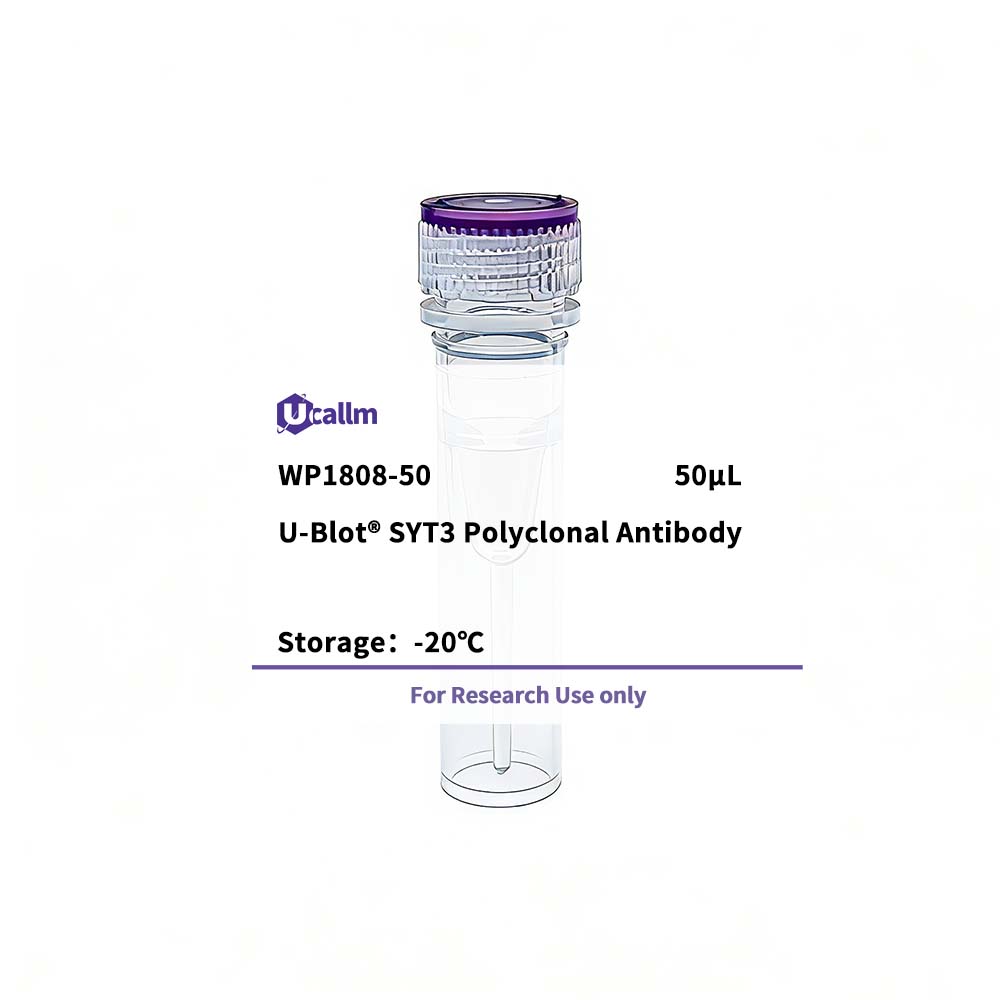
SKU: WP1808 Categories: ,

SYT3 Polyclonal Antibody

Price range: $268.00 through $328.00

SKU: WP1808-100
Enter the quantity you would like, or drag the panel to find the quantity and price that best for you
Bulk QuoteAuthorize OEM & ODM

Product details

Background:

cofactor:Binds 3 calcium ions per subunit. The ions are bound to the C2 domains., domain:The first C2 domain mediates Ca(2+)-dependent phospholipid binding., function:May be involved in Ca(2+)-dependent exocytosis of secretory vesicles through Ca(2+) and phospholipid binding to the C2 domain or may serve as Ca(2+) sensors in the process of vesicular trafficking and exocytosis., similarity:Belongs to the synaptotagmin family., similarity:Contains 2 C2 domains., subunit:Homodimer. Can also form heterodimers.,

Specifications

Size50μL/100μL
TargetSYT3
ReactivityHuman, Mouse, Rat
ApplicationsWB, ELISA
MW(Calculated)
MW(Observed)64kD
Host SpeciesRabbit
IsotypeIgG
Conjugate/ModificationUnmodified
Recommended Dilution RatioWB 1:500-2000; ELISA 1:5000-20000
FormulationLiquid in PBS containing 50% glycerol,0.5% BSA and 0.02% sodium azide.
PurificationThe antibody was affinity-purified from rabbit antiserum by affinity-chromatography using epitope-specific immunogen.
Storage-15°C to -25°C/1 year(Do not lower than -25°C)
Concentration1 mg/ml
ClonalityPolyclonal
Clone Number
ImmunogenSynthesized peptide derived from part region of human protein
SpecificitySYT3 Polyclonal Antibody detects endogenous levels of protein.
Gene NameSYT3
Protein NameSynaptotagmin-3 (Synaptotagmin III) (SytIII)
Other Name
SpeciesHuman
Gene ID84258
UniprotQ9BQG1,
Species.1Mouse
Gene ID.1
Uniprot.1O35681,
Species.2Rat
Gene ID.2
Uniprot.2P40748
Cellular LocalizationCell membrane; Single-pass membrane protein . Cytoplasmic vesicle, secretory vesicle membrane; Single-pass membrane protein .
Tissue ExpressionExpressed in melanocytes (PubMed:23999003).
Signaling_pathway
Research Areas
Functioncofactor:Binds 3 calcium ions per subunit. The ions are bound to the C2 domains.,Domain:The first C2 domain mediates Ca(2+)-dependent phospholipid binding.,Function:May be involved in Ca(2+)-dependent exocytosis of secretory vesicles through Ca(2+) and phospholipid binding to the C2 domain or may serve as Ca(2+) sensors in the process of vesicular trafficking and exocytosis.,similarity:Belongs to the synaptotagmin family.,similarity:Contains 2 C2 domains.,subunit:Homodimer. Can also form heterodimers.,
Please login to post questions
Back to Top
Product has been added to your cart