

Tafazzin Polyclonal Antibody
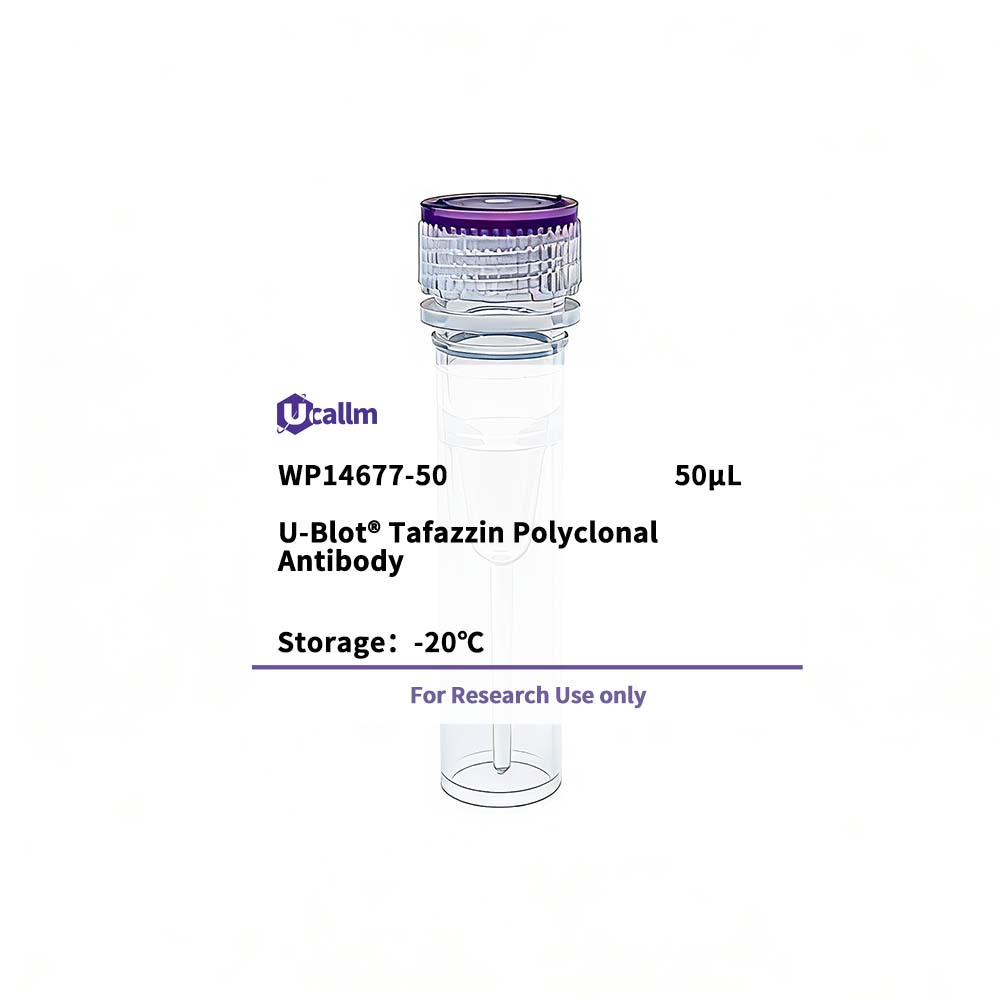
Ucallm_WP14677-50
Price range: $268.00 through $328.00
Product details
Background:
This gene encodes a protein that is expressed at high levels in cardiac and skeletal muscle. Mutations in this gene have been associated with a number of clinical disorders including Barth syndrome, dilated cardiomyopathy (DCM), hypertrophic DCM, endocardial fibroelastosis, and left ventricular noncompaction (LVNC). Multiple transcript variants encoding different isoforms have been described. A long form and a short form of each of these isoforms is produced; the short form lacks a hydrophobic leader sequence and may exist as a cytoplasmic protein rather than being membrane-bound. Other alternatively spliced transcripts have been described but the full-length nature of all these transcripts is not known. [provided by RefSeq, Jul 2008],
Specifications
| Size | 50μL/100μL |
| Target | Tafazzin |
| Reactivity | Human, Mouse |
| Applications | WB, ELISA |
| MW(Calculated) | |
| MW(Observed) | 33kD |
| Host Species | Rabbit |
| Isotype | IgG |
| Conjugate/Modification | Unmodified |
| Recommended Dilution Ratio | WB 1:500-1:2000; ELISA 1:5000; Not yet tested in other applications. |
| Formulation | Liquid in PBS containing 50% glycerol, 0.5% BSA and 0.02% sodium azide. |
| Purification | The antibody was affinity-purified from rabbit antiserum by affinity-chromatography using epitope-specific immunogen. |
| Storage | -15°C to -25°C/1 year(Do not lower than -25°C) |
| Concentration | 1 mg/ml |
| Clonality | Polyclonal |
| Clone Number | |
| Immunogen | Synthesized peptide derived from the Internal region of human Tafazzin. |
| Specificity | Tafazzin Polyclonal Antibody detects endogenous levels of Tafazzin protein. |
| Gene Name | TAZ |
| Protein Name | Tafazzin |
| Other Name | TAZ; / EFE2; / G4.5; / Tafazzin; / Protein G4.5 |
| Species | Human |
| Gene ID | 6901 |
| Uniprot | Q16635 |
| Species.1 | |
| Gene ID.1 | |
| Uniprot.1 | |
| Species.2 | |
| Gene ID.2 | |
| Uniprot.2 | |
| Cellular Localization | Mitochondrion outer membrane; Peripheral membrane protein; Intermembrane side . Mitochondrion inner membrane; Peripheral membrane protein; Intermembrane side .; [Isoform 1]: Mitochondrion membrane .; [Isoform 2]: Cytoplasm .; [Isoform 3]: Mitochondrion membrane .; [Isoform 5]: Mitochondrion membrane .; [Isoform 6]: Cytoplasm .; [Isoform 7]: Mitochondrion membrane .; [Isoform 8]: Cytoplasm .; [Isoform 9]: Cytoplasm . |
| Tissue Expression | High levels in cardiac and skeletal muscle. Up to 10 isoforms can be present in different amounts in different tissues. Most isoforms are ubiquitous. Isoforms that lack the N-terminus are found in leukocytes and fibroblasts, but not in heart and skeletal muscle. Some forms appear restricted to cardiac and skeletal muscle or to leukocytes. |
| Signaling_pathway | |
| Research Areas | >>Glycerophospholipid metabolism |
| Function | Disease:Defects in TAZ are the cause of 3-methylglutaconic aciduria type 2 (MGA2) [MIM:302060]. MGA2 is a severe metabolic disorder, often fatal in childhood, characterized by dilated cardiomyopathy, skeletal myopathy, short stature, neutropenia and 3-methylglutaconicaciduria.,Disease:Defects in TAZ are the cause of non-compaction of left ventricular myocardium isolated X-linked (LVNCX) [MIM:300183]. LVNC is due to an arrest of myocardial morphogenesis. The disorder is characterized by a hypertrophic left ventricular with deep trabeculations and with poor systolic function, with or without associated left ventricular dilation. In some cases, the right ventricle is also affected.,Domain:The hydrophilic domain may serve as an exposed loop interacting with other proteins.,Function:Some isoforms may be involved in cardiolipin metabolism.,online information:TAZ mutation db,similarity:Belongs to the taffazin family.,tissue specificity:High levels in cardiac and skeletal muscle. Up to 10 isoforms can be present in different amounts in different tissues. Most isoforms are ubiquitous. Isoforms that lack the N-terminus are found in leukocytes and fibroblasts, but not in heart and skeletal muscle. Some forms appear restricted to cardiac and skeletal muscle or to leukocytes., |
Please login to post questions
Related products



