SKU: WR4218 Categories: ,

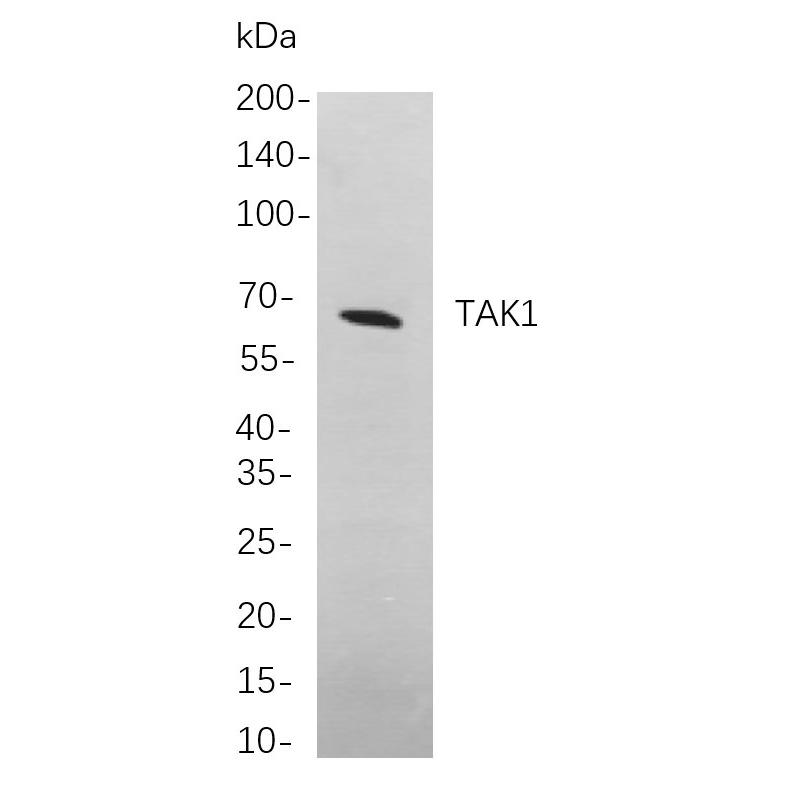
U-Blot® TAK1 Rabbit mAb

Price range: $268.00 through $328.00

SKU: WR4218-50
Enter the quantity you would like, or drag the panel to find the quantity and price that best for you
Bulk QuoteAuthorize OEM & ODM

Product details

Background:The protein encoded by this gene is a member of the serine/threonine protein kinase family. This kinase mediates the signaling transduction induced by TGF beta and morphogenetic protein (BMP), and controls a variety of cell functions including transcription regulation and apoptosis. In response to IL-1, this protein forms a kinase complex including TRAF6, MAP3K7P1/TAB1 and MAP3K7P2/TAB2; this complex is required for the activation of nuclear factor kappa B. This kinase can also activate MAPK8/JNK, MAP2K4/MKK4, and thus plays a role in the cell response to environmental stresses. Four alternatively spliced transcript variants encoding distinct isoforms have been reported. [provided by RefSeq, Jul 2008],

Specifications

Size50μL/100μL
TargetTak1
ReactivityHuman, Mouse, Rat
ApplicationsWB, IF, ELISA, IHC
MW(Calculated)67kD
MW(Observed)67kD
Host SpeciesRabbit
IsotypeIgG,Kappa
Conjugate/ModificationUnmodified
Recommended Dilution RatioWB 1:1000-1:5000; IF 1:200-1:1000; ELISA 1:5000-1:20000; IHC 1:100-1:400 / Note: For IHC, we suggest antigen retrieval with TE buffer pH 9.0 (Cat#WT1004)
FormulationPBS, 50% glycerol, 0.05% Proclin 300, 0.05%BSA
PurificationRecombinant Antibody expressed in animal component-free (ACF) media, purified via Protein A affinity chromatography.
Storage-15°C to -25°C/1 year(Do not lower than -25°C)
Concentration
ClonalityMonoclonal
Clone NumberRM0396R
ImmunogenThe specific immunogen used to produce this antibody is proprietary information.
SpecificityEndogenous
Gene NameMAP3K7
Protein NameMitogen-activated protein kinase kinase kinase 7
Other NameMAP3K7; / TAK1; / Mitogen-activated protein kinase kinase kinase 7; / Transforming growth factor-beta-activated kinase 1; / TGF-beta-activated kinase 1
SpeciesHuman
Gene ID6885
UniprotO43318,
Species.1Mouse
Gene ID.126409
Uniprot.1Q62073,
Species.2Rat
Gene ID.2313121
Uniprot.2P0C8E4
Cellular LocalizationCytoplasm, Membrane
Tissue ExpressionIsoform 1A is the most abundant in ovary, skeletal muscle, spleen and blood mononuclear cells. Isoform 1B is highly expressed in brain, kidney and small intestine. Isoform 1C is the major form in prostate. Isoform 1D is the less abundant form.
Signaling_pathwayCellular Processes >> Transport and catabolism >> Autophagy - animal;Cellular Processes >> Cellular community - eukaryotes >> Adherens junction;Organismal Systems >> Immune system >> Neutrophil extracellular trap formation;Organismal Systems >> Immune system >> Toll-like receptor signaling pathway;Organismal Systems >> Immune system >> NOD-like receptor signaling pathway;Organismal Systems >> Immune system >> RIG-I-like receptor signaling pathway;Organismal Systems >> Immune system >> T cell receptor signaling pathway;Organismal Systems >> Immune system >> IL-17 signaling pathway;Organismal Systems >> Development and regeneration >> Osteoclast differentiation;Environmental Information Processing >> Signal transduction >> MAPK signaling pathway;Environmental Information Processing >> Signal transduction >> Wnt signaling pathway;Environmental Information Processing >> Signal transduction >> NF-kappa B signaling pathway;Environmental Information Processing >> Signal transduction >> TNF signaling pathway;Environmental Information Processing >> Signal transduction >> AMPK signaling pathway
Research Areas>>MAPK signaling pathway; / >>NF-kappa B signaling pathway; / >>Autophagy - animal; / >>AMPK signaling pathway; / >>Wnt signaling pathway; / >>Osteoclast differentiation; / >>Adherens junction; / >>Neutrophil extracellular trap formation; / >>Toll-like receptor signaling pathway; / >>NOD-like receptor signaling pathway; / >>RIG-I-like receptor signaling pathway; / >>IL-17 signaling pathway; / >>T cell receptor signaling pathway; / >>TNF signaling pathway; / >>Alcoholic liver disease; / >>Pathogenic Escherichia coli infection; / >>Shigellosis; / >>Salmonella infection; / >>Yersinia infection; / >>Leishmaniasis; / >>Toxoplasmosis; / >>Hepatitis B; / >>Measles; / >>Herpes simplex virus 1 infection; / >>Epstein-Barr virus infection; / >>Human immunodeficiency virus 1 infection; / >>Coronavirus disease - COVID-19; / >>Lipid and atherosclerosis; / >>Fluid shear stress and atherosclerosis
FunctionCatalytic activity:ATP + a protein = ADP + a phosphoprotein.,cofactor:Magnesium.,Function:Component of a protein kinase signal transduction cascade. Mediator of TGF-beta signal transduction. Stimulates NF-kappa-B activation and the p38 MAPK pathway.,PTM:Association with MAP3K7IP1 promotes autophosphorylation and subsequent activation. Dephosphorylation at Thr-187 by PP2A and PPP6C leads to inactivation.,similarity:Belongs to the protein kinase superfamily.,similarity:Belongs to the protein kinase superfamily. STE Ser/Thr protein kinase family. MAP kinase kinase kinase subfamily.,similarity:Contains 1 protein kinase domain.,subunit:Binds both upstream activators and downstream substrates in multimolecular complexes. Interacts with MAP3K7IP1 and MAP3K7IP2. Interacts with PPM1L. Interaction with PP2A and PPP6C leads to its' repressed activity.,
Please login to post questions

Back to Top
Product has been added to your cart