

TBX15 Polyclonal Antibody
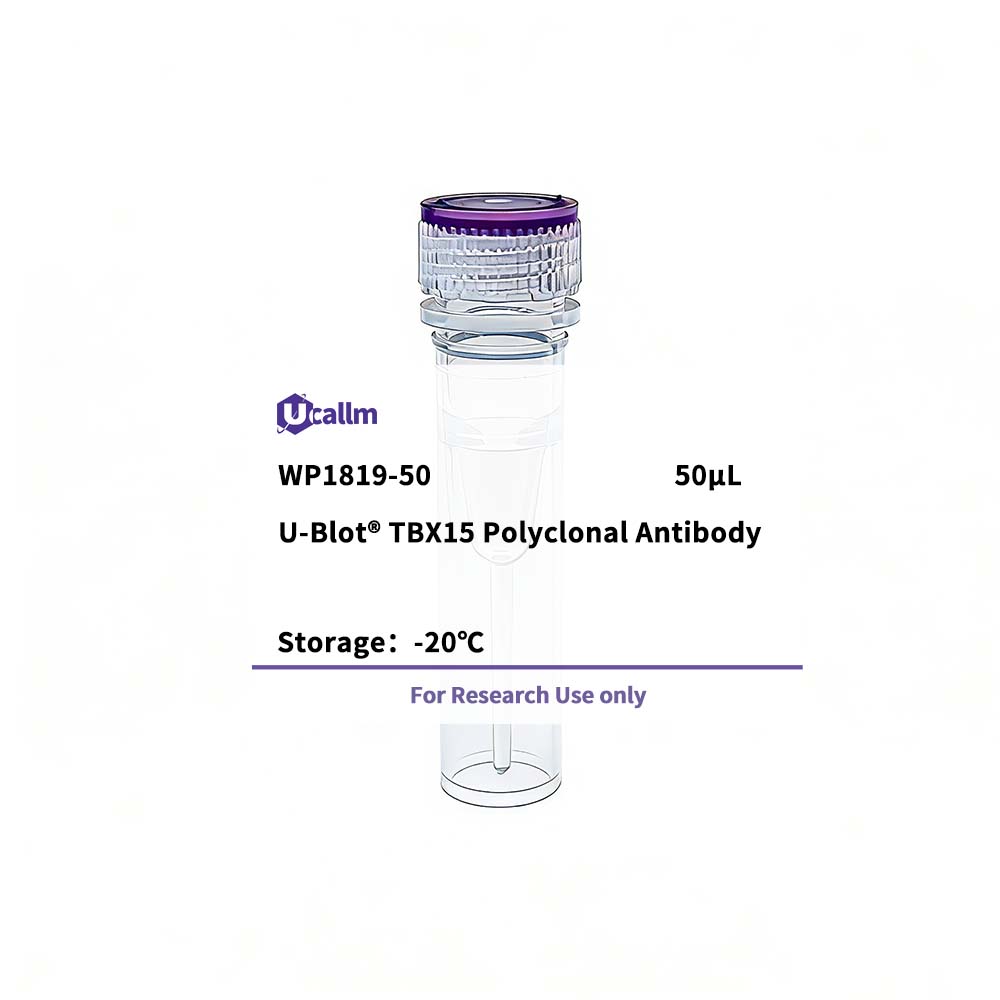
Ucallm_WP1819-50
Price range: $268.00 through $328.00
Product details
Background:
T-box 15(TBX15) Homo sapiens This gene belongs to the T-box family of genes, which encode a phylogenetically conserved family of transcription factors that regulate a variety of developmental processes. All these genes contain a common T-box DNA-binding domain. Mutations in this gene are associated with Cousin syndrome.[provided by RefSeq, Oct 2009],
Specifications
| Size | 50μL/100μL |
| Target | TBX15 |
| Reactivity | Human, Mouse |
| Applications | WB, ELISA |
| MW(Calculated) | |
| MW(Observed) | 66kD |
| Host Species | Rabbit |
| Isotype | IgG |
| Conjugate/Modification | Unmodified |
| Recommended Dilution Ratio | WB 1:500-2000; ELISA 1:5000-20000 |
| Formulation | Liquid in PBS containing 50% glycerol,0.5% BSA and 0.02% sodium azide. |
| Purification | The antibody was affinity-purified from rabbit antiserum by affinity-chromatography using epitope-specific immunogen. |
| Storage | -15°C to -25°C/1 year(Do not lower than -25°C) |
| Concentration | 1 mg/ml |
| Clonality | Polyclonal |
| Clone Number | |
| Immunogen | Synthesized peptide derived from part region of human protein |
| Specificity | TBX15 Polyclonal Antibody detects endogenous levels of protein. |
| Gene Name | TBX15 TBX14 |
| Protein Name | T-box transcription factor TBX15 (T-box protein 15) (T-box transcription factor TBX14) (T-box protein 14) |
| Other Name | |
| Species | Human |
| Gene ID | 6913 |
| Uniprot | Q96SF7, |
| Species.1 | Mouse |
| Gene ID.1 | |
| Uniprot.1 | O70306 |
| Species.2 | |
| Gene ID.2 | |
| Uniprot.2 | |
| Cellular Localization | Nucleus . |
| Tissue Expression | Liver,PCR rescued clones, |
| Signaling_pathway | |
| Research Areas | |
| Function | Disease:Defects in TBX15 are the cause of Cousin syndrome [MIM:260660]; also called craniofacial dysmorphism, hypoplasia of scapula and pelvis, and short stature. Cousin syndrome is defined as pelviscapular dysplasia with epiphyseal abnormalities, congenital dwarfism and facial dysmorphy (frontal bossing, hypertelorism, narrow palpebral fissures, deep set globes, strabismus, low-set posteriory rotated and unusually formed external ears, dysplasia of conchae, small chin, short neck with redundant skin folds, and a low hairline). Intelligence may vary from normal to moderately impaired. Radiographic features comprise aplasia of the body of the scapula, hypoplasia of the iliac bone, humeroradial synosthosis, dislocation of the femoral heads, and moderate brachydactyly.,Function:Probable transcriptional regulator involved in developmental processes.,similarity:Contains 1 T-box DNA-binding domain., |
Please login to post questions
Related products





