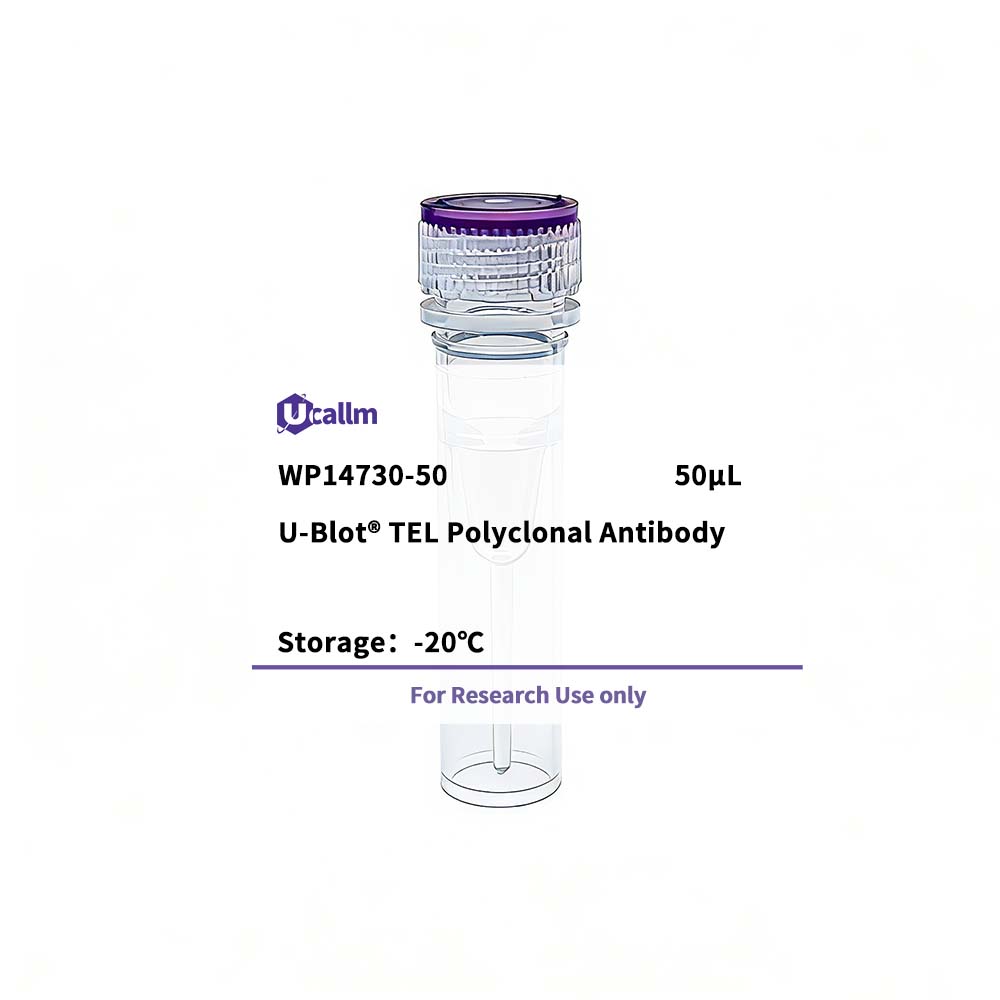
SKU: WP14730 Categories: ,

TEL Polyclonal Antibody

Price range: $268.00 through $328.00

SKU: WP14730-100
Enter the quantity you would like, or drag the panel to find the quantity and price that best for you
Bulk QuoteAuthorize OEM & ODM

Product details

Background:

This gene encodes an ETS family transcription factor. The product of this gene contains two functional domains: a N-terminal pointed (PNT) domain that is involved in protein-protein interactions with itself and other proteins, and a C-terminal DNA-binding domain. Gene knockout studies in mice suggest that it is required for hematopoiesis and maintenance of the developing vascular network. This gene is known to be involved in a large number of chromosomal rearrangements associated with leukemia and congenital fibrosarcoma. [provided by RefSeq, Sep 2008],

Specifications

Size50μL/100μL
TargetTEL
ReactivityHuman, Mouse
ApplicationsWB, ELISA
MW(Calculated)
MW(Observed)55kD
Host SpeciesRabbit
IsotypeIgG
Conjugate/ModificationUnmodified
Recommended Dilution RatioWB 1:500-1:2000; ELISA 1:10000; Not yet tested in other applications.
FormulationLiquid in PBS containing 50% glycerol, 0.5% BSA and 0.02% sodium azide.
PurificationThe antibody was affinity-purified from rabbit antiserum by affinity-chromatography using epitope-specific immunogen.
Storage-15°C to -25°C/1 year(Do not lower than -25°C)
Concentration1 mg/ml
ClonalityPolyclonal
Clone Number
ImmunogenThe antiserum was produced against synthesized peptide derived from human Tel. AA range:223-272
SpecificityTEL Polyclonal Antibody detects endogenous levels of TEL protein.
Gene NameETV6
Protein NameTranscription factor ETV6
Other NameETV6; / TEL; / TEL1; / Transcription factor ETV6; / ETS translocation variant 6; / ETS-related protein Tel1; / Tel
SpeciesHuman
Gene ID2120
UniprotP41212,
Species.1Mouse
Gene ID.114011
Uniprot.1P97360
Species.2
Gene ID.2
Uniprot.2
Cellular LocalizationNucleus.
Tissue ExpressionUbiquitous.
Signaling_pathwayHuman Diseases >> Cancer: overview >> Transcriptional misregulation in cancer
Research Areas>>Transcriptional misregulation in cancer
FunctionDisease:A chromosomal aberration involving ETV6 is a cause in many instances of chronic myeloproliferative disorder with eosinophilia (MPE) [MIM:131440]. Translocation t(5; 12) with PDGFRB on chromosome 5 creating an ETV6-PDGFRB fusion protein.,Disease:A chromosomal aberration involving ETV6 is a cause of acute lymphoblastic leukemia. Translocation t(9; 12)(p13; p13) with PAX5.,Disease:A chromosomal aberration involving ETV6 is a cause of myelodysplastic syndrome (MDS). Translocation t(1; 12)(p36.1; p13) with MDS2.,Disease:A chromosomal aberration involving ETV6 is found in a form of chronic myelomonocytic leukemia (CMML). Translocation t(5; 12)(q33; p13) with PDGFRB. It is characterized by abnormal clonal myeloid proliferation and by progression to acute myelogenous leukemia (AML).,Disease:A chromosomal aberration involving ETV6 is found in a form of pre-B acute myeloid leukemia. Translocation t(9; 12)(p24; p13) with JAK2.,Disease:A chromosomal aberration involving ETV6 may be a cause of acute eosinophilic leukemia (AEL). Translocation t(5; 12)(q31; p13) with ACSL6.,Disease:A chromosomal aberration involving ETV6 may be a cause of myelodysplastic syndrome (MDS) with basophilia. Translocation t(5; 12)(q31; p13) with ACSL6.,Disease:Chromosomal aberrations involving ETV6 are found in a form of acute myeloid leukemia (AML). Translocation t(12; 22)(p13; q11) with MN1; translocation t(4; 12)(q12; p13) with CHIC2.,Disease:Chromosomal aberrations involving ETV6 are found in childhood acute lymphoblastic leukemia (ALL). Translocations t(12; 21)(p12; q22) and t(12; 21)(p13; q22) with RUNX1/AML1.,Disease:Defects in ETV6 are a cause of acute myelogenous leukemia (AML) [MIM:601626]. AML is a malignant disease in which hematopoietic precursors are arrested in an early stage of development.,Function:Transcriptional repressor; binds to the DNA sequence 5'-CCGGAAGT-3'.,PTM:Phosphorylated.,PTM:Phosphorylation of Ser-257 by MAPK14 (p38) inhibits ETV6 transcriptional repression.,similarity:Belongs to the ETS family.,similarity:Contains 1 ETS DNA-binding domain.,similarity:Contains 1 PNT (pointed) domain.,subunit:Can form homodimers or heterodimers with TEL2 or FLI1. Interacts with L3MBTL and HDAC9.,tissue specificity:Ubiquitous.,
Please login to post questions
Back to Top
Product has been added to your cart

