


Tenascin-C Polyclonal Antibody
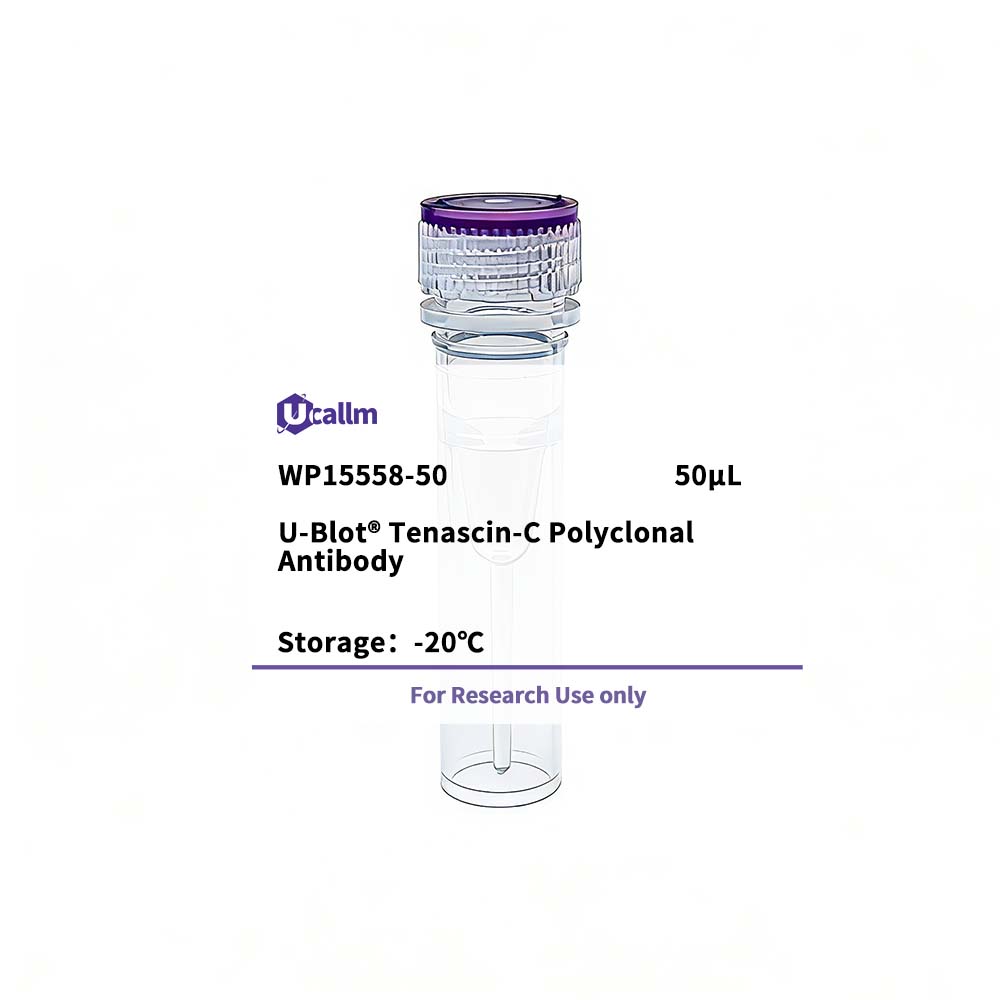
Ucallm_WP15558-50
Price range: $268.00 through $328.00
Product details
Background:
tenascin C(TNC) Homo sapiens This gene encodes an extracellular matrix protein with a spatially and temporally restricted tissue distribution. This protein is homohexameric with disulfide-linked subunits, and contains multiple EGF-like and fibronectin type-III domains. It is implicated in guidance of migrating neurons as well as axons during development, synaptic plasticity, and neuronal regeneration. [provided by RefSeq, Jul 2011],
Specifications
| Size | 50μL/100μL |
| Target | Tenascin-C |
| Reactivity | Human, Mouse, Rat |
| Applications | WB, IHC, IF, ELISA |
| MW(Calculated) | |
| MW(Observed) | 240kD |
| Host Species | Rabbit |
| Isotype | IgG |
| Conjugate/Modification | Unmodified |
| Recommended Dilution Ratio | WB 1:500-1:2000; IHC: 1:100-1:300; ELISA 1:10000; IF 1:50-200 / Note: For IHC, we suggest antigen retrieval with TE buffer pH 9.0 (Cat#WT1004) |
| Formulation | Liquid in PBS containing 50% glycerol, 0.5% BSA and 0.02% sodium azide. |
| Purification | The antibody was affinity-purified from rabbit antiserum by affinity-chromatography using epitope-specific immunogen. |
| Storage | -15°C to -25°C/1 year(Do not lower than -25°C) |
| Concentration | 1 mg/ml |
| Clonality | Polyclonal |
| Clone Number | |
| Immunogen | The antiserum was produced against synthesized peptide derived from the C-terminal region of human TNC. AA range:2151-2200 |
| Specificity | Tenascin-C Polyclonal Antibody detects endogenous levels of Tenascin-C protein. |
| Gene Name | TNC |
| Protein Name | Tenascin |
| Other Name | TNC; / HXB; / Tenascin; / TN; / Cytotactin; / GMEM; / GP 150-225; / Glioma-associated-extracellular matrix antigen; / Hexabrachion; / JI; / Myotendinous antigen; / Neuronectin; / Tenascin-C; / TN-C |
| Species | Human |
| Gene ID | 3371 |
| Uniprot | P24821, |
| Species.1 | Mouse |
| Gene ID.1 | 21923 |
| Uniprot.1 | Q80YX1 |
| Species.2 | |
| Gene ID.2 | |
| Uniprot.2 | |
| Cellular Localization | Secreted, extracellular space, extracellular matrix. |
| Tissue Expression | Brain,Fetal brain,Fetal cartilage,Glioblastoma,Human fetal kidney,Liver,Melanoma,Milk,Plasma, |
| Signaling_pathway | Cellular Processes >> Cellular community - eukaryotes >> Focal adhesion;Human Diseases >> Cancer: overview >> MicroRNAs in cancer;Environmental Information Processing >> Signal transduction >> PI3K-Akt signaling pathway;Environmental Information Processing >> Signaling molecules and interaction >> ECM-receptor interaction |
| Research Areas | >>PI3K-Akt signaling pathway; / >>Focal adhesion; / >>ECM-receptor interaction; / >>Human papillomavirus infection; / >>MicroRNAs in cancer |
| Function | Alternative products:Isoforms are produced in a tissue- and time-specific manner during development,Function:Extracellular matrix protein implicated in guidance of migrating neurons as well as axons during development, synaptic plasticity as well as neuronal regeneration. Promotes neurite outgrowth from cortical neurons grown on a monolayer of astrocytes. Ligand for integrins alpha-8/beta-1, alpha-9/beta-1, alpha-V/beta-3 and alpha-V/beta-6.,induction:By TGF-beta.,PTM:N-glycosylated.,similarity:Belongs to the tenascin family.,similarity:Contains 1 fibrinogen C-terminal domain.,similarity:Contains 15 EGF-like domains.,similarity:Contains 15 fibronectin type-III domains.,subunit:Homohexamer; disulfide-linked. A homotrimer may be formed in the triple coiled-coil region and may be stabilized by disulfide rings at both ends. Two of such half-hexabrachions may be disulfide linked within the central globule. Interacts with CSPG4., |
Please login to post questions
Related products





