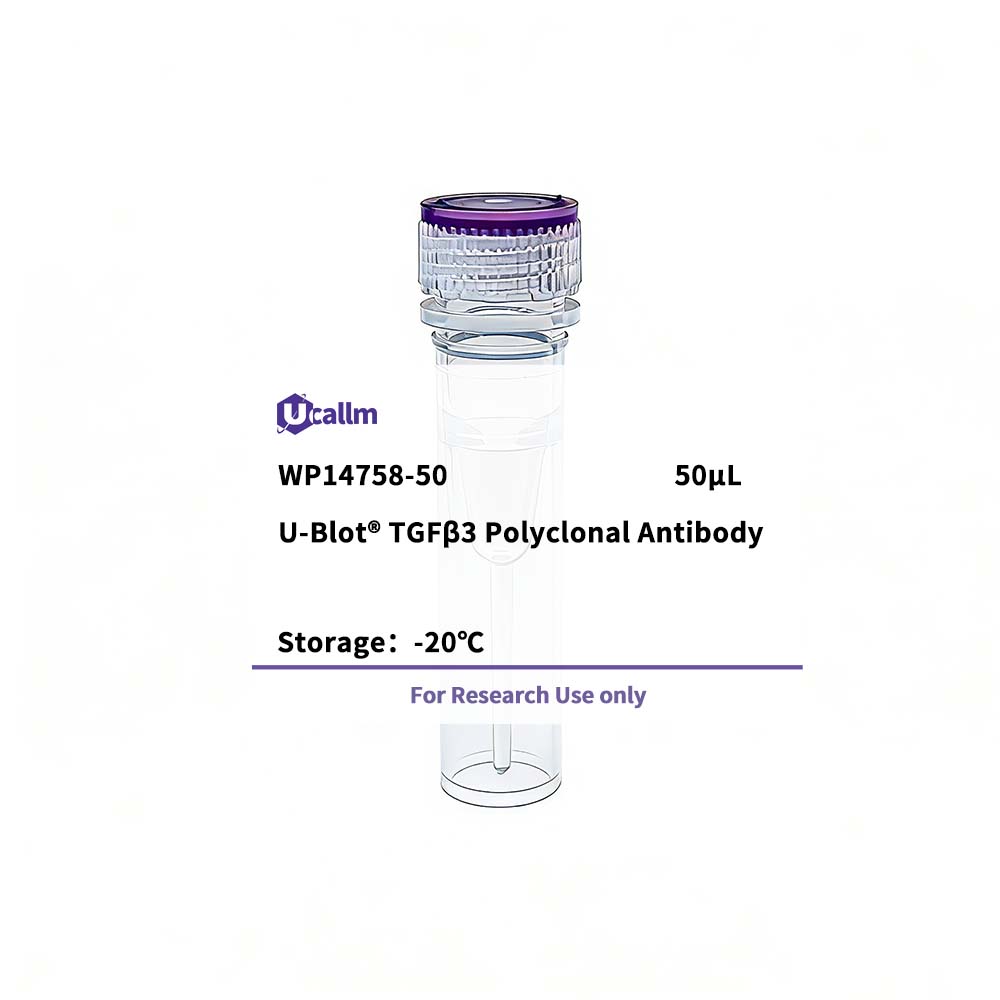
SKU: WP14758 Categories: ,

TGFβ3 Polyclonal Antibody

Price range: $268.00 through $328.00

SKU: WP14758-100
Enter the quantity you would like, or drag the panel to find the quantity and price that best for you
Bulk QuoteAuthorize OEM & ODM

Product details

Background:

This gene encodes a secreted ligand of the TGF-beta (transforming growth factor-beta) superfamily of proteins. Ligands of this family bind various TGF-beta receptors leading to recruitment and activation of SMAD family transcription factors that regulate gene expression. The encoded preproprotein is proteolytically processed to generate a latency-associated peptide (LAP) and a mature peptide, and is found in either a latent form composed of a mature peptide homodimer, a LAP homodimer, and a latent TGF-beta binding protein, or in an active form consisting solely of the mature peptide homodimer. The mature peptide may also form heterodimers with other TGF-beta family members. This protein is involved in embryogenesis and cell differentiation, and may play a role in wound healing. Mutations in this gene are a cause of aortic aneurysms and dissections, as well as familial arrhythmogenic


Specifications

Size50μL/100μL
TargetTGFB3
ReactivityHuman, Mouse, Rat, Monkey
ApplicationsWB, IHC, IF, ELISA
MW(Calculated)
MW(Observed)13kD
Host SpeciesRabbit
IsotypeIgG
Conjugate/ModificationUnmodified
Recommended Dilution RatioWB 1:500-1:2000; IHC 1:100-1:300; ELISA 1:10000; IF 1:50-200 / Note: For IHC, we suggest antigen retrieval with TE buffer pH 9.0 (Cat#WT1004)
FormulationLiquid in PBS containing 50% glycerol, 0.5% BSA and 0.02% sodium azide.
PurificationThe antibody was affinity-purified from rabbit antiserum by affinity-chromatography using epitope-specific immunogen.
Storage-15°C to -25°C/1 year(Do not lower than -25°C)
Concentration1 mg/ml
ClonalityPolyclonal
Clone Number
ImmunogenThe antiserum was produced against synthesized peptide derived from human TGF beta3. AA range:261-310
SpecificityTGFβ3 Polyclonal Antibody detects endogenous levels of TGFβ3 protein.
Gene NameTGFB3
Protein NameTransforming growth factor beta-3
Other NameTGFB3; / Transforming growth factor beta-3; / TGF-beta-3
SpeciesHuman
Gene ID7043
UniprotP10600,
Species.1Mouse
Gene ID.1
Uniprot.1P17125,
Species.2Rat
Gene ID.225717
Uniprot.2Q07258
Cellular Localization[Latency-associated peptide]: Secreted, extracellular space, extracellular matrix .; [Transforming growth factor beta-3]: Secreted .
Tissue ExpressionAmygdala,Esophageal,Placenta,Prostate,
Signaling_pathwayCellular Processes >> Cell growth and death >> Cell cycle;Cellular Processes >> Cell growth and death >> Cellular senescence;Human Diseases >> Cancer: overview >> Pathways in cancer;Human Diseases >> Cancer: specific types >> Colorectal cancer;Human Diseases >> Cancer: specific types >> Pancreatic cancer;Human Diseases >> Cancer: specific types >> Hepatocellular carcinoma;Human Diseases >> Cancer: specific types >> Gastric cancer;Human Diseases >> Cancer: specific types >> Chronic myeloid leukemia;Human Diseases >> Cancer: specific types >> Renal cell carcinoma;Human Diseases >> Immune disease >> Rheumatoid arthritis;Human Diseases >> Immune disease >> Inflammatory bowel disease;Environmental Information Processing >> Signal transduction >> MAPK signaling pathway;Environmental Information Processing >> Signal transduction >> TGF-beta signaling pathway;Environmental Information Processing >> Signal transduction >> Hippo signaling pathway;Environmental Information Processing >> Signal transduction >> FoxO signaling pathway;Environmental Information Processing >> Signaling molecules and interaction >> Cytokine-cytokine receptor interaction
Research Areas>>MAPK signaling pathway; / >>Cytokine-cytokine receptor interaction; / >>FoxO signaling pathway; / >>Cell cycle; / >>Cellular senescence; / >>TGF-beta signaling pathway; / >>Hippo signaling pathway; / >>AGE-RAGE signaling pathway in diabetic complications; / >>Leishmaniasis; / >>Chagas disease; / >>Malaria; / >>Toxoplasmosis; / >>Amoebiasis; / >>Tuberculosis; / >>Hepatitis B; / >>Human T-cell leukemia virus 1 infection; / >>Pathways in cancer; / >>Colorectal cancer; / >>Renal cell carcinoma; / >>Pancreatic cancer; / >>Chronic myeloid leukemia; / >>Hepatocellular carcinoma; / >>Gastric cancer; / >>Inflammatory bowel disease; / >>Rheumatoid arthritis; / >>Hypertrophic cardiomyopathy; / >>Dilated cardiomyopathy; / >>Diabetic cardiomyopathy
FunctionDisease:Defects in TGFB3 are a cause of familial arrhythmogenic right ventricular dysplasia 1 (ARVD1) [MIM:107970]; also known as arrhythmogenic right ventricular cardiomyopathy 1 (ARVC1). ARVD is an autosomal dominant disease characterized by partial degeneration of the myocardium of the right ventricle, electrical instability, and sudden death. It is clinically defined by electrocardiographic and angiographic criteria; pathologic findings, replacement of ventricular myocardium with fatty and fibrous elements, preferentially involve the right ventricular free wall.,Function:Involved in embryogenesis and cell differentiation.,online information:TGF beta-3 entry,similarity:Belongs to the TGF-beta family.,subunit:Homodimer; disulfide-linked.,
Please login to post questions
Back to Top
Product has been added to your cart