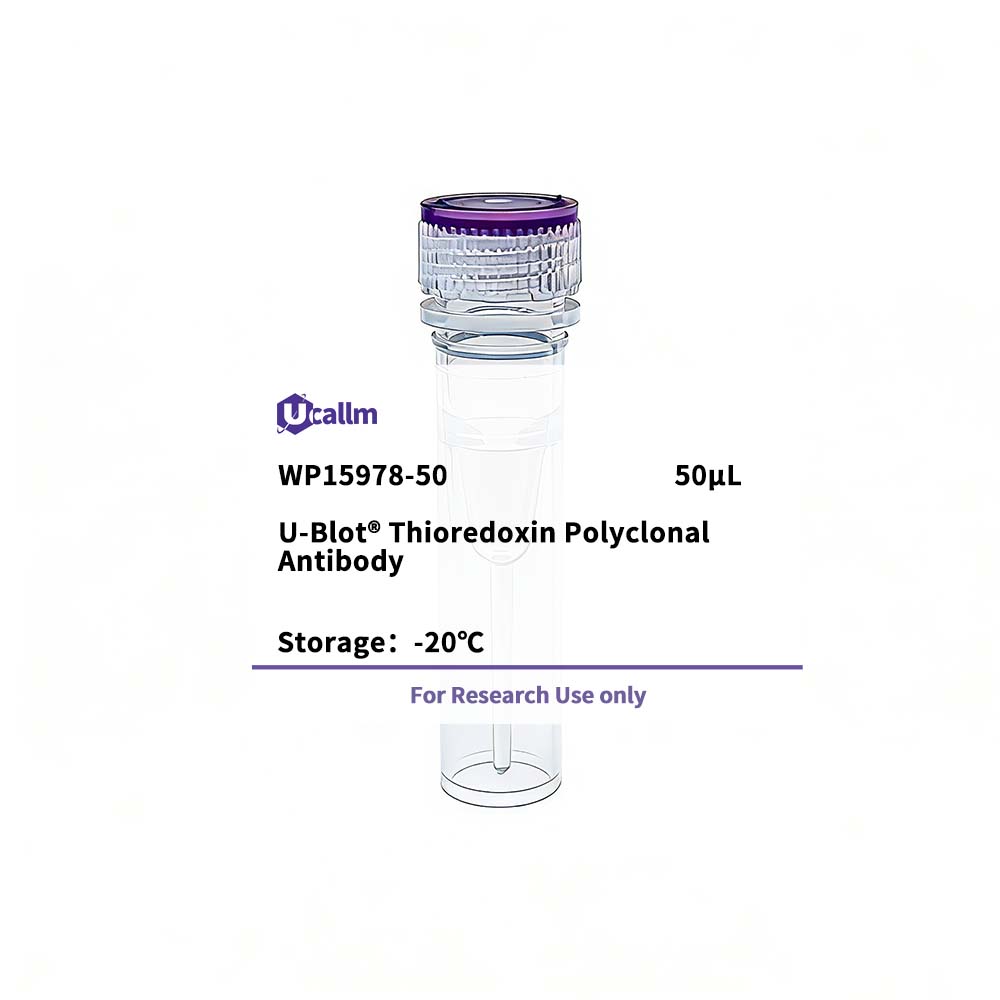
SKU: WP15978 Categories: ,

Thioredoxin Polyclonal Antibody

Price range: $268.00 through $328.00

SKU: WP15978-100
Enter the quantity you would like, or drag the panel to find the quantity and price that best for you
Bulk QuoteAuthorize OEM & ODM

Product details

Background:

The protein encoded by this gene acts as a homodimer and is involved in many redox reactions. The encoded protein is active in the reversible S-nitrosylation of cysteines in certain proteins, which is part of the response to intracellular nitric oxide. This protein is found in the cytoplasm. Two transcript variants encoding different isoforms have been found for this gene. [provided by RefSeq, Oct 2011],

Specifications

Size50μL/100μL
TargetThioredoxin
ReactivityHuman, Mouse, Rat
ApplicationsWB, IHC, IF, ELISA
MW(Calculated)
MW(Observed)12kD
Host SpeciesRabbit
IsotypeIgG
Conjugate/ModificationUnmodified
Recommended Dilution RatioIHC: 100-300; WB 1:500-2000; ELISA 1:10000-20000; IF 1:50-200 / Note: For IHC, we suggest antigen retrieval with TE buffer pH 9.0 (Cat#WT1004)
FormulationLiquid in PBS containing 50% glycerol, 0.5% BSA and 0.02% sodium azide.
PurificationThe antibody was affinity-purified from rabbit antiserum by affinity-chromatography using epitope-specific immunogen.
Storage-15°C to -25°C/1 year(Do not lower than -25°C)
Concentration1 mg/ml
ClonalityPolyclonal
Clone Number
ImmunogenSynthesized peptide derived from human Thioredoxin. at AA range: 52-101
SpecificityThis antibody detects endogenous levels of Thioredoxin
Gene NameTXN TRDX TRX TRX1
Protein NameThioredoxin
Other NameThioredoxin; / Trx; / ATL-derived factor; / ADF; / Surface-associated sulphydryl protein; / SASP
SpeciesHuman
Gene ID7295
UniprotP10599,
Species.1Mouse
Gene ID.122166
Uniprot.1P10639
Species.2
Gene ID.2
Uniprot.2
Cellular LocalizationNucleus . Cytoplasm . Secreted . Translocates from the cytoplasm into the nucleus after phorbol 12-myristate 13-acetate induction (PMA) (PubMed:9108029). Predominantly in the cytoplasm in non irradiated cells (PubMed:11118054). Radiation induces translocation of TRX from the cytoplasm to the nucleus (PubMed:11118054). Secreted by a leaderless secretory pathway (PubMed:1332947). .
Tissue ExpressionBrain,Cajal-Retzius cell,Cerebellum,Cervix,Epithelium,Fetal brain cortex,Hepatocyte,Lens,Ma
Signaling_pathwayOrganismal Systems >> Immune system >> NOD-like receptor signaling pathway;Human Diseases >> Neurodegenerative disease >> Parkinson disease
Research Areas>>NOD-like receptor signaling pathway; / >>Parkinson disease; / >>Salmonella infection; / >>Fluid shear stress and atherosclerosis
FunctionFunction:ADF augments the expression of the interleukin-2 receptor TAC (IL2R/P55).,Function:Participates in various redox reactions through the reversible oxidation of its active center dithiol to a disulfide and catalyzes dithiol-disulfide exchange reactions. Plays a role in the reversible S-nitrosylation of cysteine residues in target proteins, and thereby contributes to the response to intracellular nitric oxide. Nitrosylates the active site Cys of CASP3 in response to nitric oxide (NO), and thereby inhibits caspase-3 activity.,PTM:In the fully reduced protein, both Cys-69 and Cys-73 are nitrosylated in response to nitric oxide (NO). When two disulfide bonds are present in the protein, only Cys-73 is nitrosylated. Cys-73 can serve as donor for nitrosylation of target proteins.,similarity:Belongs to the thioredoxin family.,similarity:Contains 1 thioredoxin domain.,subunit:Homodimer; disulfide-linked. Interacts with TXNIP through the redox-active site. Interacts with MAP3K5 and CASP3.,
Please login to post questions
Back to Top
Product has been added to your cart