


TIP60 Polyclonal Antibody
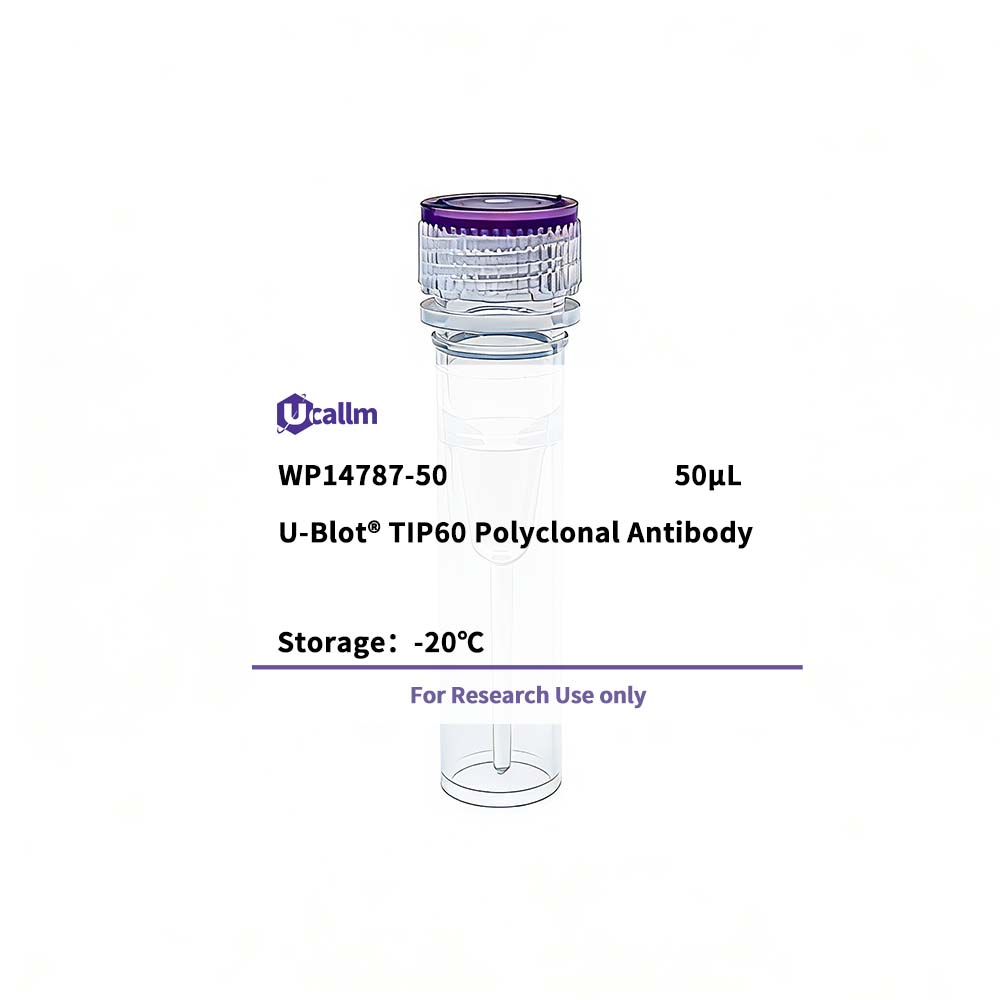
Ucallm_WP14787-50
Price range: $268.00 through $328.00
Product details
Background:
The protein encoded by this gene belongs to the MYST family of histone acetyl transferases (HATs) and was originally isolated as an HIV-1 TAT-interactive protein. HATs play important roles in regulating chromatin remodeling, transcription and other nuclear processes by acetylating histone and nonhistone proteins. This protein is a histone acetylase that has a role in DNA repair and apoptosis and is thought to play an important role in signal transduction. Alternative splicing of this gene results in multiple transcript variants. [provided by RefSeq, Jul 2008],
Specifications
| Size | 50μL/100μL |
| Target | TIP60 |
| Reactivity | Human, Mouse |
| Applications | IHC, IF, ELISA |
| MW(Calculated) | 59kD |
| MW(Observed) | |
| Host Species | Rabbit |
| Isotype | IgG |
| Conjugate/Modification | Unmodified |
| Recommended Dilution Ratio | IHC 1:100-1:300; IF 1:200-1:1000; ELISA 1:5000; Not yet tested in other applications. / Note: For IHC, we suggest antigen retrieval with TE buffer pH 9.0 (Cat#WT1004) |
| Formulation | Liquid in PBS containing 50% glycerol, 0.5% BSA and 0.02% sodium azide. |
| Purification | The antibody was affinity-purified from rabbit antiserum by affinity-chromatography using epitope-specific immunogen. |
| Storage | -15°C to -25°C/1 year(Do not lower than -25°C) |
| Concentration | 1 mg/ml |
| Clonality | Polyclonal |
| Clone Number | |
| Immunogen | The antiserum was produced against synthesized peptide derived from human TIP60. AA range:52-101 |
| Specificity | TIP60 Polyclonal Antibody detects endogenous levels of TIP60 protein. |
| Gene Name | KAT5 |
| Protein Name | Histone acetyltransferase KAT5 |
| Other Name | KAT5; / HTATIP; / TIP60; / Histone acetyltransferase KAT5; / 60 kDa Tat-interactive protein; / Tip60; / Histone acetyltransferase HTATIP; / HIV-1 Tat interactive protein; / Lysine acetyltransferase 5; / cPLA; / 2; / -interacting protein |
| Species | Human |
| Gene ID | 10524 |
| Uniprot | Q92993, |
| Species.1 | Mouse |
| Gene ID.1 | 81601 |
| Uniprot.1 | Q8CHK4 |
| Species.2 | |
| Gene ID.2 | |
| Uniprot.2 | |
| Cellular Localization | Nucleus . Chromosome . Cytoplasm . Chromosome, centromere, kinetochore . Cytoplasm, cytoskeleton, spindle pole . Nucleus, nucleolus . Cytoplasm, perinuclear region . Upon stimulation with EDN1, it is exported from the nucleus to the perinuclear region and UV irradiation induces translocation into punctuate subnuclear structures named nuclear bodies (PubMed:11262386). Transiently localizes to kinetochores in early mitosis (PubMed:26829474). Localizes to spindle poles when chromosomes align during metaphase (PubMed:34608293). Localizes in the cytoplasm and nucleus of round spermatids (By similarity). . |
| Tissue Expression | Brain, |
| Signaling_pathway | Human Diseases >> Neurodegenerative disease >> Spinocerebellar ataxia;Genetic Information Processing >> Chromosome >> ATP-dependent chromatin remodeling |
| Research Areas | >>Spinocerebellar ataxia; / >>Human T-cell leukemia virus 1 infection |
| Function | negative regulation of transcription from RNA polymerase II promoter, regulation of cytokine production, negative regulation of cytokine production, DNA metabolic process, DNA repair, double-strand break repair, chromatin organization, chromatin assembly or disassembly, transcription, regulation of transcription, DNA-dependent, regulation of transcription from RNA polymerase II promoter, protein amino acid acetylation, response to DNA damage stimulus,DNA damage response, signal transduction by p53 class mediator resulting in transcription of p21 class mediator,intracellular signaling cascade, negative regulation of biosynthetic process, positive regulation of biosynthetic process,regulation of specific transcription from RNA polymerase II promoter, negative regulation of specific transcription from RNA polymerase II promoter, positive regulation of macromolecule biosynthetic process, negative regulation of macromolecule biosynthetic process, positive regulation of macromolecule metabolic process, negative regulation of macromolecule metabolic process, positive regulation of gene expression, negative regulation of gene expression,negative regulation of transcription, chromatin modification, covalent chromatin modification, histone modification,histone acetylation, DNA damage response, signal transduction by p53 class mediator, steroid hormone receptor signaling pathway, androgen receptor signaling pathway, intracellular receptor-mediated signaling pathway, negative regulation of cellular biosynthetic process, positive regulation of cellular biosynthetic process, negative regulation of gene-specific transcription, regulation of gene-specific transcription, regulation of interleukin-2 production, negative regulation of interleukin-2 production, cellular response to stress, regulation of growth, DNA damage response, signal transduction, DNA damage response, signal transduction resulting in transcription, protein amino acid acylation,regulation of transcription, negative regulation of transcription, DNA-dependent, positive regulation of transcription, DNA-dependent, negative regulation of nucleobase, nucleoside, nucleotide and nucleic acid metabolic process, positive regulation of nucleobase, nucleoside, nucleotide and nucleic acid metabolic process, positive regulation of transcription, positive regulation of transcription from RNA polymerase II promoter, negative regulation of nitrogen compound metabolic process, positive regulation of nitrogen compound metabolic process, negative regulation of multicellular organismal process, regulation of RNA metabolic process, negative regulation of RNA metabolic process,positive regulation of RNA metabolic process, chromosome organization, |
Please login to post questions
Related products


