


TLE1 rabbit pAb
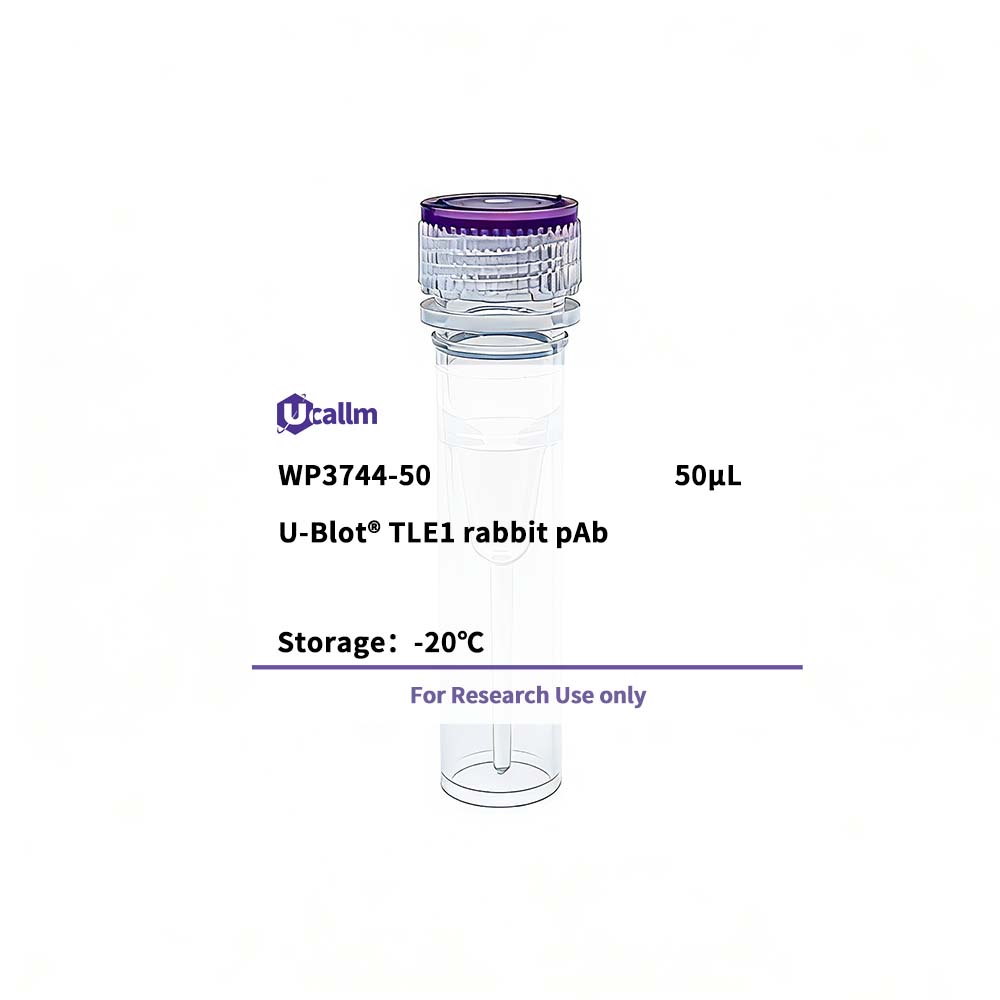
Ucallm_WP3744-50
Price range: $268.00 through $328.00
Product details
Background:
Specifications
| Size | 50μL/100μL |
| Target | TLE1 |
| Reactivity | Human, Mouse |
| Applications | WB |
| MW(Calculated) | |
| MW(Observed) | 85kD |
| Host Species | Rabbit |
| Isotype | IgG |
| Conjugate/Modification | Unmodified |
| Recommended Dilution Ratio | WB 1:500-2000 |
| Formulation | Liquid in PBS containing 50% glycerol, 0.5% BSA and 0.02% sodium azide. |
| Purification | The antibody was affinity-purified from rabbit antiserum by affinity-chromatography using epitope-specific immunogen. |
| Storage | -15°C to -25°C/1 year(Do not lower than -25°C) |
| Concentration | 1 mg/ml |
| Clonality | Polyclonal |
| Clone Number | |
| Immunogen | Synthesized peptide derived from human TLE1 AA range: 300-350 |
| Specificity | This antibody detects endogenous levels of TLE1 at Human/Mouse |
| Gene Name | TLE1 |
| Protein Name | TLE1 |
| Other Name | Transducin-like enhancer protein 1; / E; / Sp1; / homolog; / Enhancer of split groucho-like protein 1; / ESG1 |
| Species | Human |
| Gene ID | 7088 |
| Uniprot | Q04724, |
| Species.1 | Mouse |
| Gene ID.1 | 21885 |
| Uniprot.1 | Q62440 |
| Species.2 | |
| Gene ID.2 | |
| Uniprot.2 | |
| Cellular Localization | Nucleus . Nuclear and chromatin-associated, depending on isoforms and phosphorylation status. Hyperphosphorylation decreases the affinity for nuclear components. |
| Tissue Expression | In all tissues examined, mostly in brain, liver and muscle. |
| Signaling_pathway | Environmental Information Processing >> Signal transduction >> Wnt signaling pathway;Environmental Information Processing >> Signal transduction >> Notch signaling pathway |
| Research Areas | >>Wnt signaling pathway; / >>Notch signaling pathway |
| Function | Function:Transcriptional corepressor that binds to a number of transcription factors. Inhibits NF-kappa-B-regulated gene expression. Inhibits the transcriptional activation mediated by FOXA2, and by CTNNB1 and TCF family members in Wnt signaling. The effects of full-length TLE family members may be modulated by association with dominant-negative AES. Unusual function as coactivator for ESRRG.,PTM:Phosphorylated, probably by CDC2. The degree of phosphorylation varies throughout the cell cycle, and is highest at the G2/M transition. Becomes hyperphosphorylated in response to cell differentiation and interaction with HES1 or RUNX1.,similarity:Belongs to the WD repeat Groucho/TLE family.,similarity:Contains 6 WD repeats.,subcellular location:Nuclear and chromatin-associated, depending on isoforms and phosphorylation status. Hyperphosphorylation decreases the affinity for nuclear components.,subunit:Homooligomer and heterooligomer with other family members. Binds LEF1, RUNX1, RUNX3, FOXA2, KDM6A, UTY, histone H3, HESX1, ESRRG and the NF-kappa-B subunit RELA. Interacts with HES1 (via WRPW motif).,tissue specificity:In all tissues examined, mostly in brain, liver and muscle., |
Please login to post questions
Related products


