

Product details
Background:
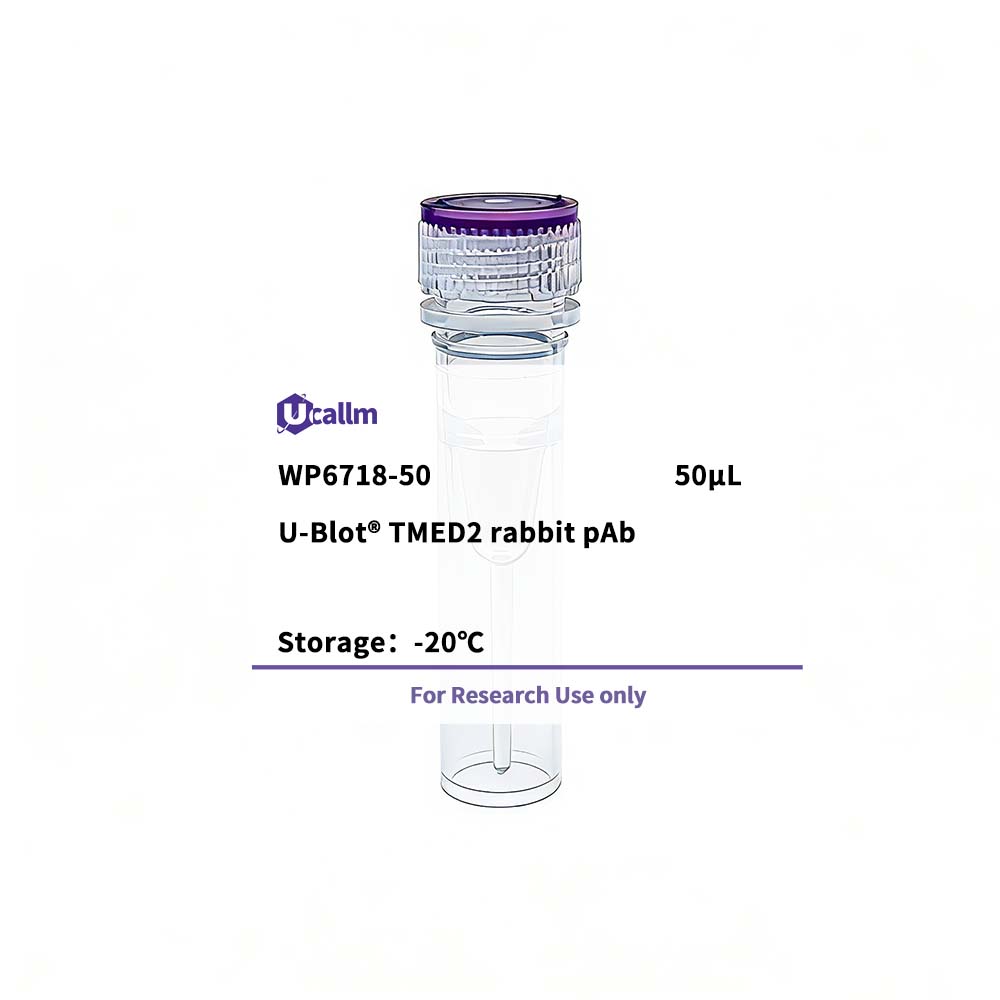
Price range: $268.00 through $328.00
Background:
| Size | 50μL/100μL |
| Target | TMED2 |
| Reactivity | Human, Mouse, Rat |
| Applications | WB |
| MW(Calculated) | 22kD |
| MW(Observed) | |
| Host Species | Rabbit |
| Isotype | IgG |
| Conjugate/Modification | Unmodified |
| Recommended Dilution Ratio | WB 1:500-2000 |
| Formulation | Liquid in PBS containing 50% glycerol, 0.5% BSA and 0.02% sodium azide. |
| Purification | The antibody was affinity-purified from rabbit antiserum by affinity-chromatography using epitope-specific immunogen. |
| Storage | -15°C to -25°C/1 year(Do not lower than -25°C) |
| Concentration | 1 mg/ml |
| Clonality | Polyclonal |
| Clone Number | |
| Immunogen | Synthesized peptide derived from human TMED2 |
| Specificity | This antibody detects endogenous levels of TMED2 at Human, Mouse,Rat |
| Gene Name | TMED2 RNP24 |
| Protein Name | Transmembrane emp24 domain-containing protein 2 (Membrane protein p24A) (p24) (p24 family protein beta-1) (p24beta1) |
| Other Name | |
| Species | Human |
| Gene ID | 10959 |
| Uniprot | Q15363, |
| Species.1 | Mouse |
| Gene ID.1 | 56334 |
| Uniprot.1 | Q9R0Q3, |
| Species.2 | Rat |
| Gene ID.2 | 65165 |
| Uniprot.2 | Q63524 |
| Cellular Localization | Cytoplasmic vesicle membrane; Single-pass type I membrane protein . Cytoplasmic vesicle, COPI-coated vesicle membrane; Single-pass type I membrane protein . Golgi apparatus, cis-Golgi network membrane; Single-pass type I membrane protein . Golgi apparatus, Golgi stack membrane; Single-pass type I membrane protein . Endoplasmic reticulum membrane; Single-pass type I membrane protein . Endoplasmic reticulum-Golgi intermediate compartment membrane; Single-pass type I membrane protein . Cycles between compartments of the early secretatory pathway. . |
| Tissue Expression | |
| Signaling_pathway | |
| Research Areas | |
| Function | Involved in vesicular protein trafficking. Mainly functions in the early secretory pathway but also in post-Golgi membranes. Thought to act as cargo receptor at the lumenal side for incorporation of secretory cargo molecules into transport vesicles and to be involved in vesicle coat formation at the cytoplasmic side. In COPII vesicle-mediated anterograde transport involved in the transport of GPI-anchored proteins and proposed to act together with TMED10 as their cargo receptor; the function specifically implies SEC24C and SEC24D of the COPII vesicle coat and lipid raft-like microdomains of the ER. Recognizes GPI anchors structural remodeled in the ER by PGAP1 and MPPE1. In COPI vesicle-mediated retrograde transport inhibits the GTPase-activating activity of ARFGAP1 towards ARF1 thus preventing immature uncoating and allowing cargo selection to take place. Involved in trafficking of G protein-coupled receptors (GPCRs). Regulates F2RL1, OPRM1 and P2RY4 exocytic trafficking from the Golgi to the plasma membrane thus contributing to receptor resensitization. Facilitates CASR maturation and stabilization in the early secretory pathway and increases CASR plasma membrane targeting. Proposed to be involved in organization of intracellular membranes such as the maintenance of the Golgi apparatus. May also play a role in the biosynthesis of secreted cargo such as eventual processing. |




