


TNK1 Monoclonal Antibody
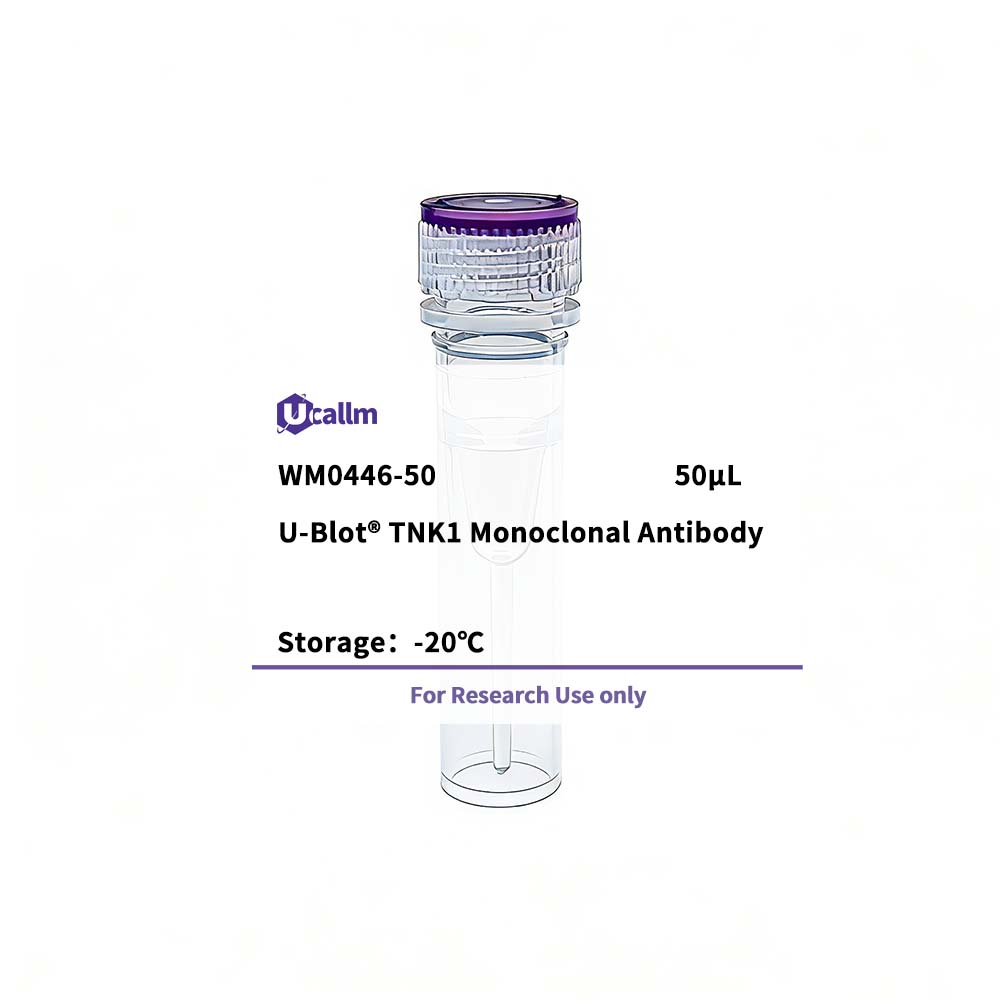
Ucallm_WM0446-50
Price range: $268.00 through $328.00
Product details
Background:
The protein encoded by this gene belongs to the tyrosine protein kinase family. Tyrosine protein kinases are important regulators of intracellular signal transduction pathways, mediating cellular proliferation, survival, and development. This gene is highly expressed in fetal tissues and at lower levels in few adult tissues, thus may function in signaling pathways utilized broadly during fetal development, and more selectively in adult tissues. It plays a negative regulatory role in the Ras-Raf1-MAPK pathway, and knockout mice have been shown to develop spontaneous tumors, suggesting a role as a tumor suppressor gene. Alternatively spliced transcript variants encoding different isoforms have been found for this gene. [provided by RefSeq, Oct 2011],
Specifications
| Size | 50μL/100μL |
| Target | TNK1 |
| Reactivity | Human |
| Applications | WB, ELISA |
| MW(Calculated) | 72kD |
| MW(Observed) | |
| Host Species | Mouse |
| Isotype | |
| Conjugate/Modification | Unmodified |
| Recommended Dilution Ratio | WB 1:500-1:2000; ELISA 1:10000; Not yet tested in other applications. |
| Formulation | Liquid in PBS containing 50% glycerol, 0.5% BSA and 0.02% sodium azide. |
| Purification | Affinity purification |
| Storage | -15°C to -25°C/1 year(Do not lower than -25°C) |
| Concentration | |
| Clonality | Monoclonal |
| Clone Number | 17D8 |
| Immunogen | Purified recombinant fragment of TNK1 (aa451-560) expressed in E. Coli. |
| Specificity | TNK1 Monoclonal Antibody detects endogenous levels of TNK1 protein. |
| Gene Name | TNK1 |
| Protein Name | Non-receptor tyrosine-protein kinase TNK1 |
| Other Name | TNK1; / Non-receptor tyrosine-protein kinase TNK1; / CD38 negative kinase 1 |
| Species | Human |
| Gene ID | 8711 |
| Uniprot | Q13470 |
| Species.1 | |
| Gene ID.1 | |
| Uniprot.1 | |
| Species.2 | |
| Gene ID.2 | |
| Uniprot.2 | |
| Cellular Localization | Cytoplasm . Membrane; Peripheral membrane protein . |
| Tissue Expression | Expressed in all umbilical cord blood, bone marrow and adult blood cell sub-populations and in several leukemia cell lines. Highly expressed in fetal blood, brain, lung, liver and kidney. Detected at lower levels in adult prostate, testis, ovary, small intestine and colon. Not expressed in adult lung, liver, kidney or brain. |
| Signaling_pathway | |
| Research Areas | |
| Function | Catalytic activity:ATP + a [protein]-L-tyrosine = ADP + a [protein]-L-tyrosine phosphate.,Function:Involved in negative regulation of cell growth. Has tumor suppressor properties. Plays a negative regulatory role in the Ras-MAPK pathway. May function in signaling pathways utilized broadly during fetal development and more selectively in adult tissues and in cells of the lymphohematopoietic system. Could specifically be involved in phospholipid signal transduction.,PTM:Autophosphorylated on tyrosine residues.,similarity:Belongs to the protein kinase superfamily. Tyr protein kinase family.,similarity:Contains 1 protein kinase domain.,similarity:Contains 1 SH3 domain.,subunit:Interacts with the SH3 domain of PLCG1 via its Pro-rich domain.,tissue specificity:Expressed in all umbilical cord blood, bone marrow and adult blood cell sub-populations and in several leukemia cell lines. Highly expressed in fetal blood, brain, lung, liver and kidney. Detected at lower levels in adult prostate, testis, ovary, small intestine and colon. Not expressed in adult lung, liver, kidney or brain., |
Please login to post questions
Related products





