


Topo I Polyclonal Antibody
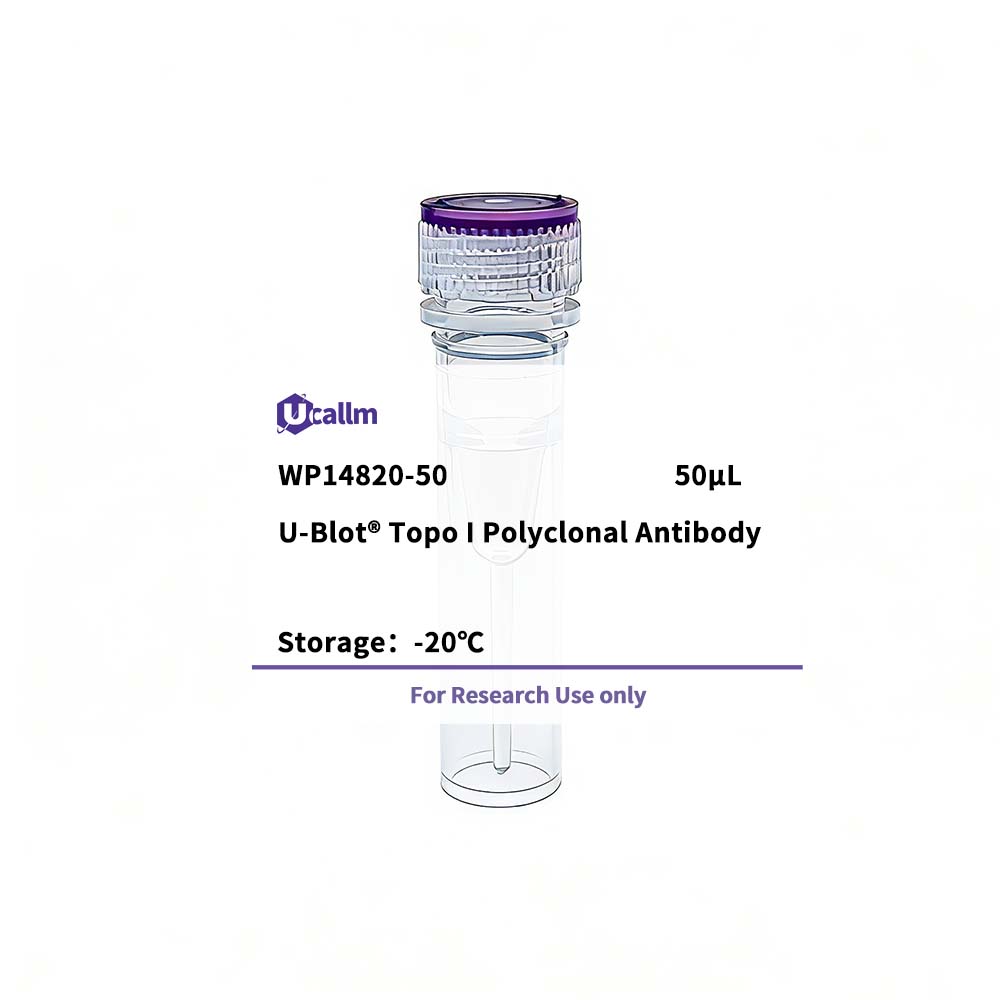
Ucallm_WP14820-50
Price range: $268.00 through $328.00
Product details
Background:
This gene encodes a DNA topoisomerase, an enzyme that controls and alters the topologic states of DNA during transcription. This enzyme catalyzes the transient breaking and rejoining of a single strand of DNA which allows the strands to pass through one another, thus altering the topology of DNA. This gene is localized to chromosome 20 and has pseudogenes which reside on chromosomes 1 and 22. [provided by RefSeq, Jul 2008],
Specifications
| Size | 50μL/100μL |
| Target | Topoisomerase I |
| Reactivity | Human, Mouse, Rat |
| Applications | WB, ELISA |
| MW(Calculated) | |
| MW(Observed) | 90kD |
| Host Species | Rabbit |
| Isotype | IgG |
| Conjugate/Modification | Unmodified |
| Recommended Dilution Ratio | WB 1:500-1:2000; ELISA 1:40000; Not yet tested in other applications. |
| Formulation | Liquid in PBS containing 50% glycerol, 0.5% BSA and 0.02% sodium azide. |
| Purification | The antibody was affinity-purified from rabbit antiserum by affinity-chromatography using epitope-specific immunogen. |
| Storage | -15°C to -25°C/1 year(Do not lower than -25°C) |
| Concentration | 1 mg/ml |
| Clonality | Polyclonal |
| Clone Number | |
| Immunogen | Synthesized peptide derived from the Internal region of human Topo I. |
| Specificity | Topo I Polyclonal Antibody detects endogenous levels of Topo I protein. |
| Gene Name | TOP1 |
| Protein Name | DNA topoisomerase 1 |
| Other Name | TOP1; / DNA topoisomerase 1; / DNA topoisomerase I |
| Species | Human |
| Gene ID | 7150 |
| Uniprot | P11387, |
| Species.1 | Mouse |
| Gene ID.1 | 21969 |
| Uniprot.1 | Q04750, |
| Species.2 | Rat |
| Gene ID.2 | 64550 |
| Uniprot.2 | Q9WUL0 |
| Cellular Localization | Nucleus, nucleolus . Nucleus, nucleoplasm . Diffuse nuclear localization with some enrichment in nucleoli. On CPT treatment, cleared from nucleoli into nucleoplasm. Sumoylated forms found in both nucleoplasm and nucleoli. |
| Tissue Expression | Endothelial cells. |
| Signaling_pathway | |
| Research Areas | |
| Function | Catalytic activity:ATP-independent breakage of single-stranded DNA, followed by passage and rejoining.,Disease:A chromosomal aberration involving TOP1 is found in a form of therapy-related myelodysplastic syndrome. Translocation t(11; 20)(p15; q11) with NUP98.,enzyme regulation:Specifically inhibited by camptothecin (CPT), a plant alkaloid with antitumor activity.,Function:The reaction catalyzed by topoisomerases leads to the conversion of one topological isomer of DNA to another.,miscellaneous:Eukaryotic topoisomerase I and II can relax both negative and positive supercoils, whereas prokaryotic enzymes relax only negative supercoils.,miscellaneous:When a topoisomerase transiently breaks a DNA backbone bond, it simultaneously forms a protein-DNA link, in which a tyrosyl oxygen in the enzyme is joined to a DNA phosphorus at one end of the enzyme-severed DNA strand.,PTM:Sumoylated. Lys-117 is the main site of sumoylation. Sumoylation plays a role in partitioning TOP1 between nucleoli and nucleoplasm. Levels are dramatically increased on camptothecin (CPT) treatment.,similarity:Belongs to the eukaryotic type I topoisomerase family.,subcellular location:Diffuse nuclear localization with some enrichment in nucleoli. On CPT treatment, cleared from nucleoli into nucleoplasm. Sumolyated forms found in both nucleoplasm and nucleoli.,subunit:Monomer. Interacts with SV40 Large T antigen; this interactions allows viral DNA replication., |
Please login to post questions
Related products


