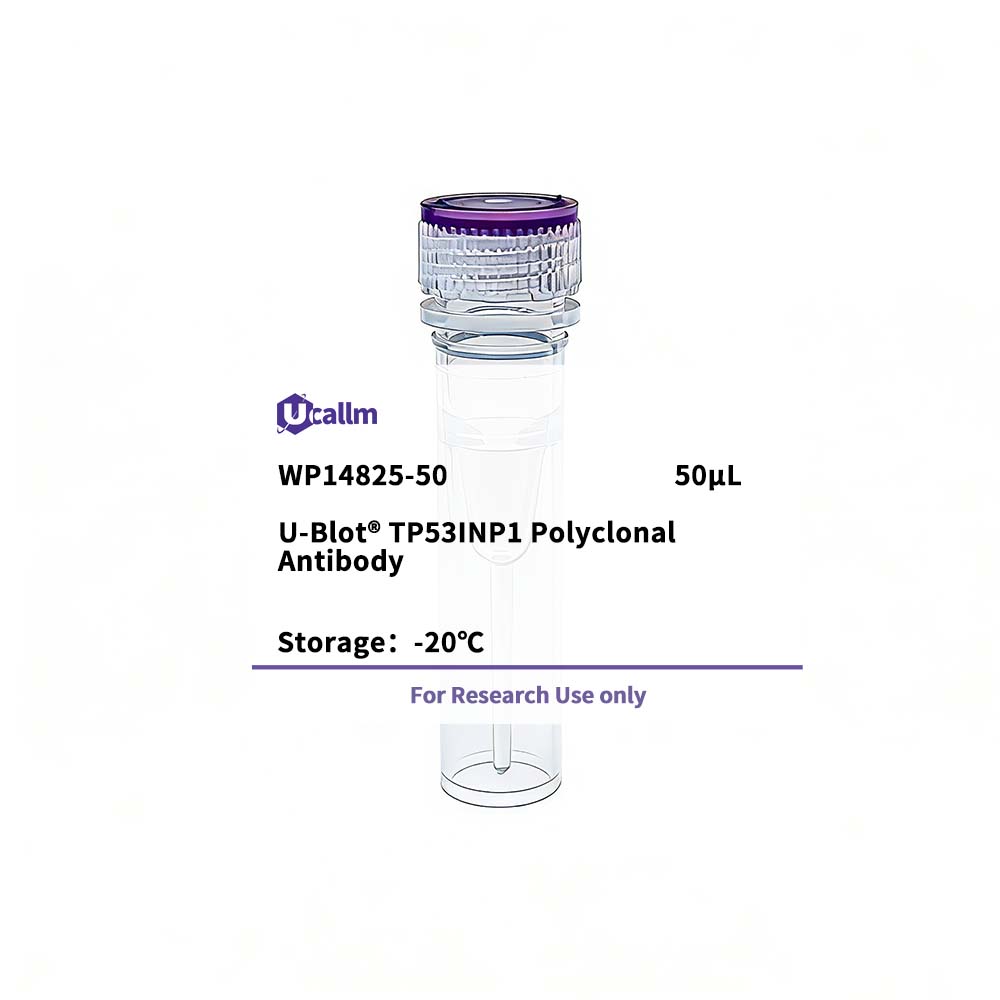
SKU: WP14825 Categories: ,

TP53INP1 Polyclonal Antibody

Price range: $268.00 through $328.00

SKU: WP14825-100
Enter the quantity you would like, or drag the panel to find the quantity and price that best for you
Bulk QuoteAuthorize OEM & ODM

Product details

Background:

function:In response to double-strand DNA breaks, promotes p53/TP53 phosphorylation on ‘Ser-46’ and subsequent apoptosis., induction:By adriamycin, gamma irradiation and H(2)O(2), in a p53-dependent way. At lower levels by ultraviolet irradiation., subcellular location:Concentrated in PML/POD/ND10 nuclear bodies., subunit:Interacts with TP53 and HIPK2., tissue specificity:Ubiquitously expressed.,

Specifications

Size50μL/100μL
TargetTP53INP1
ReactivityHuman
ApplicationsWB, IHC, IF, ELISA
MW(Calculated)
MW(Observed)27kD
Host SpeciesRabbit
IsotypeIgG
Conjugate/ModificationUnmodified
Recommended Dilution RatioWB 1:500-1:2000; IHC 1:100-1:300; ELISA 1:40000; IF 1:50-200 / Note: For IHC, we suggest antigen retrieval with TE buffer pH 9.0 (Cat#WT1004)
FormulationLiquid in PBS containing 50% glycerol, 0.5% BSA and 0.02% sodium azide.
PurificationThe antibody was affinity-purified from rabbit antiserum by affinity-chromatography using epitope-specific immunogen.
Storage-15°C to -25°C/1 year(Do not lower than -25°C)
Concentration1 mg/ml
ClonalityPolyclonal
Clone Number
ImmunogenThe antiserum was produced against synthesized peptide derived from human TP53INP1. AA range:171-220
SpecificityTP53INP1 Polyclonal Antibody detects endogenous levels of TP53INP1 protein.
Gene NameTP53INP1
Protein NameTumor protein p53-inducible nuclear protein 1
Other NameTP53INP1; / P53DINP1; / SIP; / Tumor protein p53-inducible nuclear protein 1; / Stress-induced protein; / p53-dependent damage-inducible nuclear protein 1; / p53DINP1
SpeciesHuman
Gene ID94241
UniprotQ96A56,
Species.1Mouse
Gene ID.1
Uniprot.1Q9QXE4
Species.2
Gene ID.2
Uniprot.2
Cellular LocalizationCytoplasm, cytosol. Nucleus. Nucleus, PML body. Cytoplasmic vesicle, autophagosome. Shuttles between the nucleus and the cytoplasm, depending on cellular stress conditions, and re-localizes to autophagosomes on autophagy activation.
Tissue ExpressionUbiquitously expressed.
Signaling_pathway
Research Areas
FunctionFunction:In response to double-strand DNA breaks, promotes p53/TP53 phosphorylation on 'Ser-46' and subsequent apoptosis.,induction:By adriamycin, gamma irradiation and H(2)O(2), in a p53-dependent way. At lower levels by ultraviolet irradiation.,subcellular location:Concentrated in PML/POD/ND10 nuclear bodies.,subunit:Interacts with TP53 and HIPK2.,tissue specificity:Ubiquitously expressed.,
Please login to post questions
Back to Top
Product has been added to your cart

