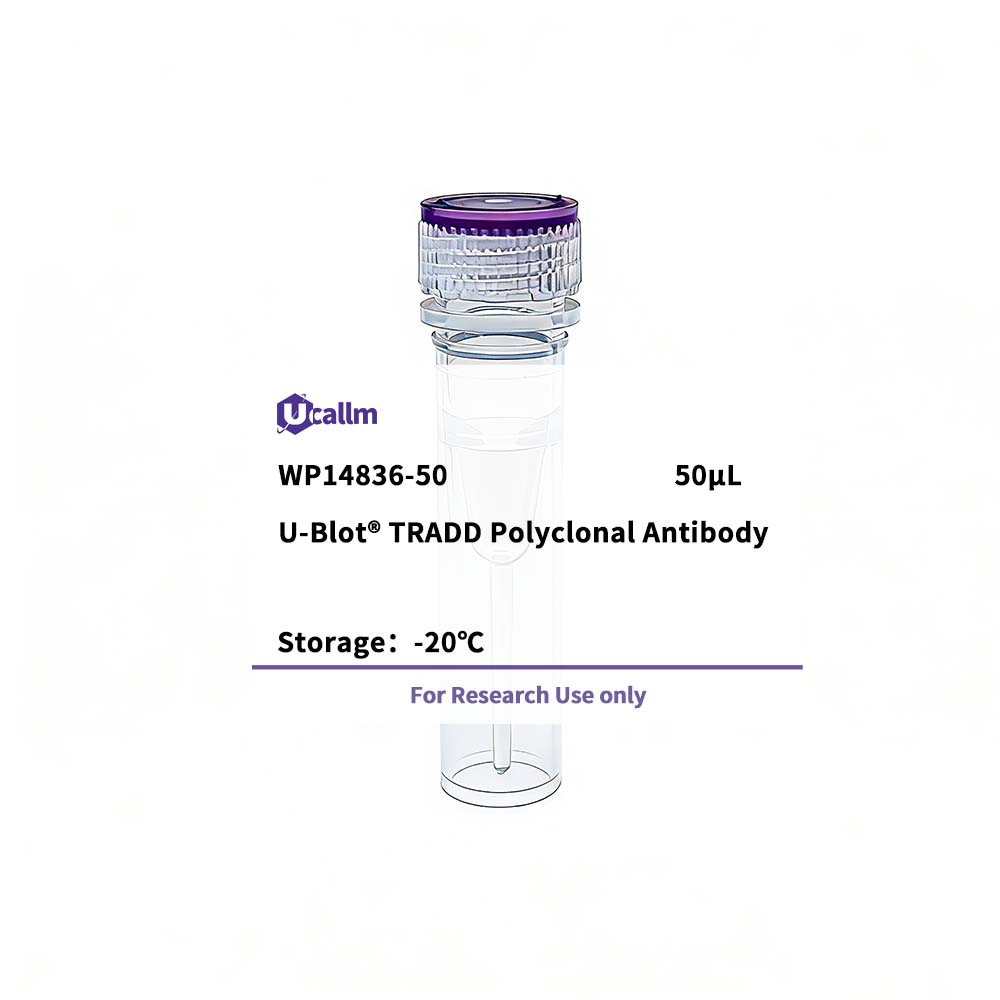
SKU: WP14836 Categories: ,

TRADD Polyclonal Antibody

Price range: $268.00 through $328.00

SKU: WP14836-100
Enter the quantity you would like, or drag the panel to find the quantity and price that best for you
Bulk QuoteAuthorize OEM & ODM

Product details

Background:

The protein encoded by this gene is a death domain containing adaptor molecule that interacts with TNFRSF1A/TNFR1 and mediates programmed cell death signaling and NF-kappaB activation. This protein binds adaptor protein TRAF2, reduces the recruitment of inhibitor-of-apoptosis proteins (IAPs) by TRAF2, and thus suppresses TRAF2 mediated apoptosis. This protein can also interact with receptor TNFRSF6/FAS and adaptor protein FADD/MORT1, and is involved in the Fas-induced cell death pathway. [provided by RefSeq, Jul 2008],


Specifications

Size50μL/100μL
TargetTRADD
ReactivityHuman, Mouse, Monkey
ApplicationsWB, IHC, IF, ELISA
MW(Calculated)
MW(Observed)34kD
Host SpeciesRabbit
IsotypeIgG
Conjugate/ModificationUnmodified
Recommended Dilution RatioWB 1:500-1:2000; IHC 1:100-1:300; ELISA 1:10000; IF 1:50-200 / Note: For IHC, we suggest antigen retrieval with TE buffer pH 9.0 (Cat#WT1004)
FormulationLiquid in PBS containing 50% glycerol, 0.5% BSA and 0.02% sodium azide.
PurificationThe antibody was affinity-purified from rabbit antiserum by affinity-chromatography using epitope-specific immunogen.
Storage-15°C to -25°C/1 year(Do not lower than -25°C)
Concentration1 mg/ml
ClonalityPolyclonal
Clone Number
ImmunogenThe antiserum was produced against synthesized peptide derived from human TRADD. AA range:251-300
SpecificityTRADD Polyclonal Antibody detects endogenous levels of TRADD protein.
Gene NameTRADD
Protein NameTumor necrosis factor receptor type 1-associated DEATH domain protein
Other NameTRADD; / Tumor necrosis factor receptor type 1-associated DEATH domain protein; / TNFR1-associated DEATH domain protein; / TNFRSF1A-associated via death domain
SpeciesHuman
Gene ID8717
UniprotQ15628,
Species.1Mouse
Gene ID.171609
Uniprot.1Q3U0V2
Species.2
Gene ID.2
Uniprot.2
Cellular LocalizationNucleus . Cytoplasm . Cytoplasm, cytoskeleton . Shuttles between the cytoplasm and the nucleus. .
Tissue ExpressionFound in all examined tissues.
Signaling_pathwayCellular Processes >> Cell growth and death >> Apoptosis;Cellular Processes >> Cell growth and death >> Necroptosis;Organismal Systems >> Immune system >> RIG-I-like receptor signaling pathway;Organismal Systems >> Immune system >> IL-17 signaling pathway;Organismal Systems >> Endocrine system >> Adipocytokine signaling pathway;Environmental Information Processing >> Signal transduction >> MAPK signaling pathway;Environmental Information Processing >> Signal transduction >> NF-kappa B signaling pathway;Environmental Information Processing >> Signal transduction >> TNF signaling pathway;Environmental Information Processing >> Signal transduction >> Sphingolipid signaling pathway
Research Areas>>MAPK signaling pathway; / >>NF-kappa B signaling pathway; / >>Sphingolipid signaling pathway; / >>Apoptosis; / >>Necroptosis; / >>RIG-I-like receptor signaling pathway; / >>IL-17 signaling pathway; / >>TNF signaling pathway; / >>Adipocytokine signaling pathway; / >>Alcoholic liver disease; / >>Pathogenic Escherichia coli infection; / >>Shigellosis; / >>Salmonella infection; / >>Tuberculosis; / >>Hepatitis C; / >>Measles; / >>Human cytomegalovirus infection; / >>Influenza A; / >>Human papillomavirus infection; / >>Kaposi sarcoma-associated herpesvirus infection; / >>Herpes simplex virus 1 infection; / >>Epstein-Barr virus infection; / >>Human immunodeficiency virus 1 infection; / >>Viral carcinogenesis
FunctionDomain:Requires the intact DEATH domain to associate with TNFRSF1A/TNFR1.,Function:Adapter molecule for TNFRSF1A/TNFR1 that specifically associates with the cytoplasmic domain of activated TNFRSF1A/TNFR1 mediating its interaction with FADD. Overexpression of TRADD leads to two major TNF-induced responses, apoptosis and activation of NF-kappa-B.,similarity:Contains 1 death domain.,subunit:Heterodimer with TNFRSF1A/TNFR1. Interacts with DAB2IP, FADD, HIPK2, KRT14, KRT16, KRT17, KRT18, RIPK1, SQSTM1, TRAF1, TRAF2 and TRPC4AP.,tissue specificity:Found in all examined tissues.,
Please login to post questions
Back to Top
Product has been added to your cart