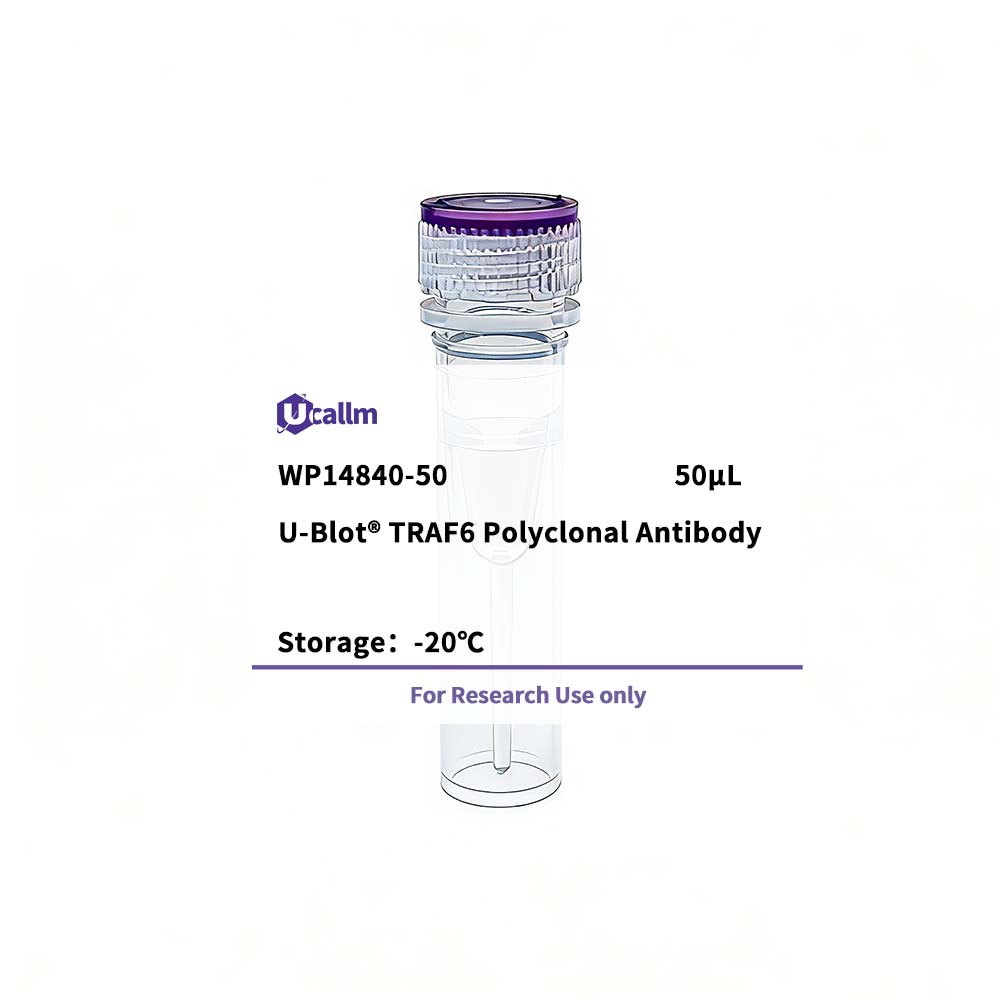
SKU: WP14840 Categories: ,

TRAF6 Polyclonal Antibody

Price range: $268.00 through $328.00

SKU: WP14840-100
Enter the quantity you would like, or drag the panel to find the quantity and price that best for you
Bulk QuoteAuthorize OEM & ODM

Product details

Background:

TNF receptor associated factor 6(TRAF6) Homo sapiens The protein encoded by this gene is a member of the TNF receptor associated factor (TRAF) protein family. TRAF proteins are associated with, and mediate signal transduction from, members of the TNF receptor superfamily. This protein mediates signaling from members of the TNF receptor superfamily as well as the Toll/IL-1 family. Signals from receptors such as CD40, TNFSF11/RANCE and IL-1 have been shown to be mediated by this protein. This protein also interacts with various protein kinases including IRAK1/IRAK, SRC and PKCzeta, which provides a link between distinct signaling pathways. This protein functions as a signal transducer in the NF-kappaB pathway that activates IkappaB kinase (IKK) in response to proinflammatory cytokines. The interaction of this protein with UBE2N/UBC13, and UBE2V1/UEV1A, which are ubiquitin conjugating enzymes catalyzing the formation of polyubiquitin chains, has

Specifications

Size50μL/100μL
TargetTRAF6
ReactivityHuman, Mouse, Rat
ApplicationsWB, IHC, IF, ELISA
MW(Calculated)
MW(Observed)60kD
Host SpeciesRabbit
IsotypeIgG
Conjugate/ModificationUnmodified
Recommended Dilution RatioWB 1:500-1:2000; IHC 1:100-1:300; ELISA 1:40000; IF 1:50-200 / Note: For IHC, we suggest antigen retrieval with TE buffer pH 9.0 (Cat#WT1004)
FormulationLiquid in PBS containing 50% glycerol, 0.5% BSA and 0.02% sodium azide.
PurificationThe antibody was affinity-purified from rabbit antiserum by affinity-chromatography using epitope-specific immunogen.
Storage-15°C to -25°C/1 year(Do not lower than -25°C)
Concentration1 mg/ml
ClonalityPolyclonal
Clone Number
ImmunogenThe antiserum was produced against synthesized peptide derived from human TRAF6. AA range:105-154
SpecificityTRAF6 Polyclonal Antibody detects endogenous levels of TRAF6 protein.
Gene NameTRAF6
Protein NameTNF receptor-associated factor 6
Other NameTRAF6; / RNF85; / TNF receptor-associated factor 6; / E3 ubiquitin-protein ligase TRAF6; / Interleukin-1 signal transducer; / RING finger protein 85
SpeciesHuman
Gene ID7189
UniprotQ9Y4K3,
Species.1Mouse
Gene ID.122034
Uniprot.1P70196,
Species.2Rat
Gene ID.2311245
Uniprot.2B5DF45
Cellular LocalizationCytoplasm . Cytoplasm, cell cortex . Nucleus . Lipid droplet . Found in the nuclei of some aggressive B-cell lymphoma cell lines as well as in the nuclei of both resting and activated T- and B-lymphocytes. Found in punctate nuclear body protein complexes. Ubiquitination may occur in the cytoplasm and sumoylation in the nucleus. RSAD2/viperin recruits it to the lipid droplet (By similarity). .
Tissue ExpressionExpressed in heart, brain, placenta, lung, liver, skeletal muscle, kidney and pancreas.
Signaling_pathwayCellular Processes >> Transport and catabolism >> Autophagy - animal;Organismal Systems >> Immune system >> Toll-like receptor signaling pathway;Organismal Systems >> Immune system >> NOD-like receptor signaling pathway;Organismal Systems >> Immune system >> RIG-I-like receptor signaling pathway;Organismal Systems >> Immune system >> IL-17 signaling pathway;Organismal Systems >> Nervous system >> Neurotrophin signaling pathway;Organismal Systems >> Development and regeneration >> Osteoclast differentiation;Human Diseases >> Cancer: overview >> Pathways in cancer;Human Diseases >> Cancer: overview >> PD-L1 expression and PD-1 checkpoint pathway in cancer;Human Diseases >> Cancer: specific types >> Small cell lung cancer;Environmental Information Processing >> Signal transduction >> MAPK signaling pathway;Environmental Information Processing >> Signal transduction >> NF-kappa B signaling pathway;Genetic Information Processing >> Folding, sorting and degradation >> Ubiquitin mediated proteolysis
Research Areas>>MAPK signaling pathway; / >>NF-kappa B signaling pathway; / >>Ubiquitin mediated proteolysis; / >>Autophagy - animal; / >>Endocytosis; / >>Osteoclast differentiation; / >>Toll-like receptor signaling pathway; / >>NOD-like receptor signaling pathway; / >>RIG-I-like receptor signaling pathway; / >>IL-17 signaling pathway; / >>Neurotrophin signaling pathway; / >>Alcoholic liver disease; / >>Pathogenic Escherichia coli infection; / >>Shigellosis; / >>Salmonella infection; / >>Pertussis; / >>Yersinia infection; / >>Leishmaniasis; / >>Chagas disease; / >>Toxoplasmosis; / >>Tuberculosis; / >>Hepatitis C; / >>Hepatitis B; / >>Measles; / >>Herpes simplex virus 1 infection; / >>Epstein-Barr virus infection; / >>Human immunodeficiency virus 1 infection; / >>Coronavirus disease - COVID-19; / >>Pathways in cancer; / >>Small cell lung cancer; / >>PD-L1 expression and PD-1 checkpoint pathway in cancer; / >>Lipid and atherosclerosis
FunctionDomain:The coiled coil domain mediates homo- and hetero-oligomerization.,Domain:The MATH/TRAF domain binds to receptor cytoplasmic domains.,Function:Adapter protein and signal transducer that links members of the tumor necrosis factor receptor family to different signaling pathways by association with the receptor cytoplasmic domain and kinases. Also involved in the IL-1 signaling pathway via MYD88 and IRAK kinases. Seems to be involved in IL-17 signaling (By similarity). Mediates activation of NF-kappa-B and JNK. May function as an E3 ubiquitin ligase.,pathway:Protein modification; protein ubiquitination.,PTM:Polyubiquitinated.,similarity:Contains 1 MATH domain.,similarity:Contains 1 RING-type zinc finger.,similarity:Contains 2 TRAF-type zinc fingers.,subunit:Homotrimer (Probable). Binds to TNFRSF5/CD40 and TNFRSF11A/RANK. Associates with NGFR, TNFRSF17, IRAK1, IRAK2, IRAK3, IRAK4, RIPK2, MAP3K1, MAP3K5, MAP3K14, CSK, and TRAF-interacting protein TRIP and TRAF and TNF receptor associated protein TTRAP. Interacts with IL17R. Interacts with SQSTM1 bridging NTRK1 and NGFR. Forms a ternary complex with SQSTM1 and PRKCZ (By similarity). Interacts with PELI1, PELI2 and PELI3. Binds UBE2V1. Interacts with MAVS/IPS1. Interacts with TAX1BP1. Interacts with IL1RL1. Interacts with TRAFD1. Interacts with ZNF675. Interacts with JUB. Interacts with TICAM1 and TICAM2.,tissue specificity:Expressed in heart, brain, placenta, lung, liver, skeletal muscle, kidney and pancreas.,
Please login to post questions
Back to Top
Product has been added to your cart
