


TRAP [ABT522] mouse mAb
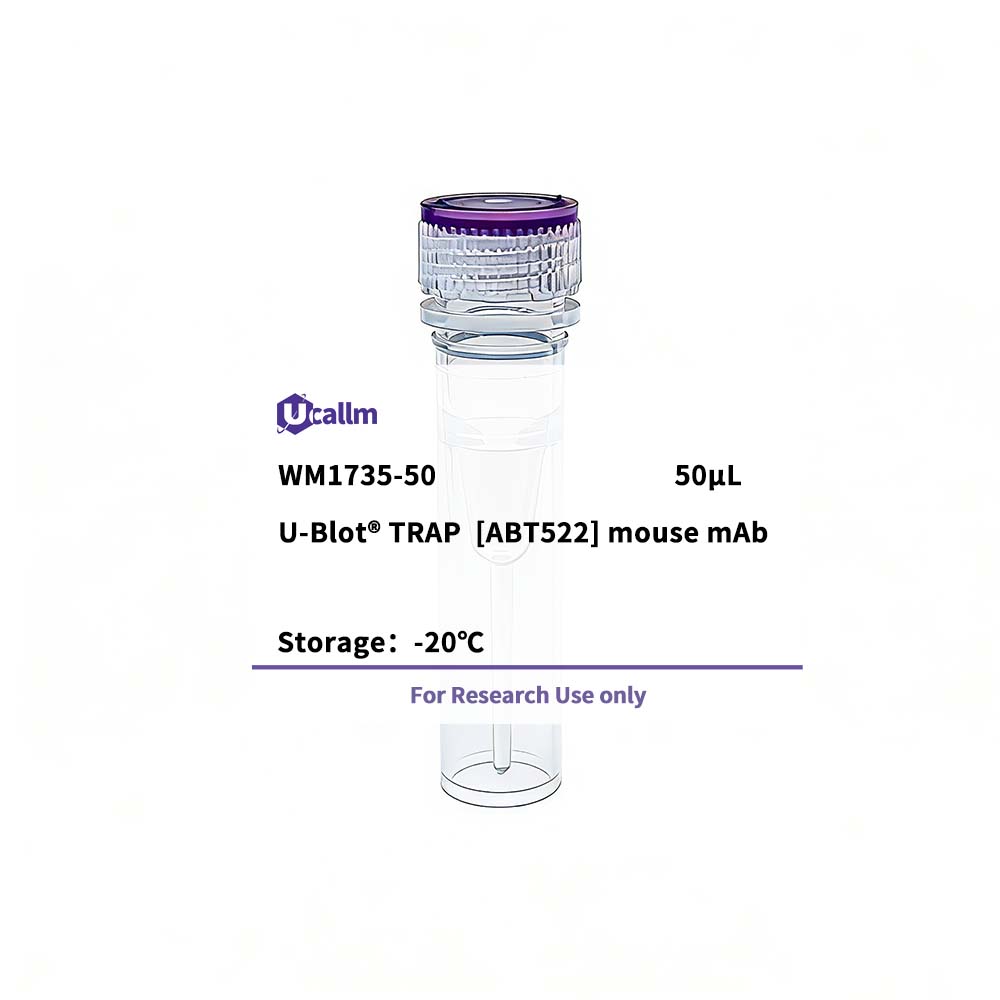
Ucallm_WM1735-50
Price range: $268.00 through $328.00
Product details
Background:
This gene encodes an iron containing glycoprotein which catalyzes the conversion of orthophosphoric monoester to alcohol and orthophosphate. It is the most basic of the acid phosphatases and is the only form not inhibited by L(+)-tartrate. [provided by RefSeq, Aug 2008],
Specifications
| Size | 50μL/100μL |
| Target | TRAP |
| Reactivity | Human |
| Applications | IHC, IF, ELISA |
| MW(Calculated) | 37kD |
| MW(Observed) | |
| Host Species | Mouse |
| Isotype | IgG1,Kappa |
| Conjugate/Modification | Unmodified |
| Recommended Dilution Ratio | IHC 1:50-200; IF 1:50-200; ELISA 1:500-5000 / Note: For IHC, we suggest antigen retrieval with TE buffer pH 9.0 (Cat#WT1004) |
| Formulation | PBS, 50% glycerol, 0.05% Proclin 300, 0.05%BSA |
| Purification | The antibody was affinity-purified from ascites by affinity-chromatography using specific immunogen. |
| Storage | -15°C to -25°C/1 year(Do not lower than -25°C) |
| Concentration | |
| Clonality | Monoclonal |
| Clone Number | RMM522 |
| Immunogen | Synthesized peptide derived from human TRAP AA range: 250-325 |
| Specificity | The antibody can specifically recognize human TRAP protein. |
| Gene Name | ACP5 |
| Protein Name | TRAP |
| Other Name | Tartrate-resistant acid phosphatase type 5; / TR-AP; / Tartrate-resistant acid ATPase; / TrATPase; / Type 5 acid phosphatase |
| Species | Human |
| Gene ID | 54 |
| Uniprot | P13686 |
| Species.1 | |
| Gene ID.1 | |
| Uniprot.1 | |
| Species.2 | |
| Gene ID.2 | |
| Uniprot.2 | |
| Cellular Localization | Cytoplasmic |
| Tissue Expression | Cytoplasmic |
| Signaling_pathway | Cellular Processes >> Transport and catabolism >> Lysosome;Organismal Systems >> Development and regeneration >> Osteoclast differentiation;Human Diseases >> Immune disease >> Rheumatoid arthritis |
| Research Areas | >>Riboflavin metabolism; / >>Metabolic pathways; / >>Lysosome; / >>Osteoclast differentiation; / >>Rheumatoid arthritis |
| Function | Catalytic activity:A phosphate monoester + H(2)O = an alcohol + phosphate.,cofactor:Binds 2 iron ions per subunit.,Disease:This relatively minor intracellular isozyme of acid phosphatase can become the dominant isozyme in certain pathological states (Gaucher and Hodgkin diseases, the hairy cell, the B-cell, and the T-cell leukemias).,similarity:Belongs to the metallophosphoesterase superfamily. Purple acid phosphatase family.,subunit:Exists either as monomer or, after proteolytic processing, as a dimer of two chains linked by disulfide bond(s)., |
Please login to post questions
Related products




