SKU: WP14863 Categories: ,

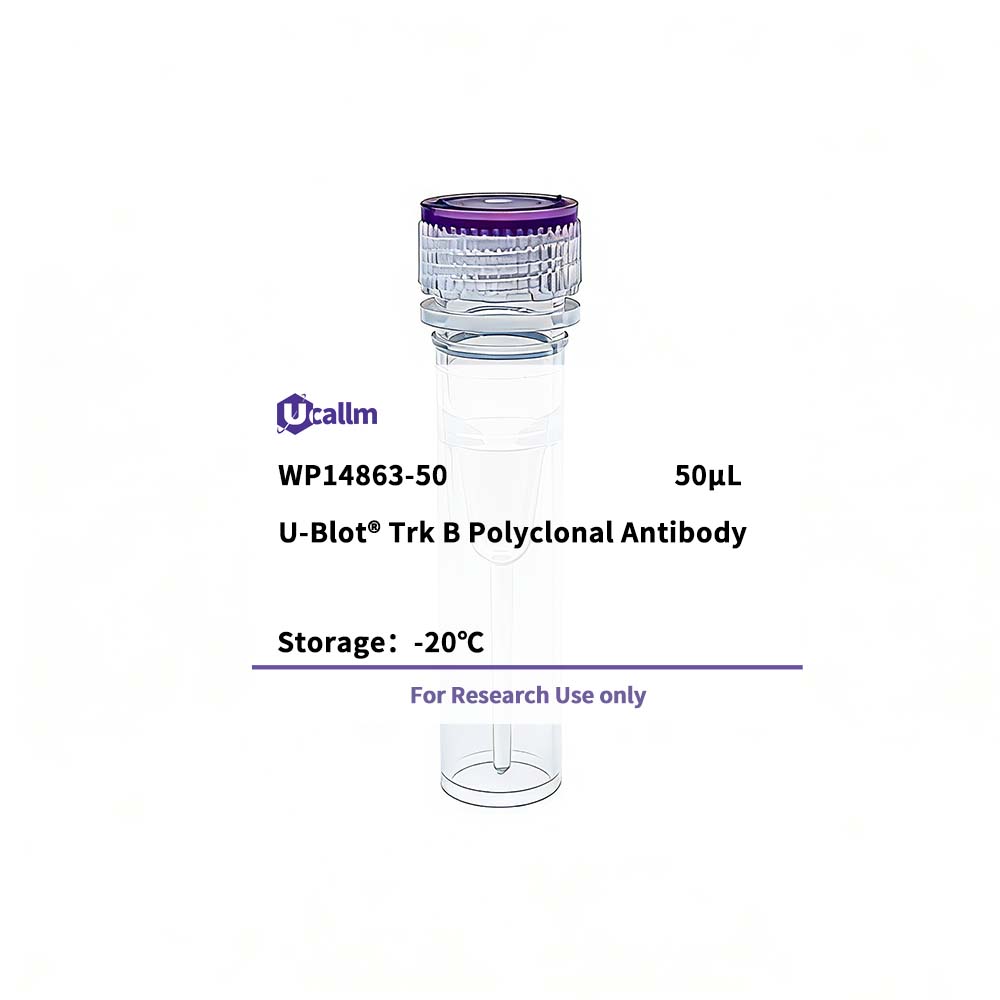
Trk B Polyclonal Antibody

Price range: $268.00 through $328.00

SKU: WP14863-100
Enter the quantity you would like, or drag the panel to find the quantity and price that best for you
Bulk QuoteAuthorize OEM & ODM

Product details

Background:

This gene encodes a member of the neurotrophic tyrosine receptor kinase (NTRK) family. This kinase is a membrane-bound receptor that, upon neurotrophin binding, phosphorylates itself and members of the MAPK pathway. Signalling through this kinase leads to cell differentiation. Mutations in this gene have been associated with obesity and mood disorders. Alternative splicing results in multiple transcript variants. [provided by RefSeq, May 2014],

Specifications

TargetTrk B
ReactivityHuman, Mouse, Rat, CoIP
ApplicationsWB, IHC, IF, mIHC, ELISA
MW(Calculated)
MW(Observed)145kd or 92kd(with limited samples)
Host SpeciesRabbit
IsotypeIgG
Conjugate/ModificationUnmodified
Modification
Recommended Dilution RatioWB 1:500-1:2000; IHC 1:100-1:300; IF 1:200-1:1000; ELISA 1:10000; Not yet tested in other applications. / Note: For IHC, we suggest antigen retrieval with TE buffer pH 9.0 (Cat#YS0004)
FormulationLiquid in PBS containing 50% glycerol, 0.5% BSA and 0.02% sodium azide.
Source
PurificationThe antibody was affinity-purified from rabbit antiserum by affinity-chromatography using epitope-specific immunogen.
Purity
Storage-15°C to -25°C/1 year(Do not lower than -25°C)
Concentration1 mg/ml
ClonalityPolyclonal
Clone Number
ImmunogenThe antiserum was produced against synthesized peptide derived from human Trk B. AA range:481-530
Sequence
SpecificityTrk B Polyclonal Antibody detects endogenous levels of Trk B protein.
Gene NameNTRK2
Protein NameBDNF/NT-3 growth factors receptor
Other NameNTRK2; / TRKB; / BDNF/NT-3 growth factors receptor; / GP145-TrkB; / Trk-B; / Neurotrophic tyrosine kinase receptor type 2; / TrkB tyrosine kinase; / Tropomyosin-related kinase B
SpeciesHuman
Gene ID-14915
UniprotQ16620,
Species.1Mouse
Gene ID-218212
Uniprot.1P15209,
Species.2Rat
Gene ID-325054
Uniprot.2Q63604
Organism-4
Gene ID-4
SwissProt-4
BackgroundThis gene encodes a member of the neurotrophic tyrosine receptor kinase (NTRK) family. This kinase is a membrane-bound receptor that, upon neurotrophin binding, phosphorylates itself and members of the MAPK pathway. Signalling through this kinase leads to cell differentiation. Mutations in this gene have been associated with obesity and mood disorders. Alternative splicing results in multiple transcript variants. [provided by RefSeq, May 2014],
Cellular LocalizationCell membrane; Single-pass type I membrane protein . Endosome membrane; Single-pass type I membrane protein . Early endosome membrane . Cell projection, axon . Cell projection, dendrite . Cytoplasm, perinuclear region . Cell junction, synapse, postsynaptic density . Internalized to endosomes upon ligand-binding. .
Tissue ExpressionIsoform TrkB is expressed in the central and peripheral nervous system. In the central nervous system (CNS), expression is observed in the cerebral cortex, hippocampus, thalamus, choroid plexus, granular layer of the cerebellum, brain stem, and spinal cord. In the peripheral nervous system, it is expressed in many cranial ganglia, the ophthalmic nerve, the vestibular system, multiple facial structures, the submaxillary glands, and dorsal root ganglia. Isoform TrkB-T1 is mainly expressed in the brain but also detected in other tissues including pancreas, kidney and heart. Isoform TrkB-T-Shc is predominantly expressed in the brain.
Signaling_pathwayOrganismal Systems >> Nervous system >> Neurotrophin signaling pathway;Environmental Information Processing >> Signal transduction >> MAPK signaling pathway;Environmental Information Processing >> Signal transduction >> Ras signaling pathway;Environmental Information Processing >> Signal transduction >> Calcium signaling pathway;Environmental Information Processing >> Signal transduction >> PI3K-Akt signaling pathway
Research Areas>>MAPK signaling pathway; / >>Ras signaling pathway; / >>Calcium signaling pathway; / >>PI3K-Akt signaling pathway; / >>Neurotrophin signaling pathway; / >>Alcoholism
FunctionAlternative products:Additional isoforms seem to exist,Catalytic activity:ATP + a [protein]-L-tyrosine = ADP + a [protein]-L-tyrosine phosphate.,Function:Receptor for brain-derived neurotrophic factor (BDNF), neurotrophin-3 and neurotrophin-4/5 but not nerve growth factor (NGF). Involved in the development and/or maintenance of the nervous system. This is a tyrosine-protein kinase receptor. Known substrates for the TRK receptors are SHC1, PI-3 kinase, and PLC-gamma-1.,PTM:Ligand-mediated auto-phosphorylation.,similarity:Belongs to the protein kinase superfamily. Tyr protein kinase family.,similarity:Belongs to the protein kinase superfamily. Tyr protein kinase family. Insulin receptor subfamily.,similarity:Contains 1 protein kinase domain.,similarity:Contains 2 Ig-like C2-type (immunoglobulin-like) domains.,similarity:Contains 2 LRR (leucine-rich) repeats.,subunit:Exists in a dynamic equilibrium between monomeric (low affinity) and dimeric (high affinity) structures. Binds SH2B2. Interacts with SQSTM1 and KIDINS220.,tissue specificity:Isoform TrkB is widely expressed, mainly in the nervous tissue. In the CNS, expression is observed in the cerebral cortex, hippocampus, thalamus, choroid plexus, granular layer of the cerebellum, brain stem, and spinal cord. In the peripheral nervous system, it is expressed in many cranial ganglia, the ophtalmic nerve, the vestibular system, multiple facial structures, the submaxillary glands, and dorsal root ganglia. Isoform TrkB-T1 is expressed in multiple tissues, mainly in brain, pancreas, kidney and heart. Isoform TrkB-T-Shc is predominantly expressed in brain.,
RRID
Please login to post questions
Back to Top
Product has been added to your cart