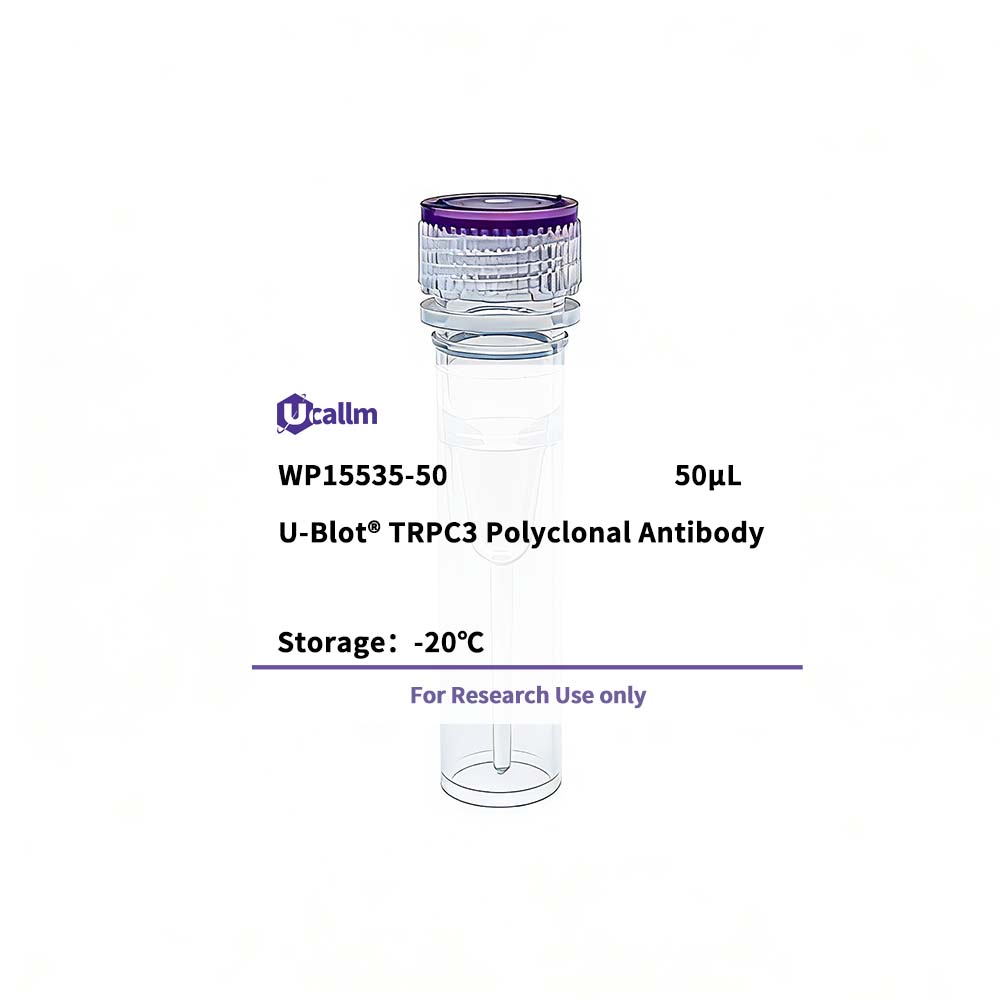
SKU: WP15535 Categories: ,

TRPC3 Polyclonal Antibody

Price range: $268.00 through $328.00

SKU: WP15535-100
Enter the quantity you would like, or drag the panel to find the quantity and price that best for you
Bulk QuoteAuthorize OEM & ODM

Product details

Background:

transient receptor potential cation channel subfamily C member 3(TRPC3) Homo sapiens The protein encoded by this gene is a membrane protein that can form a non-selective channel permeable to calcium and other cations. The encoded protein appears to be induced to form channels by a receptor tyrosine kinase-activated phosphatidylinositol second messenger system and also by depletion of intracellular calcium stores. Two transcript variants encoding different isoforms have been found for this gene. [provided by RefSeq, Oct 2011],


Specifications

Size50μL/100μL
TargetTRPC3
ReactivityHuman, Mouse, Rat
ApplicationsWB, IHC, IF, ELISA
MW(Calculated)
MW(Observed)97kD
Host SpeciesRabbit
IsotypeIgG
Conjugate/ModificationUnmodified
Recommended Dilution RatioWB 1:500-1:2000; IHC: 1:100-1:300; ELISA 1:20000; IF 1:50-200 / Note: For IHC, we suggest antigen retrieval with TE buffer pH 9.0 (Cat#WT1004)
FormulationLiquid in PBS containing 50% glycerol, 0.5% BSA and 0.02% sodium azide.
PurificationThe antibody was affinity-purified from rabbit antiserum by affinity-chromatography using epitope-specific immunogen.
Storage-15°C to -25°C/1 year(Do not lower than -25°C)
Concentration1 mg/ml
ClonalityPolyclonal
Clone Number
ImmunogenThe antiserum was produced against synthesized peptide derived from the Internal region of human TRPC3. AA range:411-460
SpecificityTRPC3 Polyclonal Antibody detects endogenous levels of TRPC3 protein.
Gene NameTRPC3
Protein NameShort transient receptor potential channel 3
Other NameTRPC3; / TRP3; / Short transient receptor potential channel 3; / TrpC3; / Transient receptor protein 3; / TRP-3; / hTrp-3; / hTrp3
SpeciesHuman
Gene ID7222
UniprotQ13507,
Species.1Mouse
Gene ID.1
Uniprot.1Q9QZC1,
Species.2Rat
Gene ID.2
Uniprot.2Q9JMI9
Cellular LocalizationMembrane; Multi-pass membrane protein.
Tissue ExpressionExpressed predominantly in brain and at much lower levels in ovary, colon, small intestine, lung, prostate, placenta and testis.
Signaling_pathwayHuman Diseases >> Neurodegenerative disease >> Spinocerebellar ataxia;Human Diseases >> Neurodegenerative disease >> Pathways of neurodegeneration - multiple diseases
Research Areas>>Axon guidance; / >>Spinocerebellar ataxia; / >>Pathways of neurodegeneration - multiple diseases
FunctionFunction:Thought to form a receptor-activated non-selective calcium permeant cation channel. Probably is operated by a phosphatidylinositol second messenger system activated by receptor tyrosine kinases or G-protein coupled receptors. Activated by diacylglycerol (DAG) in a membrane-delimited fashion, independently of protein kinase C, and by inositol-1,4,5-triphosphate receptors (ITPR) with bound IP3. May also be activated by internal calcium store depletion.,similarity:Belongs to the transient receptor family. STrpC subfamily.,similarity:Contains 5 ANK repeats.,subunit:Interacts with TRPC1. Interacts with ITPR3. Interacts with MX1 and RNF24.,tissue specificity:Expressed predominantly in brain and at much lower levels in ovary, colon, small intestine, lung, prostate, placenta and testis.,
Please login to post questions
Back to Top
Product has been added to your cart


