


TRPC3 Polyclonal Antibody
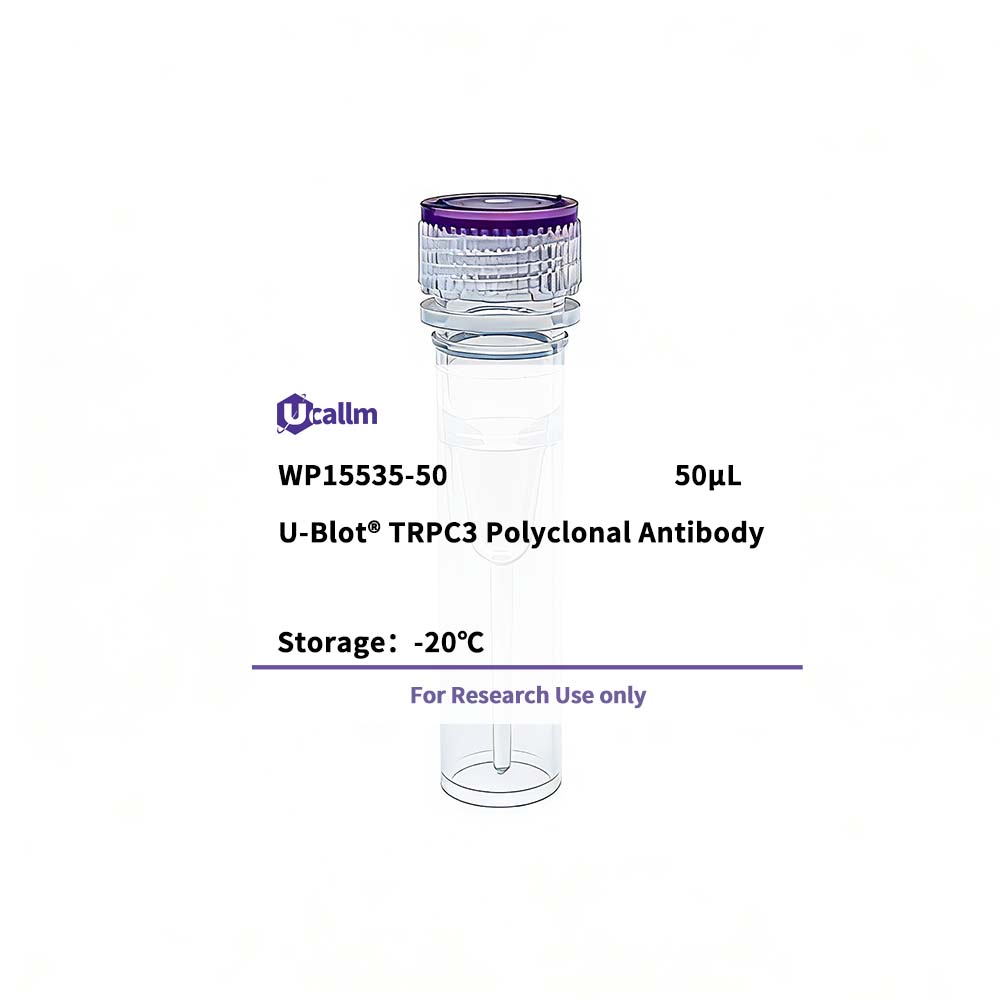
Ucallm_WP15535-50
Price range: $268.00 through $328.00
Product details
Background:
transient receptor potential cation channel subfamily C member 3(TRPC3) Homo sapiens The protein encoded by this gene is a membrane protein that can form a non-selective channel permeable to calcium and other cations. The encoded protein appears to be induced to form channels by a receptor tyrosine kinase-activated phosphatidylinositol second messenger system and also by depletion of intracellular calcium stores. Two transcript variants encoding different isoforms have been found for this gene. [provided by RefSeq, Oct 2011],
Specifications
| Size | 50μL/100μL |
| Target | TRPC3 |
| Reactivity | Human, Mouse, Rat |
| Applications | WB, IHC, IF, ELISA |
| MW(Calculated) | |
| MW(Observed) | 97kD |
| Host Species | Rabbit |
| Isotype | IgG |
| Conjugate/Modification | Unmodified |
| Recommended Dilution Ratio | WB 1:500-1:2000; IHC: 1:100-1:300; ELISA 1:20000; IF 1:50-200 / Note: For IHC, we suggest antigen retrieval with TE buffer pH 9.0 (Cat#WT1004) |
| Formulation | Liquid in PBS containing 50% glycerol, 0.5% BSA and 0.02% sodium azide. |
| Purification | The antibody was affinity-purified from rabbit antiserum by affinity-chromatography using epitope-specific immunogen. |
| Storage | -15°C to -25°C/1 year(Do not lower than -25°C) |
| Concentration | 1 mg/ml |
| Clonality | Polyclonal |
| Clone Number | |
| Immunogen | The antiserum was produced against synthesized peptide derived from the Internal region of human TRPC3. AA range:411-460 |
| Specificity | TRPC3 Polyclonal Antibody detects endogenous levels of TRPC3 protein. |
| Gene Name | TRPC3 |
| Protein Name | Short transient receptor potential channel 3 |
| Other Name | TRPC3; / TRP3; / Short transient receptor potential channel 3; / TrpC3; / Transient receptor protein 3; / TRP-3; / hTrp-3; / hTrp3 |
| Species | Human |
| Gene ID | 7222 |
| Uniprot | Q13507, |
| Species.1 | Mouse |
| Gene ID.1 | |
| Uniprot.1 | Q9QZC1, |
| Species.2 | Rat |
| Gene ID.2 | |
| Uniprot.2 | Q9JMI9 |
| Cellular Localization | Membrane; Multi-pass membrane protein. |
| Tissue Expression | Expressed predominantly in brain and at much lower levels in ovary, colon, small intestine, lung, prostate, placenta and testis. |
| Signaling_pathway | Human Diseases >> Neurodegenerative disease >> Spinocerebellar ataxia;Human Diseases >> Neurodegenerative disease >> Pathways of neurodegeneration - multiple diseases |
| Research Areas | >>Axon guidance; / >>Spinocerebellar ataxia; / >>Pathways of neurodegeneration - multiple diseases |
| Function | Function:Thought to form a receptor-activated non-selective calcium permeant cation channel. Probably is operated by a phosphatidylinositol second messenger system activated by receptor tyrosine kinases or G-protein coupled receptors. Activated by diacylglycerol (DAG) in a membrane-delimited fashion, independently of protein kinase C, and by inositol-1,4,5-triphosphate receptors (ITPR) with bound IP3. May also be activated by internal calcium store depletion.,similarity:Belongs to the transient receptor family. STrpC subfamily.,similarity:Contains 5 ANK repeats.,subunit:Interacts with TRPC1. Interacts with ITPR3. Interacts with MX1 and RNF24.,tissue specificity:Expressed predominantly in brain and at much lower levels in ovary, colon, small intestine, lung, prostate, placenta and testis., |
Please login to post questions
Related products




