

TULP1 rabbit pAb
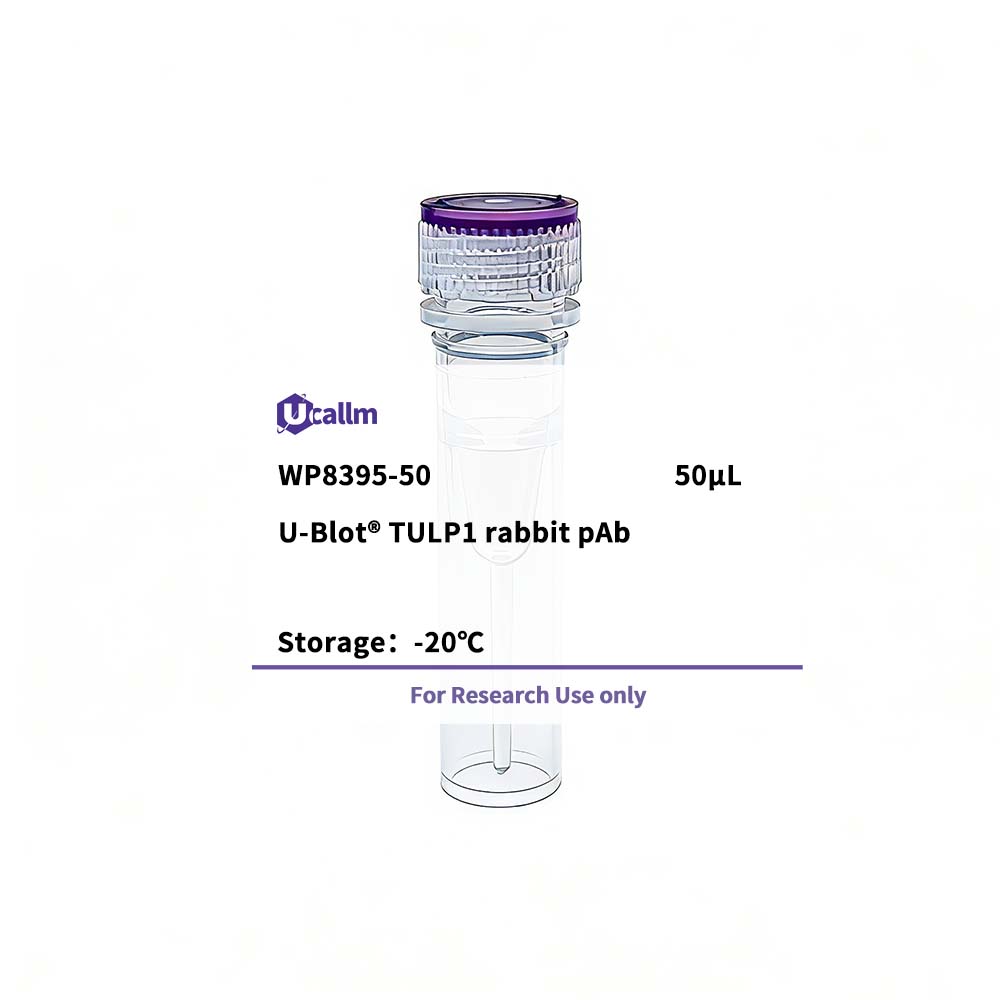
Ucallm_WP8395-50
Price range: $268.00 through $328.00
Product details
Background:
Specifications
| Size | 50μL/100μL |
| Target | TULP1 |
| Reactivity | Human, Mouse |
| Applications | WB |
| MW(Calculated) | 60kD |
| MW(Observed) | |
| Host Species | Rabbit |
| Isotype | IgG |
| Conjugate/Modification | Unmodified |
| Recommended Dilution Ratio | WB 1:500-2000 |
| Formulation | Liquid in PBS containing 50% glycerol, 0.5% BSA and 0.02% sodium azide. |
| Purification | The antibody was affinity-purified from rabbit antiserum by affinity-chromatography using epitope-specific immunogen. |
| Storage | -15°C to -25°C/1 year(Do not lower than -25°C) |
| Concentration | 1 mg/ml |
| Clonality | Polyclonal |
| Clone Number | |
| Immunogen | Synthesized peptide derived from human TULP1 |
| Specificity | This antibody detects endogenous levels of TULP1 at Human, Mouse |
| Gene Name | TULP1 TUBL1 |
| Protein Name | Tubby-related protein 1 (Tubby-like protein 1) |
| Other Name | |
| Species | Human |
| Gene ID | 7287 |
| Uniprot | O00294, |
| Species.1 | Mouse |
| Gene ID.1 | 22157 |
| Uniprot.1 | Q9Z273 |
| Species.2 | |
| Gene ID.2 | |
| Uniprot.2 | |
| Cellular Localization | Cytoplasm . Cell membrane; Peripheral membrane protein; Cytoplasmic side . Secreted . Cell junction, synapse . Detected at synapses between photoreceptor cells and second-order neurons. Does not have a cleavable signal peptide and is secreted by an alternative pathway (By similarity). . |
| Tissue Expression | Retina-specific. |
| Signaling_pathway | |
| Research Areas | |
| Function | Required for normal development of photoreceptor synapses. Required for normal photoreceptor function and for long-term survival of photoreceptor cells. Interacts with cytoskeleton proteins and may play a role in protein transport in photoreceptor cells (By similarity). Binds lipids, especially phosphatidylinositol 3-phosphate, phosphatidylinositol 4-phosphate, phosphatidylinositol 5-phosphate, phosphatidylinositol 3,4-bisphosphate, phosphatidylinositol 4,5-bisphosphate, phosphatidylinositol 3,4,5-bisphosphate, phosphatidylserine and phosphatidic acid (in vitro). Contribute to stimulation of phagocytosis of apoptotic retinal pigment epithelium (RPE) cells and macrophages. |
Please login to post questions
Related products




