


TUT4 Polyclonal Antibody
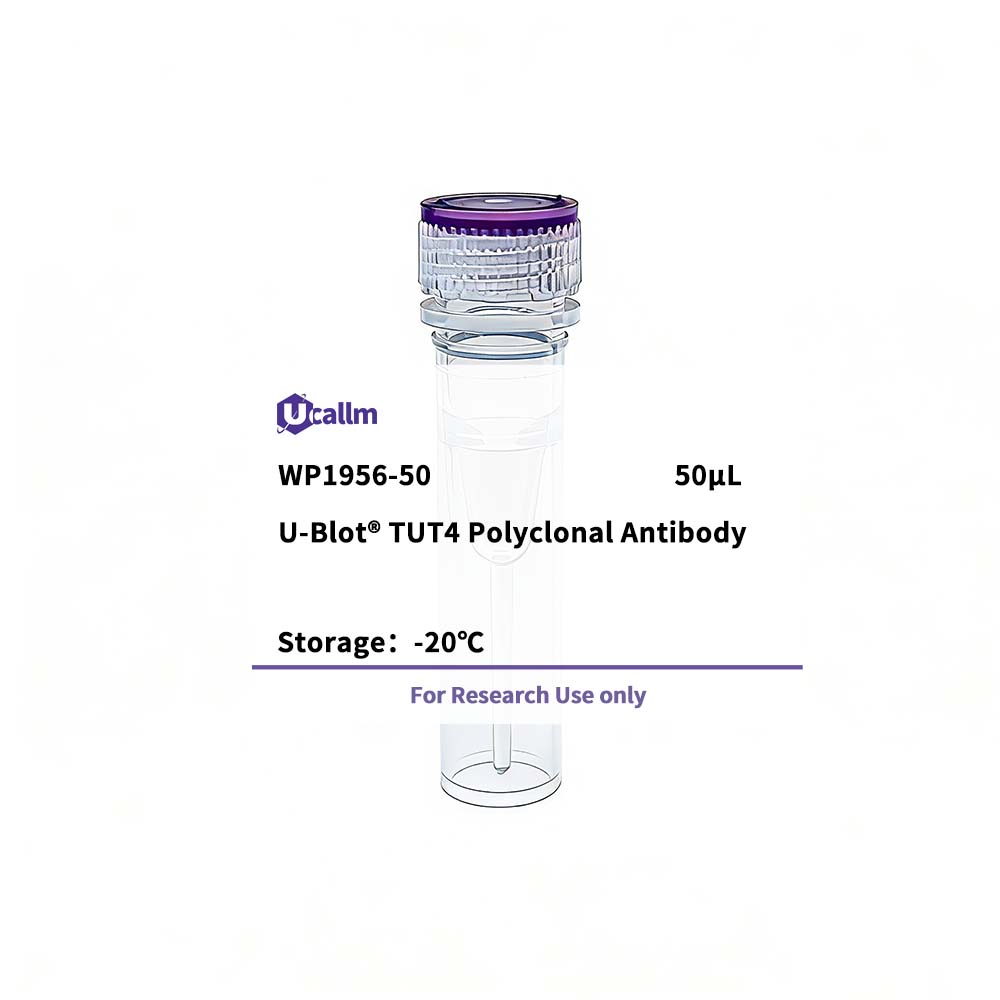
Ucallm_WP1956-50
Price range: $268.00 through $328.00
Product details
Background:
ZCCHC11 is an RNA uridyltransferase (EC 2.7.7.52) that uses UTP to add uridines to the 3-prime end of substrate RNA molecules (Jones et al., 2009 [PubMed 19701194]).[supplied by OMIM, Jan 2011],
Specifications
| Size | 50μL/100μL |
| Target | TUT4 |
| Reactivity | Human, Mouse |
| Applications | WB, ELISA |
| MW(Calculated) | |
| MW(Observed) | 180kD |
| Host Species | Rabbit |
| Isotype | IgG |
| Conjugate/Modification | Unmodified |
| Recommended Dilution Ratio | WB 1:500-2000; ELISA 1:5000-20000 |
| Formulation | Liquid in PBS containing 50% glycerol,0.5% BSA and 0.02% sodium azide. |
| Purification | The antibody was affinity-purified from rabbit antiserum by affinity-chromatography using epitope-specific immunogen. |
| Storage | -15°C to -25°C/1 year(Do not lower than -25°C) |
| Concentration | 1 mg/ml |
| Clonality | Polyclonal |
| Clone Number | |
| Immunogen | Synthesized peptide derived from part region of human protein |
| Specificity | TUT4 Polyclonal Antibody detects endogenous levels of protein. |
| Gene Name | ZCCHC11 KIAA0191 TUT4 |
| Protein Name | Terminal uridylyltransferase 4 (TUTase 4) (Zinc finger CCHC domain-containing protein 11) |
| Other Name | |
| Species | Human |
| Gene ID | 23318 |
| Uniprot | Q5TAX3, |
| Species.1 | Mouse |
| Gene ID.1 | |
| Uniprot.1 | B2RX14 |
| Species.2 | |
| Gene ID.2 | |
| Uniprot.2 | |
| Cellular Localization | Nucleus . Cytoplasm . Cytoplasm, Cytoplasmic ribonucleoprotein granule . Mainly cytoplasmic (PubMed:19703396, PubMed:25480299). Translocates into the cytoplasm following treatment of the cell with LPS (PubMed:16643855). Co-enriched in cytoplasmic foci with MOV10 (PubMed:30122351). . |
| Tissue Expression | |
| Signaling_pathway | |
| Research Areas | |
| Function | RNA processing, RNA catabolic process, macromolecule catabolic process, response to organic substance, miRNA metabolic process, miRNA catabolic process, negative regulation of macromolecule metabolic process,posttranscriptional regulation of gene expression, negative regulation of gene expression, posttranscriptional gene silencing, gene silencing, stem cell maintenance, gene silencing by RNA, dsRNA fragmentation, pre-microRNA processing, RNA 3'-end processing, ncRNA processing, ncRNA metabolic process, ncRNA catabolic process,posttranscriptional gene silencing by RNA, gene silencing by miRNA, gene silencing by miRNA, production of miRNAs,regulation of gene expression, epigenetic, response to dsRNA, cellular macromolecule catabolic process, negative regulation of cell differentiation, stem cell differentiation, stem cell development, |
Please login to post questions
Related products





