


TWST1 Polyclonal Antibody
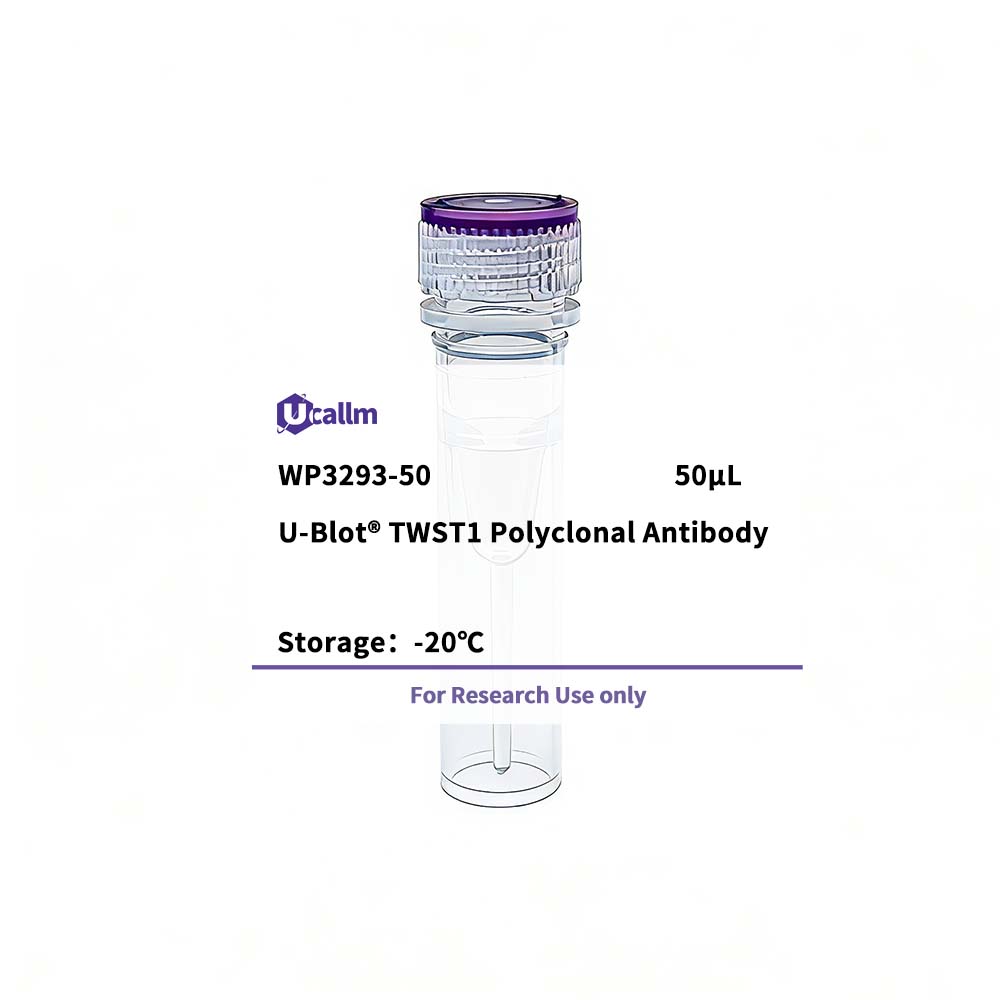
Ucallm_WP3293-50
Price range: $268.00 through $328.00
Product details
Background:
Basic helix-loop-helix (bHLH) transcription factors have been implicated in cell lineage determination and differentiation. The protein encoded by this gene is a bHLH transcription factor and shares similarity with another bHLH transcription factor, Dermo1. The strongest expression of this mRNA is in placental tissue; in adults, mesodermally derived tissues express this mRNA preferentially. Mutations in this gene have been found in patients with Saethre-Chotzen syndrome. [provided by RefSeq, Jul 2008],
Specifications
| Size | 50μL/100μL |
| Target | TWIST1 |
| Reactivity | Human, Mouse |
| Applications | WB, ELISA |
| MW(Calculated) | |
| MW(Observed) | 22kD |
| Host Species | Rabbit |
| Isotype | IgG |
| Conjugate/Modification | Unmodified |
| Recommended Dilution Ratio | WB 1:500-2000; ELISA 1:5000-20000 |
| Formulation | Liquid in PBS containing 50% glycerol,0.5% BSA and 0.02% sodium azide. |
| Purification | The antibody was affinity-purified from rabbit antiserum by affinity-chromatography using epitope-specific immunogen. |
| Storage | -15°C to -25°C/1 year(Do not lower than -25°C) |
| Concentration | 1 mg/ml |
| Clonality | Polyclonal |
| Clone Number | |
| Immunogen | Synthesized peptide derived from part region of human protein |
| Specificity | TWST1 Polyclonal Antibody detects endogenous levels of protein. |
| Gene Name | TWIST1 BHLHA38 TWIST |
| Protein Name | Twist-related protein 1 (Class A basic helix-loop-helix protein 38) (bHLHa38) (H-twist) |
| Other Name | |
| Species | Human |
| Gene ID | 7291 |
| Uniprot | Q15672, |
| Species.1 | Mouse |
| Gene ID.1 | |
| Uniprot.1 | P26687 |
| Species.2 | |
| Gene ID.2 | |
| Uniprot.2 | |
| Cellular Localization | Nucleus. |
| Tissue Expression | Subset of mesodermal cells. |
| Signaling_pathway | |
| Research Areas | >>Proteoglycans in cancer |
| Function | Disease:Defects in TWIST1 are a cause of Saethre-Chotzen syndrome (SCS) [MIM:101400]; also known as acrocephalosyndactyly type 3 (ACS3). SCS is a craniosynostosis syndrome characterized by coronal synostosis, brachycephaly, low frontal hairline, facial asymmetry, hypertelorism, broad halluces, and clinodactyly.,Disease:Defects in TWIST1 are the cause of craniosynostosis type 1 (CRS1) [MIM:123100]. Craniosynostosis consists of premature fusion of one or more cranial sutures, resulting in an abnormal head shape.,Disease:Defects in TWIST1 are the cause of Robinow-Sorauf syndrome (RSS) [MIM:180750]; also known as craniosynostosis-bifid hallux syndrome. RSS is an autosomal dominant defect characterized by minor skull and limb anomalies which is very similar to Saethre-Chotzen syndrome.,Function:Probable transcription factor, which seems to be involved in the negative regulation of cellular determination and in the differentiation of several lineages including myogenesis, osteogenesis, and neurogenesis. Inhibits myogenesis by sequestrating E proteins, inhibiting trans-activation by MEF2, and inhibiting DNA-binding by MYOD1 through physical interaction. This interaction probably involves the basic domains of both proteins (By similarity). Also represses expression of proinflammatory cytokines such as TNFA and IL1B.,similarity:Contains 1 basic helix-loop-helix (bHLH) domain.,subunit:Efficient DNA binding requires dimerization with another bHLH protein. Homodimer.,tissue specificity:Subset of mesodermal cells., |
Please login to post questions
Related products



