


TYSD1 Polyclonal Antibody
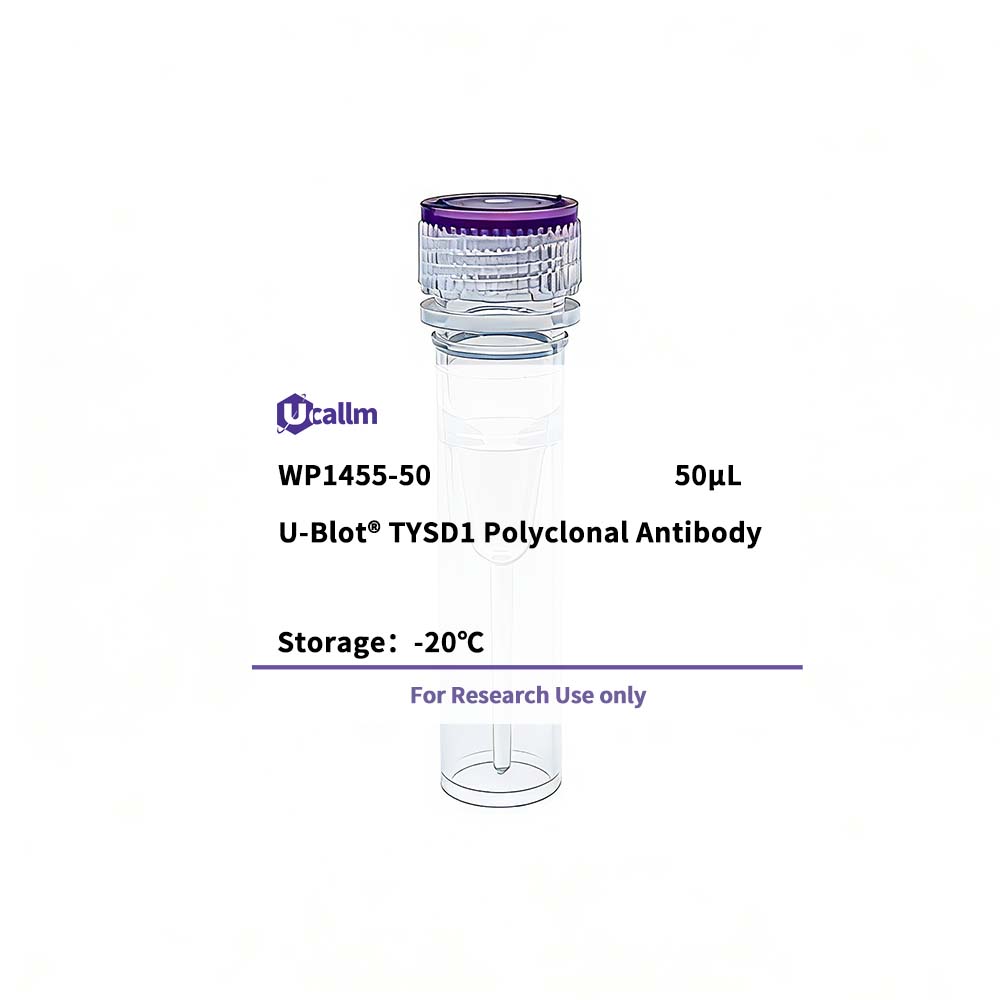
Ucallm_WP1455-50
Price range: $268.00 through $328.00
Product details
Background:
This gene encodes a protease that removes the N-terminal peroxisomal targeting signal (PTS2) from proteins produced in the cytosol, thereby facilitating their import into the peroxisome. The encoded protein is also capable of removing the C-terminal peroxisomal targeting signal (PTS1) from proteins in the peroxisomal matrix. The full-length protein undergoes self-cleavage to produce shorter, potentially inactive, peptides. Alternative splicing results in multiple transcript variants for this gene. [provided by RefSeq, Jan 2013],
Specifications
| Size | 50μL/100μL |
| Target | TYSD1 |
| Reactivity | Human, Mouse |
| Applications | WB, ELISA |
| MW(Calculated) | |
| MW(Observed) | 62kD |
| Host Species | Rabbit |
| Isotype | IgG |
| Conjugate/Modification | Unmodified |
| Recommended Dilution Ratio | WB 1:500-2000; ELISA 1:5000-20000 |
| Formulation | Liquid in PBS containing 50% glycerol,0.5% BSA and 0.02% sodium azide. |
| Purification | The antibody was affinity-purified from rabbit antiserum by affinity-chromatography using epitope-specific immunogen. |
| Storage | -15°C to -25°C/1 year(Do not lower than -25°C) |
| Concentration | 1 mg/ml |
| Clonality | Polyclonal |
| Clone Number | |
| Immunogen | Synthesized peptide derived from human protein . at AA range: 120-200 |
| Specificity | TYSD1 Polyclonal Antibody detects endogenous levels of protein. |
| Gene Name | TYSND1 |
| Protein Name | Peroxisomal leader peptide-processing protease (Trypsin domain-containing protein 1) [Cleaved into: Peroxisomal leader peptide-processing protease, 15 kDa form; Peroxisomal leader peptide-processing protease, 45 kDa form] |
| Other Name | |
| Species | Human |
| Gene ID | 219743 |
| Uniprot | Q2T9J0, |
| Species.1 | Mouse |
| Gene ID.1 | |
| Uniprot.1 | Q9DBA6 |
| Species.2 | |
| Gene ID.2 | |
| Uniprot.2 | |
| Cellular Localization | Peroxisome . |
| Tissue Expression | Brain,Lung, |
| Signaling_pathway | |
| Research Areas | |
| Function | Function:Peroxisomal protease that mediates both the removal of the leader peptide from proteins containing a PTS2 target sequence and the specific processing of PTS1 proteins. May participate to a regulatory mechanism that control the peroxisomal beta-oxidation of fatty acids.,PTM:Processed into the 49 kDa and the 10 kDa forms upon import into the peroxisomes. The 49 kDa form probably corresponds to the mature enzyme, while the 10 kDa form may represent an inhibitory N-terminal fragment which prevents protease activity until it reaches the peroxisomes.,similarity:Belongs to the peptidase S1B family., |
Please login to post questions
Related products




