

U-Blot® ATF-2 Rabbit mAb
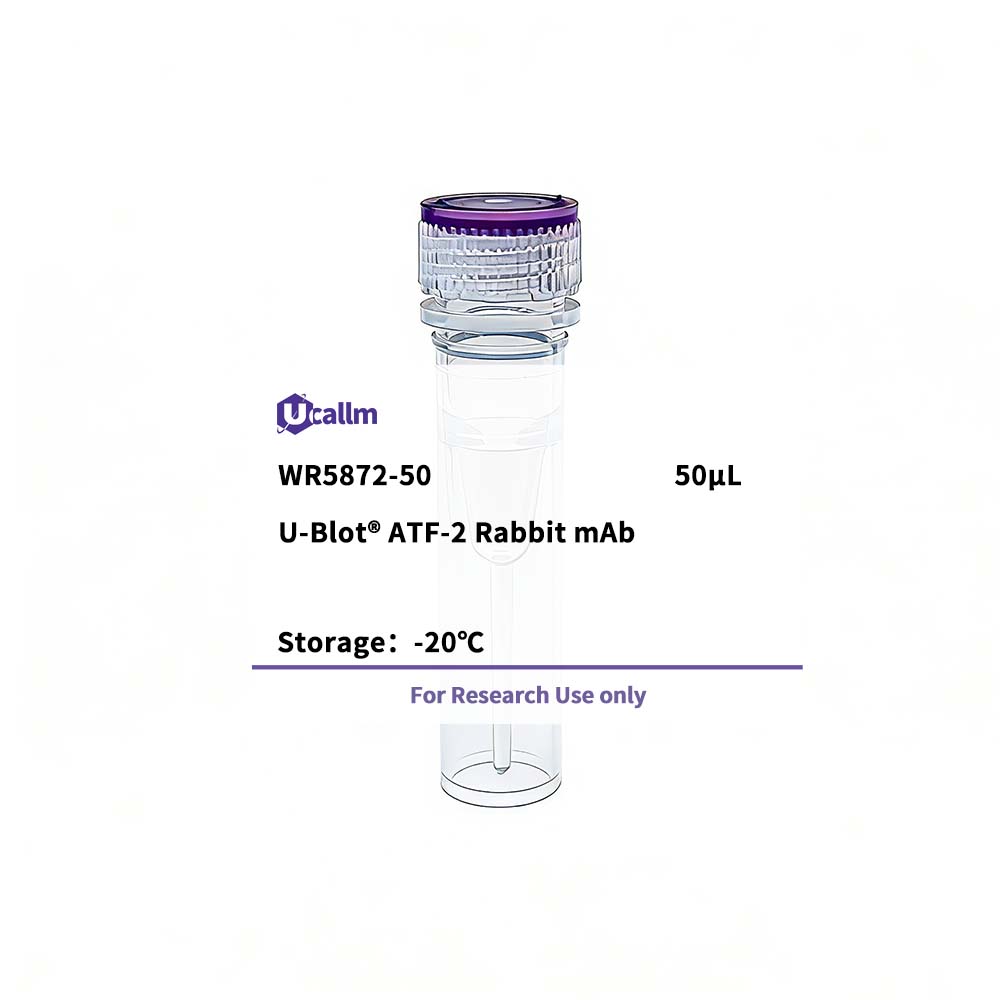
Ucallm_WR5872-50
Price range: $268.00 through $328.00
Specifications
| Size | 50μL/100μL |
| Target | ATF-2 |
| Reactivity | Human |
| Applications | WB, IHC, IF, IP, ELISA |
| MW(Calculated) | 55kD |
| MW(Observed) | 70kD |
| Host Species | Rabbit |
| Isotype | IgG,Kappa |
| Conjugate/Modification | Unmodified |
| Recommended Dilution Ratio | IHC 1:200-1:1000; WB 1:1000-1:5000; IF 1:200-1:1000; ELISA 1:5000-1:20000; IP 1:50-1:200; / Note: For IHC, we suggest antigen retrieval with TE buffer pH 9.0 (Cat#WT1004) |
| Formulation | PBS, 50% glycerol, 0.05% Proclin 300, 0.05%BSA |
| Purification | Recombinant Antibody expressed in animal component-free (ACF) media, purified via Protein A affinity chromatography. |
| Storage | -15°C to -25°C/1 year(Do not lower than -25°C) |
| Concentration | |
| Clonality | Monoclonal |
| Clone Number | RM1846R |
| Immunogen | The specific immunogen used to produce this antibody is proprietary information. |
| Specificity | Endogenous |
| Gene Name | ATF2 |
| Protein Name | Cyclic AMP-dependent transcription factor ATF-2 |
| Other Name | ATF2; / CREB2; / CREBP1; / Cyclic AMP-dependent transcription factor ATF-2; / cAMP-dependent transcription factor ATF-2; / Activating transcription factor 2; / Cyclic AMP-responsive element-binding protein 2; / CREB-2; / cAMP-responsive element-binding pro |
| Species | Human |
| Gene ID | 1386 |
| Uniprot | P15336, |
| Species.1 | Mouse |
| Gene ID.1 | 234199 |
| Uniprot.1 | Q71KU9, |
| Species.2 | Rat |
| Gene ID.2 | |
| Uniprot.2 | Q5M8C6 |
| Cellular Localization | Nucleus. Cytoplasm. Mitochondrion outer membrane. Shuttles between the cytoplasm and the nucleus and heterodimerization with JUN is essential for the nuclear localization. Localization to the cytoplasm is observed under conditions of cellular stress and in disease states. Localizes at the mitochondrial outer membrane in response to genotoxic stress. Phosphorylation at Thr-52 is required for its nuclear localization and negatively regulates its mitochondrial localization. Co-localizes with the MRN complex in the IR-induced foci (IRIF). |
| Tissue Expression | Ubiquitously expressed, with more abundant expression in the brain. |
| Signaling_pathway | Organismal Systems >> Endocrine system >> Insulin secretion;Organismal Systems >> Endocrine system >> Glucagon signaling pathway;Organismal Systems >> Endocrine system >> Estrogen signaling pathway;Organismal Systems >> Endocrine system >> Relaxin signaling pathway;Organismal Systems >> Endocrine system >> Growth hormone synthesis, secretion and action;Organismal Systems >> Endocrine system >> Aldosterone synthesis and secretion;Organismal Systems >> Circulatory system >> Adrenergic signaling in cardiomyocytes;Organismal Systems >> Nervous system >> Dopaminergic synapse;Organismal Systems >> Aging >> Longevity regulating pathway;Human Diseases >> Neurodegenerative disease >> Prion disease;Environmental Information Processing >> Signal transduction >> MAPK signaling pathway;Environmental Information Processing >> Signal transduction >> TNF signaling pathway;Environmental Information Processing >> Signal transduction >> cGMP-PKG signaling pathway;Environmental Information Processing >> Signal transduction >> PI3K-Akt signaling pathway |
| Research Areas | >>MAPK signaling pathway; / >>cGMP-PKG signaling pathway; / >>PI3K-Akt signaling pathway; / >>Longevity regulating pathway; / >>Adrenergic signaling in cardiomyocytes; / >>TNF signaling pathway; / >>Thermogenesis; / >>Dopaminergic synapse; / >>Insulin secretion; / >>Estrogen signaling pathway; / >>Thyroid hormone synthesis; / >>Glucagon signaling pathway; / >>Aldosterone synthesis and secretion; / >>Relaxin signaling pathway; / >>Cortisol synthesis and secretion; / >>Parathyroid hormone synthesis, secretion and action; / >>Cushing syndrome; / >>Growth hormone synthesis, secretion and action; / >>Prion disease; / >>Cocaine addiction; / >>Amphetamine addiction; / >>Alcoholism; / >>Hepatitis B; / >>Human cytomegalovirus infection; / >>Human T-cell leukemia virus 1 infection; / >>Viral carcinogenesis; / >>Chemical carcinogenesis - receptor activation |
| Function | Caution:It is uncertain whether Met-1 or Met-19 is the initiator.,Function:Transcriptional activator, probably constitutive, which binds to the cAMP-responsive element (CRE) (consensus: 5'-GTGACGT[AC][AG]-3'), a sequence present in many viral and cellular promoters. Interaction with JUN redirects JUN to bind to CRES preferentially over the 12-O-tetradecanoylphorbol-13-acetate response elements (TRES) as part of an ATF2-c-Jun complex.,PTM:Phosphorylation of Thr-69 and Thr-71 by MAPK14 causes increased transcriptional activity. Also phosphorylated and activated by JNK.,similarity:Belongs to the bZIP family.,similarity:Belongs to the bZIP family. ATF subfamily.,similarity:Contains 1 bZIP domain.,similarity:Contains 1 C2H2-type zinc finger.,subunit:Binds DNA as a dimer and can form a homodimer in the absence of DNA. Can form a heterodimer with JUN. Interacts with SMAD3 and SMAD4. Binds through its N-terminal region to UTF1 which acts as a coactivator of ATF2 transcriptional activity.,tissue specificity:Abundant expression seen in the brain., |
Please login to post questions
Related products





