SKU: WR5233 Categories: ,

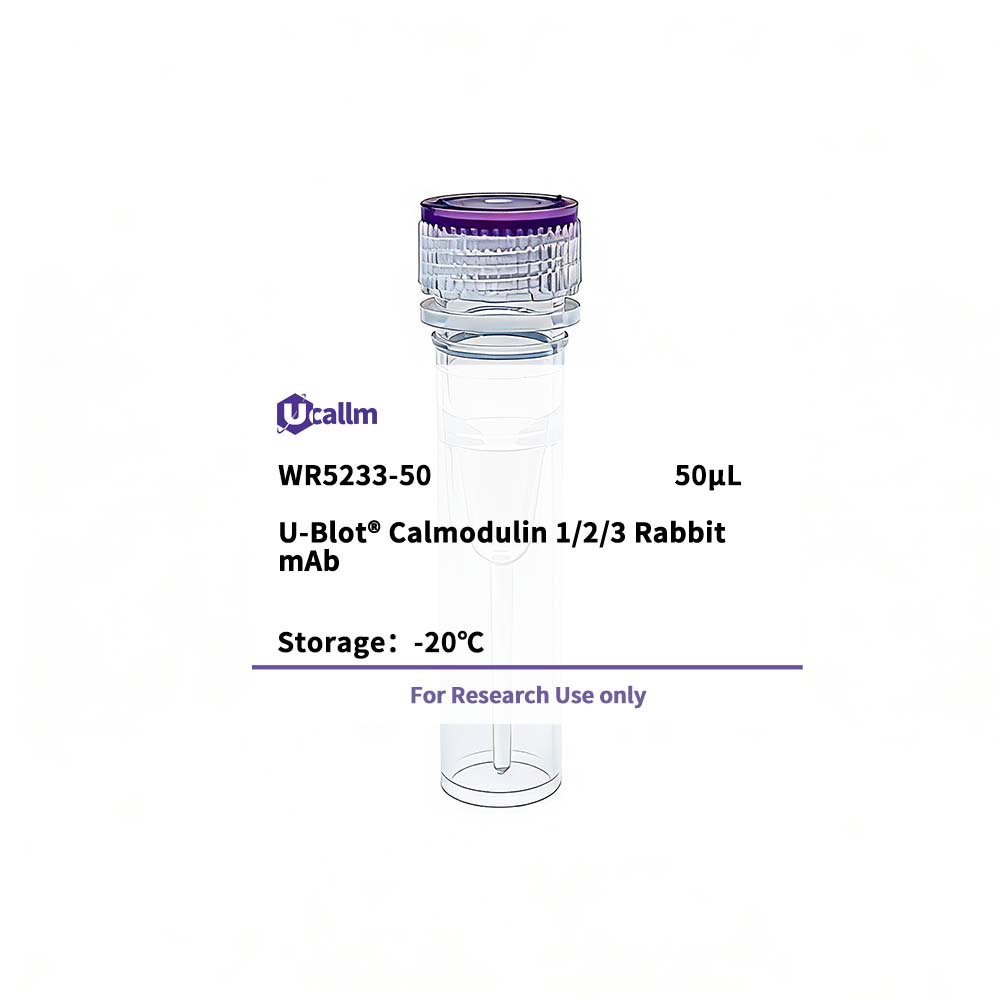
U-Blot® Calmodulin 1/2/3 Rabbit mAb

Price range: $268.00 through $328.00

SKU: WR5233-100
Enter the quantity you would like, or drag the panel to find the quantity and price that best for you
Bulk QuoteAuthorize OEM & ODM

Product details

Background:This gene encodes a member of the EF-hand calcium-binding protein family. It is one of three genes which encode an identical calcium binding protein which is one of the four subunits of phosphorylase kinase. Two pseudogenes have been identified on chromosome 7 and X. Multiple transcript variants encoding different isoforms have been found for this gene.[provided by RefSeq, Oct 2009],

Specifications

Size50μL/100μL
TargetCalmodulin 1/2/3
ReactivityHuman, Mouse, Rat
ApplicationsWB, IHC, IF, IP, ELISA
MW(Calculated)17kD
MW(Observed)18kD
Host SpeciesRabbit
IsotypeIgG,Kappa
Conjugate/ModificationUnmodified
Recommended Dilution RatioIHC 1:2000-1:10000; WB 1:2000-1:10000; IF 1:200-1:1000; ELISA 1:5000-1:20000; IP 1:50-1:200; / Note: For IHC, we suggest antigen retrieval with TE buffer pH 9.0 (Cat#WT1004)
FormulationPBS, 50% glycerol, 0.05% Proclin 300, 0.05%BSA
PurificationRecombinant Antibody expressed in animal component-free (ACF) media, purified via Protein A affinity chromatography.
Storage-15°C to -25°C/1 year(Do not lower than -25°C)
Concentration
ClonalityMonoclonal
Clone NumberRM1470R
ImmunogenThe specific immunogen used to produce this antibody is proprietary information.
SpecificityEndogenous
Gene NameCALM1
Protein NameCalmodulin
Other NameCALM1; / CALM; / CAM; / CAM1; / CALM2; / CAM2; / CAMB; / CALM3; / CALML2; / CAM3; / CAMC; / CAMIII; / Calmodulin; / CaM
SpeciesHuman
Gene ID801;805;808
UniprotP0DP23;P0DP24;P0DP25,
Species.1Mouse
Gene ID.112313
Uniprot.1P0DP26,
Species.2Rat
Gene ID.224242
Uniprot.2P0DP29
Cellular Localizationspindle pole,extracellular region,nucleus,nucleoplasm,cytoplasm,centrosome,cytosol,spindle microtubule,plasma membrane,voltage-gated potassium channel complex,sarcomere,growth cone,vesicle,calcium channel complex,G
Tissue ExpressionBlood,Brain,Cajal-Retzius cell,Fetal brain cortex,Lung,Lymph,Lymphoma,Muscle,Osteosarcoma,P
Signaling_pathwayCellular Processes >> Cell growth and death >> Cellular senescence;Organismal Systems >> Endocrine system >> Insulin signaling pathway;Organismal Systems >> Endocrine system >> Glucagon signaling pathway;Organismal Systems >> Endocrine system >> GnRH signaling pathway;Organismal Systems >> Endocrine system >> Estrogen signaling pathway;Organismal Systems >> Endocrine system >> Oxytocin signaling pathway;Organismal Systems >> Endocrine system >> Aldosterone synthesis and secretion;Organismal Systems >> Circulatory system >> Adrenergic signaling in cardiomyocytes;Organismal Systems >> Circulatory system >> Vascular smooth muscle contraction;Organismal Systems >> Nervous system >> Dopaminergic synapse;Organismal Systems >> Nervous system >> Neurotrophin signaling pathway;Organismal Systems >> Sensory system >> Inflammatory mediator regulation of TRP channels;Human Diseases >> Cancer: overview >> Pathways in cancer;Human Diseases >> Cancer: specific types >> Glioma;Human Diseases >> Neurodegenerative disease >> Alzheimer disease;Human Diseases >> Neurodegenerative disease >> Parkinson disease;Human Diseases >> Neurodegenerative disease >> Pathways of neurodegeneration - multiple diseases;Environmental Information Processing >> Signal transduction >> Ras signaling pathway;Environmental Information Processing >> Signal transduction >> Rap1 signaling pathway;Environmental Information Processing >> Signal transduction >> Apelin signaling pathway;Environmental Information Processing >> Signal transduction >> Calcium signaling pathway;Environmental Information Processing >> Signal transduction >> cAMP signaling pathway;Environmental Information Processing >> Signal transduction >> cGMP-PKG signaling pathway
Research Areas
FunctionFunction:Calmodulin mediates the control of a large number of enzymes and other proteins by Ca(2+). Among the enzymes to be stimulated by the calmodulin-Ca(2+) complex are a number of protein kinases and phosphatases. Together with CEP110 and centrin, is involved in a genetic pathway that regulates the centrosome cycle and progression through cytokinesis.,miscellaneous:This protein has four functional calcium-binding sites.,PTM:Phosphorylation results in a decreased activity.,PTM:Ubiquitination results in a strongly decreased activity.,similarity:Belongs to the calmodulin family.,similarity:Contains 4 EF-hand domains.,subcellular location:Distributed throughout the cell during interphase, but during mitosis becomes dramatically localized to the spindle poles and the spindle microtubules.,subunit:Interacts with MYO1C (By similarity). Interacts with CEP97, CEP110, TTN/titin and SRY.,
Please login to post questions
Back to Top
Product has been added to your cart
