SKU: WR5331 Categories: ,

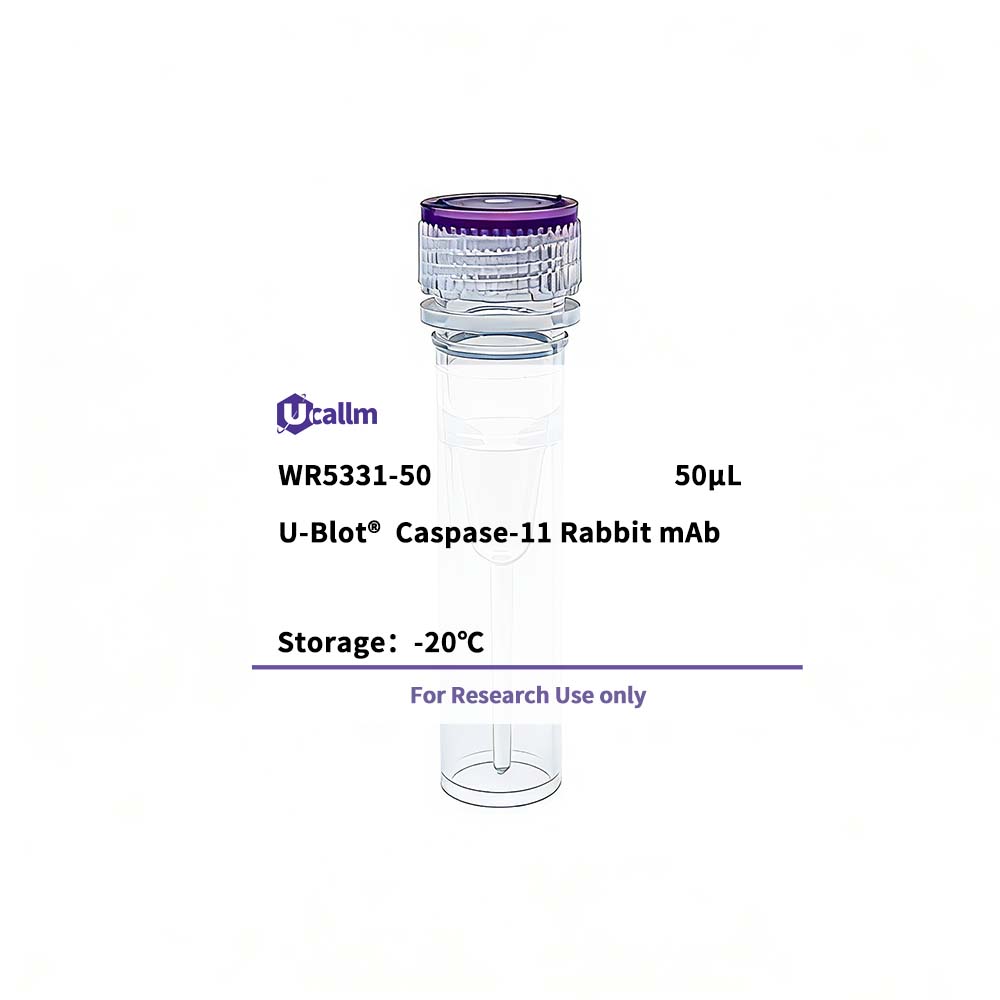
U-Blot® Caspase-11 Rabbit mAb

Price range: $268.00 through $328.00

SKU: WR5331-50
Enter the quantity you would like, or drag the panel to find the quantity and price that best for you
Bulk QuoteAuthorize OEM & ODM

Product details

Background:This gene encodes a member of the cysteine proteases that plays important roles in apoptosis, cell migration and the inflammatory response. The encoded protein mediates production of pro-inflammatory cytokines by macrophages upon bacterial infection. Mice lacking the encoded protein are resistant to endotoxic shock induced by lipopolysaccharide. A 5-bp deletion encompassing a splice acceptor junction resulting in alternate splicing and a shorter non-functional isoform in certain mouse strains has been described. Although its official nomenclature is “caspase 4, apoptosis-related cysteine peptidase”, this gene and its encoded protein have historically been called caspase 11. This gene is present in a cluster of three caspase genes on chromosome 9. [provided by RefSeq, Apr 2015]


Specifications

Size50μL/100μL
TargetCaspase-11
ReactivityMouse
ApplicationsWB, IHC, IF, ELISA
MW(Calculated)43kD
MW(Observed)42kD
Host SpeciesRabbit
IsotypeIgG,Kappa
Conjugate/ModificationUnmodified
Recommended Dilution RatioIHC 1:200-1:1000; WB 1:2000-1:10000; IF 1:200-1:1000; ELISA 1:5000-1:20000; / Note: For IHC, we suggest antigen retrieval with TE buffer pH 9.0 (Cat#WT1004)
FormulationPBS, 50% glycerol, 0.05% Proclin 300, 0.05%BSA
PurificationRecombinant Antibody expressed in animal component-free (ACF) media, purified via Protein A affinity chromatography.
Storage-15°C to -25°C/1 year(Do not lower than -25°C)
Concentration
ClonalityMonoclonal
Clone NumberRM1565R
ImmunogenThe specific immunogen used to produce this antibody is proprietary information.
SpecificityEndogenous
Gene NameCASP4 ICH2
Protein NameCASP4(Caspase4)
Other NameCASP4; / ICH2; / Caspase-4; / CASP-4; / ICE; / rel; / -II; / Protease ICH-2; / Protease TX
SpeciesHuman
Gene ID837
UniprotP49662,
Species.1Mouse
Gene ID.112363
Uniprot.1P70343
Species.2
Gene ID.2
Uniprot.2
Cellular LocalizationCytoplasm. Endoplasmic.reticulum.Inflammasome.Membrane.Mitochondrion.Secreted
Tissue ExpressionWidely expressed, including in thymus, lung and spleen (at protein level). Very low levels, if any, in the brain.
Signaling_pathwayOrganismal Systems >> Immune system >> Neutrophil extracellular trap formation;Organismal Systems >> Immune system >> NOD-like receptor signaling pathway
Research Areas
FunctionInflammatory caspase that acts as the effector of the non-canonical inflammasome by mediating lipopolysaccharide (LPS)-induced pyroptosis (PubMed:22002608, PubMed:23348507, PubMed:23887873, PubMed:24031018, PubMed:25119034, PubMed:30135078, PubMed:37001519, PubMed:38632402). Also indirectly activates the NLRP3 and NLRP6 inflammasomes (PubMed:26320999, PubMed:30392956, PubMed:37001519). Acts as a thiol protease that cleaves a tetrapeptide after an Asp residue at position P1: catalyzes cleavage of CGAS and GSDMD (PubMed:26375003, PubMed:28314590, PubMed:30392956, PubMed:38632402). In contrast to its human ortholog, does not cleave IL18 (PubMed:37993712, PubMed:37993714). Effector of the non-canonical inflammasome independently of NLRP3 inflammasome and CASP1: the non-canonical inflammasome promotes pyroptosis through GSDMD cleavage without involving secretion of cytokine IL1B and IL18 (PubMed:22002608, PubMed:22895188, PubMed:23348507, PubMed:23887873, PubMed:24031018, PubMed:26320999, PubMed:26375003, PubMed:30135078, PubMed:30589883). In the non-canonical inflammasome, CASP4/CASP11 is activated by direct binding to the lipid A moiety of LPS without the need of an upstream sensor (PubMed:22002608, PubMed:23348507, PubMed:25119034, PubMed:37001519, PubMed:38632402). LPS-binding promotes CASP4/CASP11 activation and CASP4/CASP11-mediated cleavage of GSDMD, followed by pyroptosis of infected cells and their extrusion into the gut lumen (PubMed:22002608, PubMed:23348507, PubMed:25119034, PubMed:38632402). Also indirectly promotes secretion of mature cytokines (IL1A, IL18 and HMGB1) downstream of GSDMD-mediated pyroptosis via activation of the NLRP3 and NLRP6 inflammasomes (By similarity). Involved in NLRP3-dependent CASP1 activation and IL1B and IL18 secretion in response to non-canonical activators, such as UVB radiation or cholera enterotoxin (PubMed:26320999). Involved in NLRP6 inflammasome-dependent activation in response to lipoteichoic acid (LTA), a cell-wall component of Gram-positive bacteria, which leads to CASP1 activation and IL1B and IL18 secretion (PubMed:30392956). Involved in LPS-induced IL6 secretion; this activity may not require caspase enzymatic activity (By similarity). The non-canonical inflammasome is required for innate immunity to cytosolic, but not vacuolar, bacteria (PubMed:23348507). Plays a crucial role in the restriction of S.typhimurium replication in colonic epithelial cells during infection (PubMed:25121752, PubMed:26375003, PubMed:34671164). Activation of the non-canonical inflammasome in brain endothelial cells can lead to excessive pyroptosis, leading to blood-brain barrier breakdown (PubMed:38632402). Pyroptosis limits bacterial replication, while cytokine secretion promotes the recruitment and activation of immune cells and triggers mucosal inflammation (PubMed:25121752). May also act as an activator of adaptive immunity in dendritic cells, following activation by oxidized phospholipid 1-palmitoyl-2-arachidonoyl- sn-glycero-3-phosphorylcholine, an oxidized phospholipid (oxPAPC) (PubMed:27103670). Cleavage of GSDMD is not strictly dependent on the consensus cleavage site but depends on an exosite interface on CASP4/CASP11 that recognizes and binds the Gasdermin-D, C-terminal (GSDMD-CT) part (PubMed:32109412, PubMed:32554464). In contrast, it does not directly process IL1B (PubMed:8702803, PubMed:9038361). During non-canonical inflammasome activation, cuts CGAS and may play a role in the regulation of antiviral innate immune activation (PubMed:28314590).
Please login to post questions
Back to Top
Product has been added to your cart
